
Tag: writing

  • How To Get Those Thoughts Out – Writing with Scrivener and Scapple

    How To Get Those Thoughts Out – Writing with Scrivener and Scapple

    Monk scribe has written ornate letter 'S' which turns into 'Sod this for a lark!!'The final stage of the research process is usually synthesis, where ideas and concepts come together in a new form. But those syntheses rarely meet their goals if they are simply stored in your head. While there are many blockers in the writing process, from cognitive blocks to research issues, the software in your toolkit for writing should never be a block at all. I know many people who use simple word processors, like Word or Pages, for this process. But they can be buggy, and there is a better way. Here are the tools in my toolkit for writing: Scrivener and Scapple.

    Scrivener and Scapple fill slightly different roles in the synthesis process. While Scrivener is a full featured writing tool, Scapple is a small lightweight mind mapping tool that lets you set out your thoughts quickly and easily. They are both cross-platform (Win/Mac/Linux [unpolished]), and have a generous trial period.

    Scapple

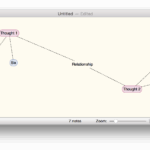
    Scapple is a quick mind mapping tool, and has been one that I been wanting for quite a few years now. In the early days of my research career, I coded up a quick mindmap tool based on a Computer Science FSA assignment I had to do in my final year. That tool was ugly, clunky, and was really a kludge. Scapple is the opposite of this. It is quick and easy to use, just double clicking on the panel allows you to create a node. Dragging nodes on top of each other allows for connections. In the words of Queensland Rail: ‘Super Simple Stuff.’ Like Briss that I talked about a few posts ago, Scapple has one purpose in mind, and it does it admirably.

    Once your mind map is complete, you can easily export it to PDF, PNG or a host of other formats for later reference on devices that don’t have Scapple installed. In addition once you are at this stage you can also export it to an OPML file ready for import into Scrivener with your synthesis outline already complete. I find Scapple an invaluable tool for mind mapping, and one of the easiest tools I have used for this task. Plus it has to easily take the prize for the best price:performance ratio.
    Scrivener

    Onto Scrivener then. While Word and Pages, and other single document editors, may do their job for shorter pieces, they tend to be rather buggy once the file size increases. Word especially, as its method of storing the material, plus formatting, plus recent changes, plus tracked changed etc etc is prone to errors. As the document gets longer these get exponentially worse, and so for a 3000 word term paper Word is generally fine, but for a 20,000 word report, or a 90,000 word thesis, it is unacceptable.

    One solution to this is to use a markup language, such as LaTeX, which I used for the majority of my Eng, Math and Psych papers. LaTeX is word processor agnostic, just using simple text files for its input, so you can edit it in anything. However, where LaTeX is excellent for rendering complex mathematical formulae, and modifying markup for export, it is not the easiest method to use. Occasionally I have had students and peers, especially in Psych, object that they aren’t computer programmers when being asked to write in TeX. The plethora of { \$ and many other codes makes it hard to learn for those who are mainly interested in text based writing.

    This is where Scrivener comes in, and more. At one level Scrivener is a full featured writing device, which allows you to write easily and in a format that you are used to. But at another level it has a powerful refactoring export system, similar to working with markup languages. At yet another level Scrivener works as a consolidated research tool, allowing you to put thoughts together before writing. Another level again Scrivener allows for easy chapter and section management, letting you streamline your argument in the synthesis process. Finally, for our purposes, at a system level, Scrivener separates out its sections to different files, reducing the chances of file corruption as the document gets larger.

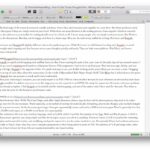
    Personally I use Scrivener for almost all of my writing, be that this blog that you can see in the screenshot above, through to my conference papers, and now this new PhD thesis I am starting work on. I generally only export to Word for sharing the documents with proofreaders who don’t have Scrivener, or for final delivery. While there are many features of Scrivener that make it much easier to use than Word or other writing tools, I will quickly go through some of my favourites.

    • Firstly, the nested document system allows for a structured approach to building your argument. You can create folders for chapters, and sections and then arrange your argument beneath that. This can give you a birds eye view in the Binder of where your argument is going at any time, and helps with coherence.
    •  Secondly, each document can be given a word limit, to help to keep you to task, and make sure that you don’t blow out your word count. This simply helps with management later on.
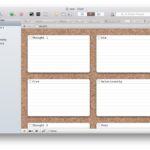
    • Thirdly, there are a multitude of methods for being able to mark material as reference material. You can either put it in your cork board for reference, or you can annotate it inline. This means you can have some of your reference material right in front of you as you write.
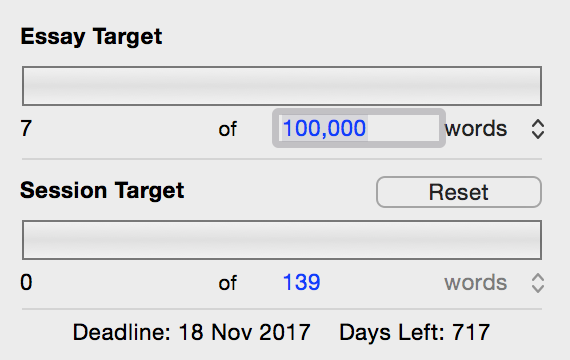
    • Fourthly, you can set overall word limits for a project, and also deadlines. This lets you write to task and make sure you aren’t getting too far behind on a writing project. This also helps with keeping the writing juices flowing. If you set a 500-1000 word a day target, then you can simply write to that deadline easily.
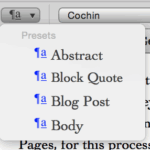
    • Fifthly, it keeps the formatting out of the way. In my Scrivener templates I have a handful of formatting options, usually one for the abstract, one for headings, one for general body text and one for block quotes. The robust way that Scrivener deals with formatting means I don’t have to muck around with whatever formatting system the word processor has decided to do that day.
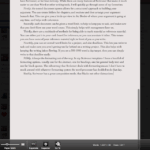
    • Sixthly, Scrivener has a great composition mode, that blacks out other distractions on the screen, letting you just focus on the text.
    • Seventhly, it allows for a regular backup routine, so that you won’t lose any of your data. Plus it writes synchronously to the file system and doesn’t require you to neurotically Ctrl/Cmd-S all the time.
    • Finally, the export system, like that of LaTeX allows you to reformat your document at export time for various targets. For example, if one journal has a specific formatting system you can easily export it to their specification. Then if you are reading the same paper at a conference you can export it for a lectern friendly format as well. All without having to modify the formatting of the original document.
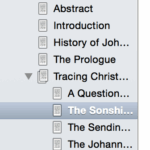
     

    Overall Scrivener is a robust and powerful writing tool. It incorporates many aspects of LaTeX and other markup languages, without having the steep learning curve. But there are still a couple of downsides to Scrivener and Scapple. One is the cost, although at a total of US$60 for both apps it is one of the best investments you can make, and it has certainly saved me a lot more than $60 in crash and lost material generated heartache. In addition they are commonly on sale throughout the year, so if you want them keep an eye out. They both have a very generous trial policy as well, so you can give them a go for free without laying out the cash.

    The second is the lack of a direct integration with Zotero or other reference managers. You can easily use the RTF shortcodes from Zotero, but I wish for something that was more tightly integrated.

    Finally, and most minorly, there isn’t an iOS/Android app yet for Scrivener, although there is one coming soon. Which a lot of the time is fine, as for research I tend to write at my desk. There are workarounds for this one though, which I will likely cover in the future.

    There we go, the final tool in my general research toolkit—although there are plenty of domain specific tools. I highly recommend Scrivener and Scapple, and I will likely do a couple more posts on both over the next little while as I want to explore specific areas of the tools.

    Tell me below in the comments what tools you use for the synthesis task, and do give Scrivener and Scapple a go.


  • It’s All About the Style – Writing Well

    It’s All About the Style – Writing Well

    Style or substance, which one is more important?

    While our last Friday post dealt with the process of writing—how to stimulate those word juices flowing in your head—this post looks at the style of those words. Now style is a very personal thing, and it is entirely likely that your style will change based on what you are writing. For example this chatty style that is suitable for a blog post would be terribly inappropriate in an academic paper. However, there are still some aspects of style that have broader applications, and these should be examined.

    Aspects of style have already popped up a couple of times in the various comments on this series, with some people loving and others disliking my style (no-one hates me yet). To some degree the style on this blog is part of my natural writing output, and the technicality that creeps in reflects some of my background. Nevertheless, there are many foibles to my writing style, and this sentence is but one florid example of this. Personally I have a tendency to over-use adjectives, and make my sentences overly complex, while also introducing technical jargon in the middle of a thought process. While a lot of this I have picked up from the reading I have done in my fields, they are still poor habits to be in. I am certainly not be the best writer. In fact with many others I decry ‘I am no Hemingway,’ and I certainly have a lot to learn. But here are my top five tips—really the top things I need to work on too—for thinking about your style and writing well.

    1. Style is Personal

    formal-writingThis one is relatively obvious, your style is your own. It is useless slavishly copying someone else’s writing, as it will appear forced and unnatural. Getting comfortable with your own writing style is essential. However, don’t use this as an excuse for sloppy writing. While your style may have particular nuances, and engage with certain audiences effectively, it should still be intelligible to a wider range. For example one of my bad habits is to create run-on sentences, joining ideas together in, what for me is, a logical manner. But these sentences actually make my work harder to read, harder to digest, and harder to understand. Similarly my digressions into technical language rarely make my writing more intelligible. Simply because certain jargon is used in a specific field doesn’t mean it is ideal.

    One of the ways you can shake up your style is to simply write in a different genre. While for an academic paper it may be acceptable to use ’this author’ or ‘this paper’, to use such formality on a blog makes it hard to read and you look excessively formal. You need to find your writing style, but don’t etch it in stone, it can always be improved.

    2. Edit… a lot

    In his very useful book On Writing Well, William Zinnser expounds the virtues of editing:

    ‘Examine every word you put on paper. You’ll find a surprising number that don’t serve any purpose.’

    and

    ‘Clutter is the disease of … writing. We are a society strangling in unnecessary words, circular constructions, pompous frills and meaningless jargon.’

    It is not unusual for writing to require editing, that is only natural. In fact I haven’t met a single author who is able to write their pieces without any editing work whatsoever. Of course if we are so focused on putting the first draft down perfectly, such that it needs no editing, then we will rarely write anything. Write first, then edit. But definitely edit, and be ruthless with your work.

    3. Get to the Pointget-on-with-it

    Similar to the old Monty Python sketch in The Holy Grail: ‘Get On With It!’ Often our writing can take circuitous routes that involve so many qualifications and hedges that the reader loses sight of the point. There is a virtue in simply getting to the point of a sentence. In my case those sentences of mine that involve layered adverbs, and compound superlatives can be simplified. If you strip sentences back to their raw components and then build from there your writing will normally be better for it. As Zinsser poetically comments:

    ‘Most writers sow adjectives almost unconsciously into the soil of their prose to make it more lush and pretty, and the sentences become longer and longer as they fill up with stately elms and frisky kittens and hard-bitten detectives and sleepy lagoons.’

    4. Be Active

    While the passive voice has a place in the writing sphere, it shouldn’t be used as the primary voice. Be active, use the active voice as much as you can. Not only is it simpler and more direct, but it also engages the reader vigorously. But there is more than that, being active conveys passion and intent. It communicates your thoughts with the same passion that they are swirling around your head. Rarely do we write without any passion for the topic at hand. Yet often the reader receives a piece that is dispassionate and flat. Make your writing active.

    5. Get an external reader or editor

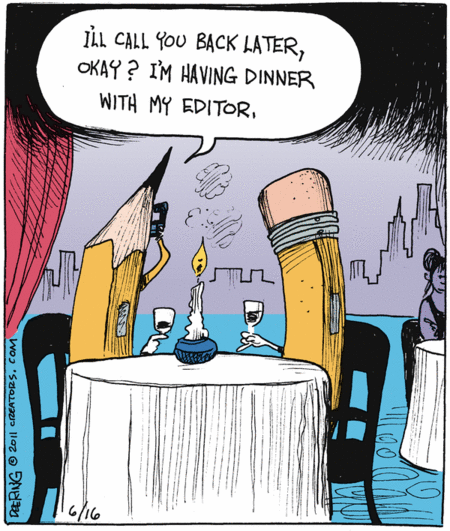
    editing-humorAlthough the idea of getting someone else to read through your work with a critical eye may be terrifying, it is one of the best ways to become a better writer. Ideally you want someone who is distant enough from your content that they absorb the force of the argument for the first time. Yet also someone who is close enough to the content to not be plunged in the deep end of your laboured work. In addition try to pick someone who you don’t interact with in that frame as often. That way they are not used to the foibles of your writing style, and can highlight them for you. Once you have an editor or reader, take on their advice. It is of little use if all of the red ink is never read or absorbed.


    Bonus: Read widely.

    The broader your reading base is the more you will see other styles in action. Keeping across multiple styles and fields helps with not being anchored in any specific style. In addition reading books on writing, such as William Zinsser’s On Writing Well will help identify your style issues.

    That is my top five (plus one) tips for writing well, or at least improving stylistically. Does it sound a bit hypocritical? Well really I am also preaching to myself here, as I tend to fall short in each of these areas regularly.
    What is it that you fall short in? What tips would you give in improving style? Comment below. I look forward to reading them.

  • How to Write a Lot – The Writing Task

    How to Write a Lot – The Writing Task

    We often consider writing an arduous task, bemoaning things such as writers block, or looming deadlines; and the writing requirement of academia usually won’t alleviate this.

    However, it doesn’t have to be this way, the seemingly sheer cliff face of a writing task can be scaled, and often with relative ease. Welcome to the Friday theory session of the work and research methods series, today we will be covering writing. Last week I intimated that reading is not a stand alone process, and that writing is its strong partner in crime. So if this is the case, then why is writing so hard?

    Well one of the reasons is in the same vein as why reading is so hard. Our primary modes of communication have become shorter and shorter, from when the long form letter ruled supreme, through to the telegraph, phone calls, email, Facebook and now Twitter. Our communications, and therefore our regular writing tasks, are becoming pithier and shorter. So on the whole our long form writing suffers from length of concentration and frequency. Have you ever tried writing a dissertation or even a blog post on a phone keyboard? Yeah… So instead we talk about writers block and deadlines, and then subsequently consume copious quantities of caffeinated beverages while staring at a blank word processor document, and interrupted only by frequent panicked glances at the clock, calendar, task list, research pile, and social media. Perhaps this is a little hyperbolic, although I’m willing to bet that for many readers this picture resonates at some level.

    writers-block1What can be done about it? Well, simply put the main thing to be done about the difficulty of writings is to write. The majority of advice that I have received over my years of having to write reports, papers, presentations, essays, etc (and commonly bemoaning the process), is to simply write a lot. Now that most likely sounds pithy and trite, like telling someone who is struggling to climb over a fence to simply climb over the fence. But while it is trite, it is also true. Writing begets writing, and writing regularly makes the overall process easier. Indeed, studies have shown that regular writing increases the number of fresh ideas for the writing task.[ref]Boice, Robert. Professors as Writers: A Self-Help Guide to Productive Writing. New Forums Press, 1990.[/ref] Nevertheless very few of us have the prodigious writing output of someone like Colleen McCullough, who reportedly wrote up to 30,000 words a day![ref]http://www.nytimes.com/2015/01/30/books/colleen-mccullough-author-of-the-thorn-birds-dies-at-77.html?_r=3[/ref] However, there are methods and mechanisms that can be put in place to assist in the writing process. Here are some of the top methods on my list of writing strategies.

    Writing Regularly

    keep-calm-and-don-t-stop-writing-2One of the best ways to get those writing juices flowing is to write regularly. I know quite a few people who simply set aside a couple of hours a day in their schedule to write. In that writing time they simply write on whatever is currently on the agenda. It could be for a paper, or project, or a conference; so long as it is writing. The dedicated time set aside helps to get a little bit done every day. However, for me this isn’t optimal, as some days with the little man I barely get a chance to write at all. For me I instead aim to write a certain amount per day, a task focused goal rather than time focused. While I don’t dedicate time, I do set myself a task every day to be written. This type of regularity works better with my schedule, and my thought processes. But whichever one you do it gets you writing regularly, and set it as a goal. As Bandura showed, short term goal setting increases the motivation for the task.[ref]Bandura, Albert. Self-Efficacy: The Exercise of Control. New York: Freeman, 1997.[/ref]



    Writing summaries

    While often we have far more things to write about than there is time to write, occasionally there are lulls, or periods where you don’t have enough time to dedicate to that long-form argument, or a larger piece. In these scenarios I generally have a handful of other writing tasks that can fill the gap. One of these comes from last week’s theory post, on reading. When reading in the ‘studying’ methodology the idea is to absorb the information but also mark up the material for later recording as a reference. This transcription and synthesis of argument from my reading tasks forms one of my regular writing tasks as well. It’s almost killing two birds with one stone.

    connectomeIn addition this phase also is a great reinforcement technique for the reading process. The act of writing a synopsis or summary of the work in your own words is a great way of reinforcing the material. It allows for a different set of neural connections to be formed, rather than simply absorbing the material second hand, in the synthesis process you are making it your own (this still means you have to cite the original idea). To harken back to Bruce Ellis Benson’s idea of academic writing as improv, in writing your synopsis you are learning the flow of the music on your own instrument. Writing out what we read helps us to tune our signal-to-noise heuristics, and really absorb the things that matter. As William Zinsser reflects:

    ‘Writing is thinking on paper, or talking to someone on paper. If you can think clearly … you can write – with confidence and enjoyment’

    Blogging

    blogOccasionally though you may have written all your synopses, or for various other reasons don’t have any ‘on-topic’ things to write about. Well for this phase it is great to have an alternative writing outlet. It just so happens that you are currently reading my alternative outlet. Basically every summer (Dec/Jan) when I have had a bit of a lull in the academic year, I tend to write for my own means. For several years this meant documenting various motorsport related items that I had worked on in the past year, or fixing up a journal paper or two. However, this year I decided to focus much of my extraneous writing on this blog, and in an inception like moment am actually writing this article on writing to fulfil my regular writing commitment. Not only do I get to explore some of the aspects of studying that I enjoy, and answer some questions that I am regularly asked in my tutoring role on campus, but it keeps the writing juices flowing. I would encourage you to start your own blog, write a bunch, and then send me the link.

    Enforced writing

    The final aspect of writing regularly that I will briefly touch on is that of enforced writing. I have some friends who set themselves a specific word limit every day that they must hit. Personally this doesn’t work for me, as it feels quite rigid and doesn’t fit with my writing style. But if it keeps the brain stimulated, then by all means go for it.

    Writing Differently

    The next tactic I will touch on more briefly, that of the need for variety. In academia, as with many fields, the style of writing rarely changes, and it is easy to be staid in the writing style. For example I still find it difficult to talk in the first person in a journal paper, and prefer to use ‘this author’ or ‘this paper;’ despite the first person being acceptable. Further evidence can be found in that I am footnoting on a blog…  In that regard it is very easy to fall into a rut, especially when it comes to the use of florid language and jargon. But more on style in another post. It is worth changing up your writing style occasionally, and one of the best ways to do this is to try for a different methodology or audience.

    NaNoWriMo

    crest_square-1902dc8c2829c4d58f4cd667a59f9259

    There are two ways that I do this from time to time. Firstly, it can be enjoyable to write a short piece of fiction, as academic writing can sap the creative juices. A couple of times now I have participated in the NaNoWriMo event. NaNoWriMo is a celebration of National Novel Writing Month, and encourages writers to sit down and write a short novel in the 30 days of November. Now the 50,000 word draft can be a bit daunting, and I only made it to the word limit once, but it is still worth doing. It is a fun little event, and a good opportunity to turn some writing time to a different end. However, for my purposes the timing is problematic, as November is the end of semester in Australia, and is also conference month. Still I hope to bash out a novel again some time. Perhaps this time it will be worth someone else reading.

    Different Styles

    The second way that I mix up my writing is to try a different style. There are many methods of writing, and one that I have experimented with twice—once actually for NaNoWriMo— is narrative writing through a ‘stream of consciousness’ or ‘free writing.’ This mode of writing is simply writing for a certain duration of time whatever flows through your head. Colleen McCullough is said to have used this type of writing, and that it contributed to her prodigious output. Essentially you write without concern for grammar, spelling and you don’t correct anything. The idea is to follow your mind where it leads, including all those tangents, diversions and your small rabbit warren under the hippocampus. A lot of the time it produces relatively unusable writing. But it can be a way of shifting so dramatically out of a set mode of writing that it freshens up your entire writing style and perspective.

    Sectioning Work

    phd_targetFinally I want to briefly touch on breaking work up in to small manageable sections. I know a lot of people are daunted by the prospects of writing large bodies of material. Quite a few first year students I meet wonder how they will write a 2,000 word essay. Later year students wonder how they could ever write a 3,000 word piece, let alone their 6,000 word project. Many in both categories are in equal parts shocked, awed and dismayed at the prospect of writing an 80-100,000 word PhD thesis. However, if these targets are broken down in to their relevant sections the overall scope suddenly appears more manageable. That 100,000 word thesis is really only 8 12,500 word chapters, and each chapter is really 5 2,500 word sections. All of which suddenly seem more workable. Plus if you keep breaking it down, and you end up daily, then that PhD thesis is only 139 words a day if you are working 5 days a week, 11 months a year for the nominal 3 year duration! Quite manageable really. The added bonus is that breaking your work down lets you see the flow of the argument better, and helps you stay coherent. But that is a topic for another time.

    Finally there are many good books out there to help you in this process. I have found three exceedingly useful, for both methodology and style. They are:

    Kidder, Tracy, and Richard Todd. Good Prose: The Art of Nonfiction. New York: Random House, 2013.
    Silvia, Paul J. How to Write a Lot: A Practical Guide to Productive Academic Writing. 1 edition. Washington, DC: APA, 2007.
    Zinsser, William. On Writing Well, 30th Anniversary Edition: The Classic Guide to Writing Nonfiction. New York: Harper Perennial, 2006.

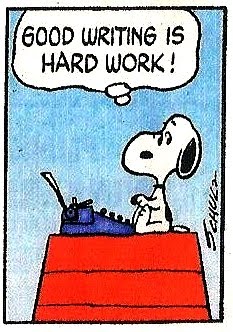
    good-writing-is-hard-workUltimately though, as even William Zinsser admits ‘Writing is hard work.’ But if we write regularly, then the process comes a bit more easily, and rather than focusing on the writing task we can focus on writing style, which is arguably even more important. After all how can one edit and refine their work if there is no work there to edit in the first place. So focus first on getting words out on the screen or page and then perfecting them. Undoubtedly they wont come out exactly right the first time, or the second, or even perhaps the third, but get something out so you can work with it. In the vein of Confucious or Yoda, ‘to write a lot, you first have to write.’ Next week we will take a look at the second aspect of writing: style.

    Would love to hear your feedback and suggestions on how you write, and the processes you have for writing regularly. Tell me below, in the comments.