Tag: theology

  • Academic Catchphrase – Help Sourcing a Calvin Quote on ‘Muzzling Dogs.’

    Academic Catchphrase – Help Sourcing a Calvin Quote on ‘Muzzling Dogs.’

    UPDATE: See end of blog post.

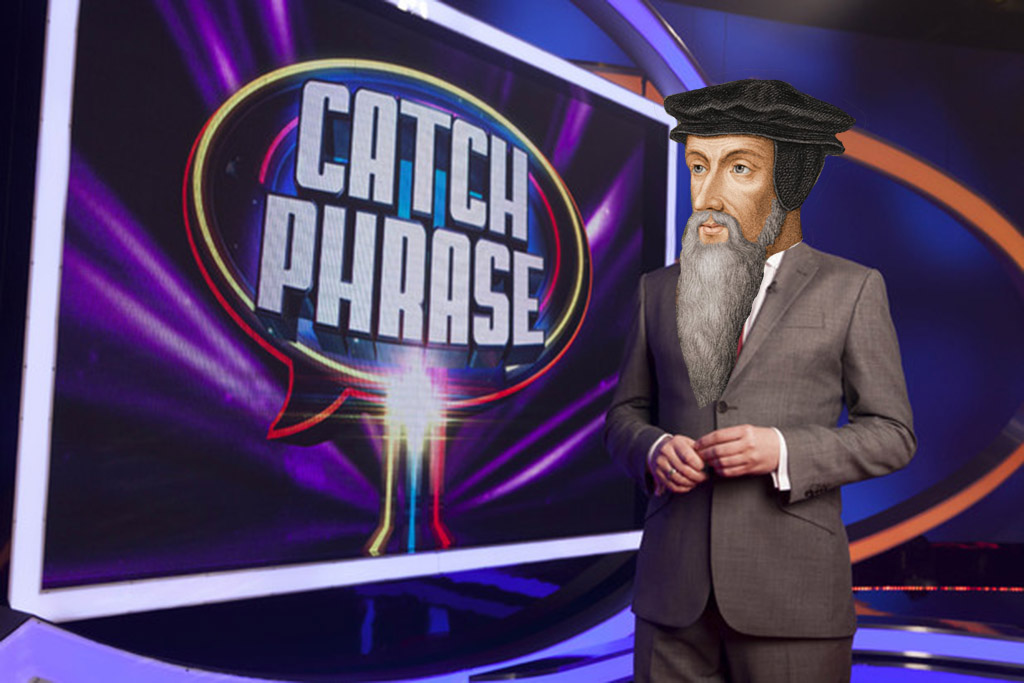
    At times finding quotes and references in student essays, and even in academic works, can be a bit like the old gameshow Catchphrase. Although on the whole quotations should be clearly referenced, and therefore relatively easily found, there are occasionally those which send you deep down the rabbit hole and turn up only loose ends. One of these quotes that keeps raising its head is this quote attributed to Calvin:

    ‘But we muzzle dogs, and shall we leave men free to open their mouths as they please.’

    Over the last couple of decades it has been popularised in a wide variety of sources, and generally attributed to Calvin’s works on Deuteronomy. It is understandable why it has become popular: it is polemical, expresses a censorious sentiment that is abhorrent to modern ears, and does it with a degree of vitriolic rhetoric that grabs the attention. On that basis it gets trotted out regularly to support issues of religious censorship such as this piece from the ABC on the Zaky Mallah/QandA affair: http://www.theage.com.au/comment/the-abc-wasnt-wrong-to-have-zaky-mallah-on-qa-20150623-ghvaow.[ref]Thanks to a friend for pointing this one out[/ref] However, the majority of these secondary works, if they cite anything at all, refer not to any work by Calvin, but to other secondary literature.

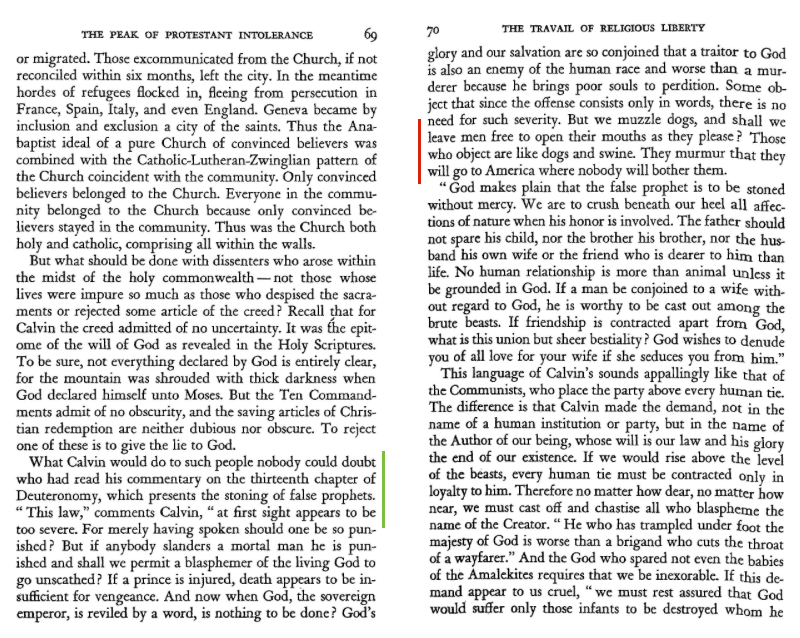
    When these references are chased through the rabbit warren eventually lead back to The Travail of Religious Liberty by Roland Bainton (1951).[ref]The full text of this is out of copyright and archived on Archive.org here: https://archive.org/details/travailofreligio012230mbp[/ref] The quote itself is found on page 70 of the book, but has no citation for the quote itself (update: citations were in an end-note that was missing from my copy). For context, here is the two page spread extracted from the archive.org edition with the pertinent pieces highlighted:
    Screen Shot 2015-09-03 at 10.25.50 am

    The full quote reads:

    ‘But we muzzle dogs, and shall we leave men free to open their mouths as they please? Those who object are like dogs and swine. They murmur that they will go to America where nobody will bother them.’ [ref]Bainton, Roland H. The Travail of Religious Liberty – Nine Biographical Studies. Philadelphia, PA: Westminster Press, 1951.,70.[/ref]

    In the text this quote has no ending quotemark, although the next paragraph starts with a further quotemark, and so one may presume that these words are intended to be cited as a quote from Calvin, especially as the opening quotemark on page 69 reads ‘“This law,” comments Calvin “at first sight…’ It is relatively safe to take the understanding that Bainton is intending to quote Calvin at this point.

    Indeed in the opening sentence of this paragraph he writes:

    ‘What Calvin would do to such people nobody could doubt who had read his commentary on the thirteenth chapter of Deuteronomy’[ref]Roland H. Bainton, The Travail of Religious Liberty – Nine Biographical Studies (Philadelphia, PA: Westminster Press, 1951)., 69[/ref]

    From this the natural reference for Bainton is that of Calvin’s words on Deuteronomy 13. However, here lies the multi-faceted problem.

    Firstly, in the reference editions of Calvin’s commentaries, there is no distinct commentary on Deuteronomy. Rather there is a commentary on the Harmony of the Law, which contains many of his words on Deuteronomy. It would be a reasonable expectation to find this quote in the Harmony of the Law when Calvin deals with Deuteronomy 13, and it was my first port of call, but there is nothing there. I can find no references to dogs, canis, and muzzling can be found in any of the versions of the work I have looked at (the work from the Calvin Translation Society is the primary reference here).

    The second location to search was that of the Institutes, as Calvin occasionally draws upon various passages and provides a mini-commentary to support his points. Again no references to muzzling dogs may be found in any of the four editions of the Institutes that I referred to.

    The third place to search was Calvin’s sermons on Deuteronomy that he preached in October of 1555. At first this source seems to yield some parallels, with Calvin preaching regarding ‘dogs’:

    ‘At a word, men would have either dogs or swine in the pulpit. This is the thing that they seek for; and this is mens desires in most places; who instead of good and faithful servants to God, do choose dogs and swine’[ref]Calvin, John. Sermons on Deuteronomy. Translated by Arthur Golding. Facsimile edition edition. Edinburgh; Carlisle, Pa.: Banner of Truth, 1987., 538[/ref]

    In this sermon, and the sermon preached in the following week, Calvin does talk about dogs and swine (dogges and ſwine) in a few places. However, all but one are paired as ‘dogs and swine,’ while the final reference is to the Papists and Cardinals as being dogs. Throughout his sermons on Deuteronomy I can find no reference to muzzling at all.

    These three locations form the core of the material that Calvin wrote or preached on Deuteronomy. But in case I was missing something I also ran searches for ‘muzzling’ and ‘dogs’ throughout all of the resources I could find electronically (the Calvini Opera, Archive.org, CCEL, StudyLight etc provided ample resourcing). Logos, DevonThink, were used for basic searches and a custom LSA[ref]Latent Semantic Analysis is a natural language computational linguistics tool[/ref] corpus was used to see if any inferences and alternately translated words could be detected. None of these searches returned any significant results, with the majority of hits being those found in Calvin’s sermons on Deuteronomy 13. All in all I cannot find any reference to the core of the original quote regarding muzzling dogs anywhere in Calvin’s works.

    However, I have another reservation about the full quote from Bainton’s book. The quote continues on to indicate that ‘they murmur that they will go to America where nobody will bother them.’ Given that Bainton is talking about Protestant religious persecution in this chapter, this indication seems somewhat anachronistic. Presuming the quote is genuine, at latest it would have been written in c.1559 when the last of the material on Deuteronomy (Commentary on the Harmony of the Law) was written, as from this quote in Vie de Calvin

    Towards the end of that year [1559] they began in the Friday meetings the exposition of the four last books of Moses in the form of a Harmony, just as Calvin assembled the material in his commentary which he had published afterwards. [ref]CO 21:90. See DeBoer Origin And Originality Of John Calvin’s ‘Harmony Of The Law’, The Expository Project On Exodus-Deuteronomy (Acta Theologica Supplementum 10, 2008) for more details[/ref]

    At this time the prime settlements in America were Catholic in nature. The only reference to a Protestant site that I can find is that of Charlesfort-Santa Elena in South Carolina, the site of a Hugenot settlement. However, apart from this failed settlement where may this American settlement refer to. Indeed if, as Bainton is arguing, this quote is referring to Protestants fleeing Europe over persecution (Bainton later links the Michael Servetus incident here), then it would make no sense to flee to a location that was experiencing significant religious persecution if they want to go somewhere where ‘nobody will bother them.’ This sentiment fits far better in the early-17th century, rather than the mid-16th century.

    This historical tangent aside, what do we make of this quote? Certainly if one wants to convey the sentiment of religious persecution and debate, a case may be mounted from Calvin’s works. But I would argue that this quote is not a reliable source for it. I still cannot find any reference to the quote, nor any significant material on fleeing to America, in any of Calvin’s works. I have enquired with some Calvin scholars to no avail—or with some no reply.

    Therefore I am turning to the broader internet, if anyone can supply the location of the quote I would be very interested.

    UPDATE:

    It appears that in my prejudice for trusting the validity of physical books over archive.org scans I had missed that Travails has its sourcing in end notes after the final chapter. Unfortunately the copy that I had sourced from a local library was rebound and missing the sources and index at the end of the book. Thanks to Richard Walker for highlighting this to me, see his Disqus comment for more details (unless Disqus isn’t loading again).

    However, I’m still not convinced by the translation that Bainton has supplied and will blog on that later.
  • Book Review: Understanding Gender Dysphoria – Mark Yarhouse

    Book Review: Understanding Gender Dysphoria – Mark Yarhouse

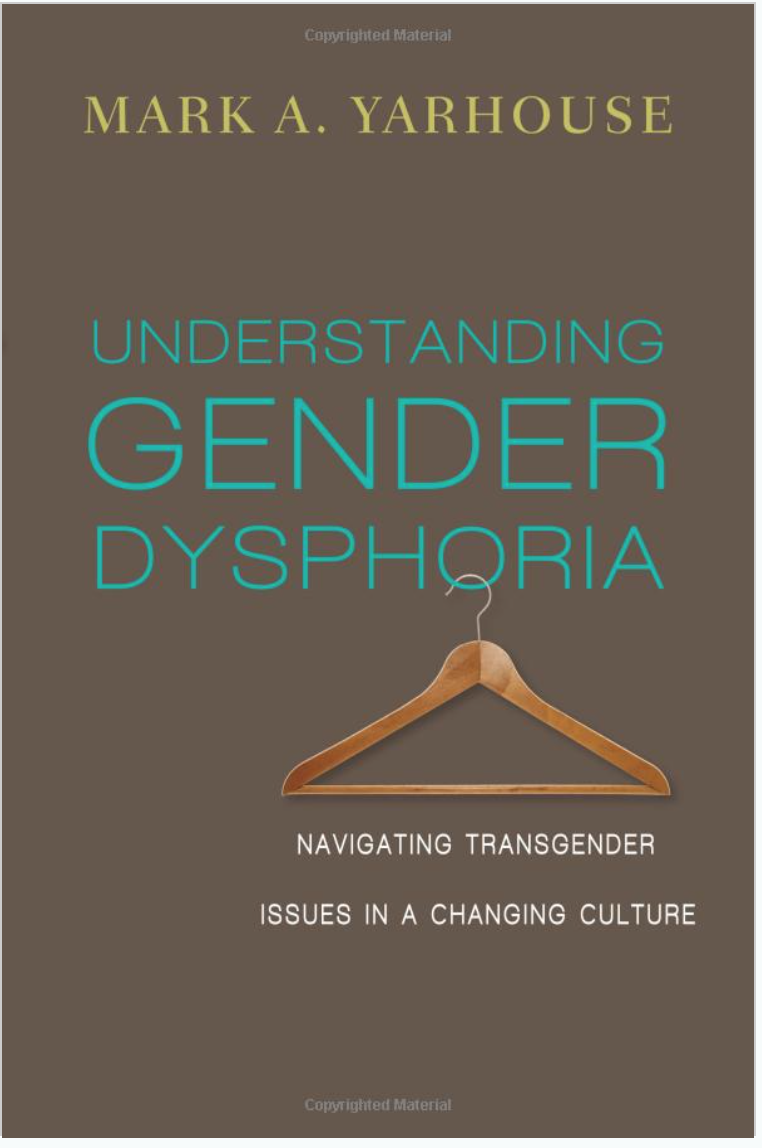
    Understanding Gender Dysphoria
    Mark Yarhouse; 2015. | IVP Academic | 191 pages
    978-0-8308-2859-3

    Gender dysphoria (GD) and transgender issues are currently a hot topic in the media and everyday discourse, thanks in no small part to the topic being thrust into the limelight by celebrity events. However, the current media focus on the topic doesn’t do justice to the complexity of the issue. Especially given the superficial gloss awarded to the psychological and medical aspects. From a psychological perspective, Gender Dysphoria [302.85]—or Gender Identity Disorder (GID) as it was known—has been described in the Diagnostics and Statistics Manual (DSM)—the psychological disagnostic handbook—since version III (1980) under different categories. My own interest in the topic originated with two friends announcing their identification as ‘trans’ and ‘gender identity dissonant’ (yeah, he was a Psych friend) around fourteen years ago. In particular, there has been a lack of helpful, well thought through analysis from a Christian perspective.

    A few books have been released recently, intent on speaking to this modern interest in gender dysphoria, and the first for review is the aptly titled Understanding Gender Dysphoria by Mark Yarhouse. This is a relatively slim book from Yarhouse, given his previous work on Modern Psychopathologies and books on therapy. As with his previous work he writes from a distinctly Christian perspective, although firmly embedded within the psychological discipline as a well-rounded practitioner. As such this book walks the fine line between disciplinary specificity and appealing to a broader audience. The introduction describes this tension well:

    ‘This book invites Christians to reflect on several issues related to these findings [sexual identity research], a broader research literature…and other anecdotal accounts. …I note that as we wade into this particular pool, we are going to quickly be in the deep end, as the topic is complex.’ (p11)

    However it is this tension that makes this book both appealing and somewhat unsatisfying. From my own background I will be reviewing it from both a psychological and a theological perspective, with all the conflict and overlap that this presents.

    Given Yarhouse’s aim of engaging with a broad Christian audience, he starts from a point that is relatively accessible to his audience. However, this accessible starting point is not without its costs, as the first few pages present a steep learning curve. By the second page of the first content chapter Yarhouse is deep within identity theory, chromosomal difference, and introducing a spectrum of gender identification. Although this book may be written for a lay audience it expects a strong degree of education, reflection and analysis. Drawing from his psychological background Yarhouse helpfully differentiates between biological/chromosomal sex, gender identity, and gender role/acts. It is this degree of nuance that is useful in defining aspects of the discussion up front.

    From the first chapter that seeks to appreciate the complexity surrounding gender dysphoria, the second chapter attempts to assemble a useful Christian perspective on the topic. The opening anecdote sets the tone for the chapter by highlighting a limited and closed-minded approach. Throughout this model building Yarhouse draws upon a biblical theology of humanity. From this he proposes three preliminary models for engaging with gender dysphoria: the integrity framework, the disability framework and the diversity framework. While these three frameworks represent usable approaches it is worth noting that of them none will please everyone. Conservative Christians will likely follow after the integrity framework, while abhorring the diversity framework. Similarly staunch supporters of Gender Dysphoria (in the DSM-5 sense) will likely support the diversity model while decrying the integrity framework. Nevertheless these three frameworks are a useful heuristic for approaching the issue. Yarhouse attempts to blend these three frameworks in presenting an integrated model that acknowledges ‘integrity of sex differences,’ drives for ‘compassionate management of gender dysphoria,’ and validates ‘meaning making, identity and community.’ From a theological perspective the anthropology feels quite shallow and I wish it wrestled further with the imago dei and Christian identity. Still this section is a good introduction to the topic, and will be useful even to those with no faith convictions whatsoever, due to the paucity of helpful literature on the topic. [ref]The majority of literature at a lay-level provides brief glosses at best, while more in-depth literature tends towards ‘clinicalisation’ and diagnostic issues.[/ref]

    From this chapter, the book moves onto an investigation of the Phenomenology and Prevalence (Ch4) and Prevention and Treatment (Ch5) of Gender Dysphoria. These chapters are presented from the perspective of the DSM-5 with some minor comparisons with the previous DSM-IV. Here Yarhouse’s clinical practice is set centre stage, with regular anecdotal excurses supporting and highlighting facets of the clinical definitions. Personally from my background in Socio-cognitive psychology, I would wish for more in these chapters on the DSM-5 update to the DSM-IV given the change from Gender Identity Disorder to Gender Dysphoria. This change in the DSM-5 acknowledges the increasing ‘medicalisation’ of the diagnostic criteria, but seemingly sidelines many of the identity issues in favour of focusing on the ‘distress’ involved in the diagnosis. (Koh, 2012) This aspect of identity and gender is the primary area that my inner socio-cognitive psych wants to see addressed and engaged with further from a Christian perspective, especially concerning issues of cognitive dissonance in this sphere.

    The final section of the book envisages a Christian response from both individuals and the broader community (or institution). These chapters seek to cement the theory and specialist praxis within the sphere of Christian community. Ultimately these chapters are likely to be the most useful to the intended audience and have the most impact; my psychological and theological wishes aside. These chapters paint a picture of a church that seeks to love and engage with those who have gender identity concerns. Furthermore, the picture that Yarhouse paints is certainly not the whitewashing of the issue that is commonly presented, nor is it the seemingly random spatters of paint that resemble a church that has not wrestled with these issues. The practical application here will greatly benefit churches and individuals alike.

    Ultimately this book provides an invaluable foray into the issues surrounding Gender Dysphoria/Gender Identity Disorder. It seeks to present a strong case for understanding gender dysphoria from a biblical, theological, pastoral and psychological standpoint. The argument presented will certainly not please everyone, with many conservatives seeing it as capitulating and many progressives seeing it as not radical enough. Personally there are times I wish that certain issues were investigated further, or extricated from the holistic model to be examined individually. However, despite these issues the book makes an important contribution to a sorely neglected issue within the church, and our society, today. All readers, even those who have no faith affiliation, are likely to find this book useful in addressing the basis of their exploration in understanding gender dysphoria.

    I hope that Gill can also review this book from a medical perspective in the near future.

    This book review was originally published on Euangelion and archived here. 

  • TGC on the Mars Hill Postmortem

    TGC on the Mars Hill Postmortem

    Following on from the last post I see that TGC has their 4 points of Mars Hill Postmortem, over here: http://www.thegospelcoalition.org/blogs/trevinwax/2014/10/16/the-mars-hill-postmortem/

    Their fourth point is roughly the point I was making in a cliff note form. I do encourage you to read their first three points though. But perhaps most poignant in there are these quotes from Tim Keller and John Stott:

    Tim Keller describes a “gospel-based ministry” not merely in terms of doctrinal correctness but as being “marked by loving honesty, not spin, image, and flattery.”

    Likewise, John Stott writes: The Christian minister should be preoccupied with the people’s spiritual progress and care nothing for his own prestige. 

    I highly encourage reading the whole thing.