Tag: story

  • Personal Stories and Narrative Identity

    Personal Stories and Narrative Identity

    Identity is a hot topic in our society, with regular articles on ‘How to find your identity’ and what identity means in a shifting culture. Advocates on all sides of the culture, gender and sexuality wars also appeal to identity as a core ideal worth defending. However, from the broad usage of ‘identity’ across these different scopes I get the feeling that many of these ‘dialogues’ are really talking cross-purposes and using different definitions of identity. So how do we think about identity?

    Well one of the helpful ways of thinking about various forms of identity is from the perspective of story telling. Simply put if you were to tell the story of your life how would you go about recounting it? What would you emphasise, and what would you leave out? Which events have shaped your life, and which have fallen by the wayside unnoticed? How do you integrate all the different facets and experiences that you have?

    I stumbled across an article over on the Atlantic that elaborates on some aspects of Narrative Identity from the perspective of telling our own personal story. It is a very useful way of figuring out identity issues, and as we struggle in a world that values identity highly, but doesn’t have a strong grasp on it, it will become invaluable. For Christians the value of Christian identity is similarly core, although just as tenuously grasped.

    This short snippet gives the gist of the article:

    In the realm of narrative psychology, a person’s life story is not a Wikipedia biography of the facts and events of a life, but rather the way a person integrates those facts and events internally—picks them apart and weaves them back together to make meaning. This narrative becomes a form of identity, in which the things someone chooses to include in the story, and the way she tells it, can both reflect and shape who she is.  A life story doesn’t just say what happened, it says why it was important, what it means for who the person is, for who they’ll become, and for what happens next.

    I highly recommend you go and read the rest: http://www.theatlantic.com/health/archive/2015/08/life-stories-narrative-psychology-redemption-mental-health/400796/

    In addition I will continue to be posting things on identity, gender and social identity in the next little while. Many of which will build on some of the concepts that I’m raising now.

    Let me know in the comments what you think of Narrative Identity.
  • Book Review: Esther and Her Elusive God

    Book Review: Esther and Her Elusive God

    One of the many joys of having children is getting to experience different aspects of your childhood all over again, albeit in a different form. I have alluded to some of these via the various reinterpretations of children’s stories and nursery rhymes on this blog. However, given my current training in biblical studies one of these aspects that interests me is how various bible stories are presented for kids. These stories come in a variety of forms, from the simple board picture books through to cartoons.

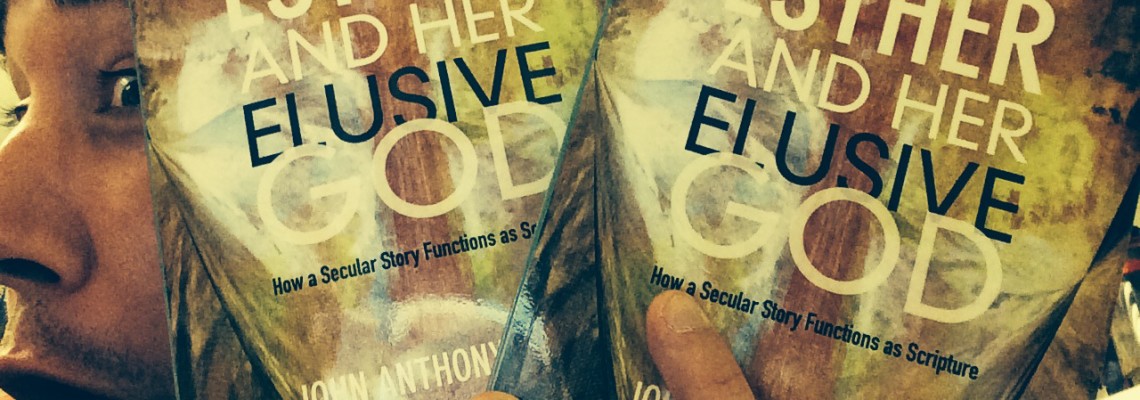
    hqdefaultBut out of the whole host of stories there are a few that irk me with their retelling: Daniel, David, Jonah etc. Notable amongst these is the book of Esther, which usually gets transformed into a Disney/Cinderella type redemption narrative. Therefore it was with interest that I saw that a friend of mine published his thoughts on the book of Esther last year in Esther and Her Elusive God.

    This book from John Anthony Dunne squarely addresses the elephant in Esther’s room: the lack of God in the story. Dunne begins by proposing that the point of Esther isn’t that God is merely the subtext behind the action that is going on. But rather that the book functions to highlight ‘that the elusive God of Esther was steadfast and faithful, preserving his people though they did not deserve it.’ (5) In order to address this point he considers the secular nature of the story through three aspects: the Compromise of the Israelites in the narrative, the relationship of the narrative to the Covenant, and the reception history of the book of Esther and its subsequent modifications in the Septuagint (LXX) and Alpha Text (AT). Throughout the book Dunne provides convenient comparisons with modern retellings of the story, and their emphases on the changed narrative in order to reintroduce and highlight God in the story.

    The analysis portion of the book is carefully, slowly and cumulatively argued and builds a strong picture of the secular nature of the book. In this section the primary weakness and likely stumbling block for many readers lies in the treatment of Esther 4:13-14 which many scholars point to as the recognition of the implied deus ex machina at work. However, even here the argument makes cumulative sense if taken as a whole and this should not cause a careful reader too many issues. The final chapter of this the first part of the book addresses the redaction and additions present within the LXX and AT. This chapter presents some of the changes to the Masoretic throughout the lifespan of the book, although it would have been useful for the associated appendix to be integrated into the chapter as a whole.

    If the first part of the book advocated for a negative reading of the lack of God in the book of Esther, the second part asks the question of why the book is in the bible at all. In these last thirty odd pages Dunne drives home his argument that the secularity of Esther and its presence and context within the canon actually highlights the providence of God in the story. Here he argues that like Job, the book of Esther is another exception that proves the rule, that ‘Esther [is] a tale of how good things happen to undeserving people.’ (125) These two chapters as the crux of the book are arguably the highlight of the careful argument that has gone before, and I wish that he had the time and space to expand on this application further.

    Overall I believe Dunne provides a convincing argument, and one that resolves many of the aspects of the book that have irked me in the past without simply being a hagiographic retelling. However, in getting his argument across occasionally the book comes across as somewhat vindictive and vilifying in its highlighting the moral, cultic and covenantal failings of the characters. This slight polemical tone jars with Dunne’s otherwise laid-back style and will hamper the absorption by some audiences. This aside I found it an enjoyable and convincing read, and look forward to thinking about how it will impact on my preaching and retelling of the story for children.

    In addition I quite like the dedication:

    10570005_953244694698823_1468668219_n


    John Anthony Dunne, Esther and Her Elusive God:How a Secular Story Functions as Scripture, Eugene: Wipf & Stock, 2014.

    Available: Amazon