Originally I wasn’t going to write on this topic, but this morning I was reading an old friend’s blog and started thinking about the situation, and these thoughts became notes, and became a small comment, and now this brief post. So the logical starting point for this post is here: http://www.dylanmalloch.com/2014/10/mark-driscoll-theology-vs-behaviour.html and with Mark Driscoll’s sudden resignation from Mars Hill (Christianity Today).
Many of the words written on Driscoll’s sudden resignation have focused on specific aspects of his life, ministry, theology or church, but while these are all good perspectives to explore, I’m not convinced that these explorations will go much further than skin deep.  While there are a plethora of facets, historical and present, theological and personal, and many more that serve to build a bigger and stronger picture of the situation at hand, but one aspect I think has been overlooked a bit. I think that it is not the theological credentials or creeds that is at stake here, rather it is more about the cult of personality that was built up around Driscoll, and that is certainly not unique.
Rather we see the same sort of implosions and resignations across a wider range of the church including many non-conservative Reformed Evangelicals. Issues with various pastors and leaders are rife in the wider church, and while snippets are heard briefly, they certainly don’t make national news headlines. I think that the case with Mars Hill got significant air time because traditionally conservative evangelical Christianity has followed the example set forth in 1 Corinthians and has rejected cults of leadership in the same fashion that is found in Paul’s admonition.
However, our society as a whole certainly has not shied away from following after leaders and personalities, and perhaps the best example of this is MTV and the plethora of people following after the strong personalities in the public space. The cult of personality appears intrinsic in human nature, and I think it probably reflects the middle category of Maslow’s hierarchy of needs: Love and Belonging. These needs are further intensified by interacting with strong social identity markers in an ever splintering social world, and seeking an in-group to feel at home with.
But I think just as the Church is in the world, it imbibes this ever nervousness over social identity and so we too can be just as obsessed with status and and personality as early Corinthian church was. Just as the Corinthian’s were divided over Apollos vs Paul vs Cephas (1 Corinthians 1:12) so too the modern church follows after Driscoll, Calvin, Dollar, Houston etc etc. Across the church as a whole there are strong tendencies towards cults of personality, and driven by a complex web of social identity construction and formation. While certainly a cult of personality needs a personality to follow after, I think there is also a strong onus on those sitting in the pews, the general congregation, and the Church catholic.
Perhaps a few illustrations are warranted. The cult of personality is easiest to see in the case of Driscoll and the wider range of mega-church preachers, and even easier again to see with itinerant preachers such as Creflow Dollar. But I was a bit stunned this week to find that the cult of personality doesn’t actually need a living breathing person to follow after.
This week I discovered a 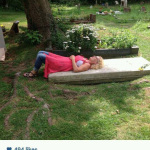 nasty little practiced called ‘grave sucking’, basically involving the veneration of grave sites of various Christian leaders. Simply put these people head out to a grave, and believe that they can ‘suck’ special blessings from the corpse of the dead. See the thumbnail for an example. A cult of personality without even a person to physically follow.
Of course there is the theologically sanitised version of this, where people follow theological tradition in such a slavish way that they may as well be physically following the individual in question. Hyper-Calvinists, hyper-Lutherans etc. Arguably the differentiating factor here is disagreement. While I follow the reformed Anglican tradition, and i think highly of Calvin’s theology, I occasionally disagree with his interpretation or application of scripture. This can be extrapolated out slightly, where it is not only a personage to follow, but an ideological slavishness. One recent example of this has been the engagement and accusations of ‘going Catholic’ towards a swathe of Reformed Protestant scholars that sits somewhere between confusing and bizarre. I wont write more on this, but simply refer to Mike Bird’s blog article on the topic: http://www.patheos.com/blogs/euangelion/2014/10/setting-the-australian-church-record-straight-about-justification/
One interesting indicator I found recently on the health of wider Anglicanism on this topic has been the responses to the admission from Justin Welby the Archbishop of Canterbury over the interaction between faith and doubt. http://www.theguardian.com/uk-news/2014/sep/18/archbishop-canterbury-doubt-god-existence-welby Interestingly there has been significant backlash from some in the church who believe that leaders should be infallible, and certainly not doubting anything whatsoever. When a leader admits that they are not on the pedestal that they have been set upon, then they are set on by the swathes of Facebook and Twitter commentators. Perhaps the less said about that the better.
The final point I will adduce is the astute and active denial of the cult of personality that some leaders, such as Tim Keller, have engaged with. Keller commonly refuses to pose for selfies, chooses to speak less on stage than others if possible, and his appearance here in Australia this year was likely a one off event. His choice to actively undercut any cult of personality as much as he can certainly says something about the human tendencies at play here.
So if these psychological and social issues are at play then what can be done to move forward here. In our sinful state I think that it is likely folly to be attempting to change our intrinsic psycho-social disposition. However, I think that there is one aspect to our social identity formation, and desire to follow after a personality that can be recognised. Namely that we do have a personality to follow, one who was a living breathing fleshly person, and indeed is so now. In the end the only persona that we should be following of is the second person of the tres persona una substantia. As Christians our cult of personality should be, must be, and is centred around Christ. It should be psychologically cathartic, socially comforting, and strongly identity building.