Blog

  • Another Chapter Done

    Another Chapter Done

    10801715_10152769425980944_997747774922569711_n
    I know I haven’t posted a Wordle for a while, but today I thought I would resurrect the practice. I submitted my major project/thesis for my M.Div/G.D.Theol today (in triplicate).

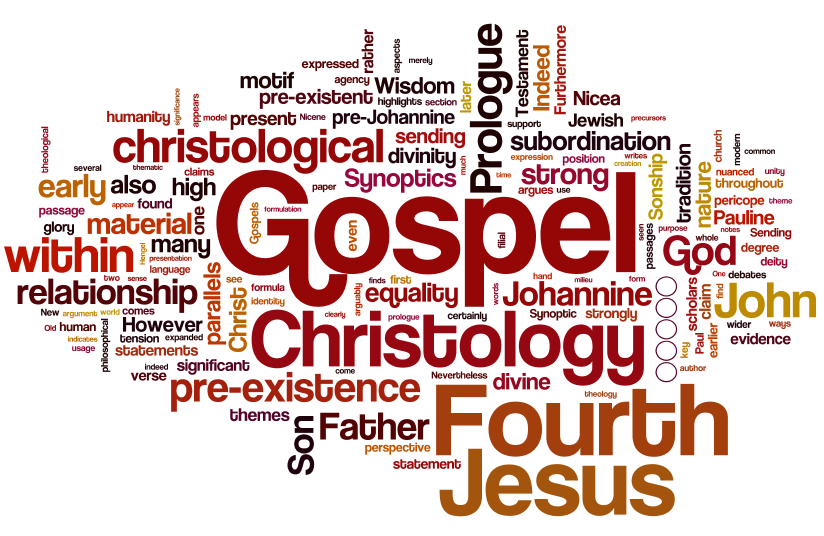
    In many ways this feels like the stepping stone that my ‘honours’ thesis was so many years ago (in quotes because it wasnt awarded for credit), and hopefully I will be admitted to the PhD program next year. More on that later. But in celebration here is the Wordle of my 16,262 words on the topic of Johannine Christology:

    Wordle

  • Enclave Theology and Social Identity

    Enclave Theology and Social Identity

    Mike Bird has a brief piece over here on the prevalence of Enclave Theology: http://www.patheos.com/blogs/euangelion/2014/10/enclave-theology/ which relates back to the previous post on how labels are used in scholarship. He quotes from George Hunsinger

    By ‘enclave’ theology, I mean a theology based narrowly in a single tradition that seeks not to learn from other traditions and to enrich them, but instead to topple and defeat them, or at least to withstand them.

    Broadly speaking this can be seen as a polemical form of legitimation of social identity in the wider social sphere. Similarly to how labels are used as well.

    However, ultimately the monsters outside the door become the monsters inside. As Pierre Bourdieu wrote

    social identity lies in difference, and difference is asserted against what is closest, which represents the greatest threat

  • Larry Hurtado on Labels in Scholarship

    Larry Hurtado on Labels in Scholarship

    This morning I noticed that Larry Hurtado has blogged on the prevalence of reductionistic and entrenched camp labels and their usage in scholarship. I must say I couldn’t agree more with the sentiment and how poisonous reductionistic and pejorative labels can be. Both when they are used to shore up weak and insufficient argument, and when they are used to compromise and tear down the arguments of others.

    I especially liked his take on scholarly works:

    But to my mind, for scholarship to mean anything, the only thing that counts is what a given scholar says/writes, and how well based it is:  How well it takes account of all relevant evidence, how soundly it is reasoned, how well it engages the positions of others, etc.

    As scholars and students, and even more as Christians, we should strive after excellence in our scholarly works, rather than bandying around labels to support or tear down.

    I do encourage you to read it on his blog over here: http://larryhurtado.wordpress.com/2014/10/20/more-on-labels-and-scholarship/

  • TGC on the Mars Hill Postmortem

    TGC on the Mars Hill Postmortem

    Following on from the last post I see that TGC has their 4 points of Mars Hill Postmortem, over here: http://www.thegospelcoalition.org/blogs/trevinwax/2014/10/16/the-mars-hill-postmortem/

    Their fourth point is roughly the point I was making in a cliff note form. I do encourage you to read their first three points though. But perhaps most poignant in there are these quotes from Tim Keller and John Stott:

    Tim Keller describes a “gospel-based ministry” not merely in terms of doctrinal correctness but as being “marked by loving honesty, not spin, image, and flattery.”

    Likewise, John Stott writes: The Christian minister should be preoccupied with the people’s spiritual progress and care nothing for his own prestige. 

    I highly encourage reading the whole thing.

  • A Cult of Personality – whose persona to follow?

    A Cult of Personality – whose persona to follow?

    Originally I wasn’t going to write on this topic, but this morning I was reading an old friend’s blog and started thinking about the situation, and these thoughts became notes, and became a small comment, and now this brief post. So the logical starting point for this post is here: http://www.dylanmalloch.com/2014/10/mark-driscoll-theology-vs-behaviour.html and with Mark Driscoll’s sudden resignation from Mars Hill (Christianity Today).

    Many of the words written on Driscoll’s sudden resignation have focused on specific aspects of his life, ministry, theology or church, but while these are all good perspectives to explore, I’m not convinced that these explorations will go much further than skin deep. Mark DriscollWhile there are a plethora of facets, historical and present, theological and personal, and many more that serve to build a bigger and stronger picture of the situation at hand, but one aspect I think has been overlooked a bit. I think that it is not the theological credentials or creeds that is at stake here, rather it is more about the cult of personality that was built up around Driscoll, and that is certainly not unique.
    Rather we see the same sort of implosions and resignations across a wider range of the church including many non-conservative Reformed Evangelicals. Issues with various pastors and leaders are rife in the wider church, and while snippets are heard briefly, they certainly don’t make national news headlines. I think that the case with Mars Hill got significant air time because traditionally conservative evangelical Christianity has followed the example set forth in 1 Corinthians and has rejected cults of leadership in the same fashion that is found in Paul’s admonition.

    However, our society as a whole certainly has not shied away from following after leaders and personalities, and perhaps the best example of this is MTV and the plethora of people following after the strong personalities in the public space. The cult of personality  appears intrinsic in human nature, and I think it probably reflects the middle category of Maslow’s hierarchy of needs: Love and Belonging. These needs are further intensified by interacting with strong social identity markers in an ever splintering social world, and seeking an in-group to feel at home with.

    But I think just as the Church is in the world, it imbibes this ever nervousness over social identity and so we too can be just as obsessed with status and and personality as early Corinthian church was. Just as the Corinthian’s were divided over Apollos vs Paul vs Cephas (1 Corinthians 1:12) so too the modern church follows after Driscoll, Calvin, Dollar, Houston etc etc. Across the church as a whole there are strong tendencies towards cults of personality, and driven by a complex web of social identity construction and formation. While certainly a cult of personality needs a personality to follow after, I think there is also a strong onus on those sitting in the pews, the general congregation, and the Church catholic.

    Perhaps a few illustrations are warranted. The cult of personality is easiest to see in the case of Driscoll and the wider range of mega-church preachers, and even easier again to see with itinerant preachers such as Creflow Dollar. But I was a bit stunned this week to find that the cult of personality doesn’t actually need a living breathing person to follow after.

    This week I discovered a 10626606_726511277385898_8876200350693483732_nnasty little practiced called ‘grave sucking’, basically involving the veneration of grave sites of various Christian leaders. Simply put these people head out to a grave, and believe that they can ‘suck’ special blessings from the corpse of the dead. See the thumbnail for an example. A cult of personality without even a person to physically follow.

    Of course there is the theologically sanitised version of this, where people follow theological tradition in such a slavish way that they may as well be physically following the individual in question. Hyper-Calvinists, hyper-Lutherans etc. Arguably the differentiating factor here is disagreement. While I follow the reformed Anglican tradition, and i think highly of Calvin’s theology, I occasionally disagree with his interpretation or application of scripture. This can be extrapolated out slightly, where it is not only a personage to follow, but an ideological slavishness. One recent example of this has been the engagement and accusations of ‘going Catholic’ towards a swathe of Reformed Protestant scholars  that sits somewhere between confusing and bizarre. I wont write more on this, but simply refer to Mike Bird’s blog article on the topic: http://www.patheos.com/blogs/euangelion/2014/10/setting-the-australian-church-record-straight-about-justification/

    One interesting indicator I found recently on the health of wider Anglicanism on this topic has been the responses to the admission from Justin Welby the Archbishop of Canterbury over the interaction between faith and doubt. http://www.theguardian.com/uk-news/2014/sep/18/archbishop-canterbury-doubt-god-existence-welby Interestingly there has been significant backlash from some in the church who believe that leaders should be infallible, and certainly not doubting anything whatsoever. When a leader admits that they are not on the pedestal that they have been set upon, then they are set on by the swathes of Facebook and Twitter commentators. Perhaps the less said about that the better.

    The final point I will adduce is the astute and active denial of the cult of personality that some leaders, such as Tim Keller, have engaged with. Keller commonly refuses to pose for selfies, chooses to speak less on stage than others if possible, and his appearance here in Australia this year was likely a one off event. His choice to actively undercut any cult of personality as much as he can certainly says something about the human tendencies at play here.

    So if these psychological and social issues are at play then what can be done to move forward here. In our sinful state I think that it is likely folly to be attempting to change our intrinsic psycho-social disposition. However, I think that there is one aspect to our social identity formation, and desire to follow after a personality that can be recognised. Namely that we do have a personality to follow, one who was a living breathing fleshly person, and indeed is so now. In the end the only persona that we should be following of is the second person of the tres persona una substantia. As Christians our cult of personality should be, must be, and is centred around Christ. It should be psychologically cathartic, socially comforting, and strongly identity building.
    christcentered

  • More Children’s Songs – Polly had a Dolly

    More Children’s Songs – Polly had a Dolly

    Creative Commons (Historical)Another of the songs that Gill, being a Doctor, likes to sing to Caleb is the old nursery rhyme about Miss Polly and her Dolly. The interpretation I hear goes something like this:[ref]Gill doesn’t actually sing this version[/ref]

    Miss Polly had a dolly who was sick, sick, sick.
    So she phoned for the doctor to be quick, quick, quick.
    The doctor came with their bag and their hat
    And they knocked at the door with a rat-a-tat-tat.
    They looked at the dolly and they shook their head
    Because Miss Polly didnt have the $7 for the co-contribution
    And Medicare wouldn’t take Monopoly money
    So Miss Polly’s Dolly Died Died Died.

    This rendition clearly finds its inspiration from the ultra-modernist healthcare zeitgeist, and the growing budgetary pressures placed upon doctors and the system alike. The parable clearly picks up on the discourse surrounding the current contribution system in Australia, while recognising that it is not based on the US model. The repetition in triplicate emphasises some of the urgency of the situation while mirroring the quagmire of political and bureaucratic administrative overheads experienced by those who interact with the system (often in triplicate). The reference to monopoly money hints at the arbitrary nature of the fiscal system, where worthless objects are imbued with a notional value determined by the authoritarian state. While the overuse of plural gender neutral language for singular objects highlights the overly politically correct emphasis of the period.

    Finally the macabre ending to the nursery rhyme transforms a child’s ditty into a stark political parable about the state of healthcare in the modern world, while recognising the ultimate futility of the hyper-preservation of life. I see this ditty as being apropos for an Orwellian futuristic vision, perhaps with gas masks and giant TV screens..

  • Writing, Jazz, Plagiarism and Improv – Jazz as a metaphor for academic writing.

    Writing, Jazz, Plagiarism and Improv – Jazz as a metaphor for academic writing.

    Copyright: Unattributed Creative CommonsAcademic writing, Jazz, Plagiarism and Improv. You might be wondering at what these concepts have in common, and why they should be written about in a single article. Well last week I had the opportunity to attend a network meeting-come-book launch-come-philosophy lecture by Bruce Ellis Benson talking about his new-ish book Liturgy as a Way of Life. “Ugh, are you serious” – I can hear the groans already. What does Liturgy have to do with anything? Well i wont be directly addressing the liturgy part of the lecture tonight, except to say that it’s not quite as you may think.

    Instead one of the parts that piqued my interest was Benson’s extensive use of musica as a philosophical framework for the explanation of life, amongst many other things. From this framework he posits a veritable bevy of comparisons between Jazz and life, of which I will only look at one in this post: Improv. Benson argues that while God is the originator and creator of the world, we are instead re-creators, taking what has been already created and reimagining it and recreating it into something new. While Marx and Hegel may have argued that everything has been done already, in the same vein as Ecclesiastes 1:9; Benson instead argues that we take the original strains of musica and reinterpret them as a form of Jazz-like improvisation i.e. Improv. In such a way we stand on the shoulders of giants and play the tune that has come before but in a slightly different way.

    Now for this metaphor to work it is worth noting a few things about Jazz music. Firstly, despite the seemingly cacaphonic nature of an improv within the piece it inevitably picks up on the theme laid out earlier in the piece, and ‘riffs’ off it. In this way the improv soloist (or band) are taking what has already happened and turning it into something a little bit new. Secondly, it is not the wholesale replacement of the original piece. Despite how different the improv may seem there is acknowledgement of what has come before, and cues for what is to come afterward. In this way an improv cannot simply stand on its own as a whole piece, it is shallow and thin; and the piece is somewhat hollow without that corresponding improv.

    But what does this have to do with academic writing? – I hear you ask; well I offer this corollary. One of the aspects of academic essay writing that the students who come and see me for first year tutoring commonly wrestle with is how to present ‘novel’ thoughts within their essays. They rebel at the concept that an essay could be simply the regurgitation of someone else’s ideas, organised into a pithy 2000 words; and I would say rightly so. Nevertheless the balance between acknowledging the supports for your argument and simply depositing it onto the page with a citation is a fine balance at times. [ref]I know that the comparison between classical music and regurgitation can be made here. However, even in classical music I think there is some scope for individual interpretations.[/ref] Here is where I think the metaphor of Jazz plays into the equation: writing an academic essay is somewhat like performing a Jazz improv. When you are writing an academic piece you are constantly acknowledging the shoulders on which you stand, those who have run the race beforehand and set benchmarks, the explorers who have charted their little bit of new territory and laid out some of the markers. Rare is it that a paper stands on its own, and in the vein of Star Trek: boldly goes ‘where no man has gone before.’

    However, a good academic essay should not be simply regurgitating the previous information, but should be teasing out the implications, the differences in individual perspective  that make previous arguments sing more brightly, or lend weight to a specific train of thought over another. This is the improv part, the offering of a different interpretation, nuances here and there, extending the bounds of the sphere of research wider. It is not simply slavish wholesale copying which is realistically plagiarism, even if it is cited. But rather seeing the intricacies of the arguments that have come before hand, watching the notes bounce off each other, and recognising the gaps that can be filled, or the silences that can be left, and working with those. Sure at an introductory level the author is bound to find that someone else has thought of their lightbulb before, or shares the same interpretation of a text as them. But even there the nuance is different. In the indomitable words of Monty Python ‘you are all individuals’, and as such the individual differences of our perspectives can be brought to bear in an essay, of any level.

    Perhaps the best way to sum it up is by using Bruce Ellis Benson’s own words:

    Just like in Jazz improv, one may borrow an idea but one must return it with interest.


  • Justification of beliefs – a philosophical perspective.

    Justification of beliefs – a philosophical perspective.

    three_legged

    Further to the last few posts here is the publication announcement of an article that a friend at church has just had accepted for publication:

    http://philpapers.org/rec/SILODJ

    No, justified belief isn’t simply clicking the “Justify Text” button in Word, but rather how we support and rationalise our beliefs. Interestingly Paul argues that even false beliefs can be validly justified. I’ll let his own words do the talking:

    More to the point, I argue that so long as one actually has good reasons for belief, it is possible to have a justified belief that is based on the worst possible reasons. For example, basing a belief on tarot card readings, irrational bias, coin flips, etc. is no barrier to doxastic justification

    He continues to expand on his argument in the brief on his own website here: http://paulsilvajr.com/2014/08/18/is-basing-really-necessary-for-doxastic-justification/

    I’m looking forward to hearing more from Paul on it, and perhaps even making it along to his presentation on the 21st of August at Melbourne Uni.

  • Opinions… like bums, everyone has one?

    Opinions… like bums, everyone has one?

    important-opinions-stamp

    Perhaps opinions are like bums, and everyone has one. But perhaps they shouldn’t be paraded around in public all that often. Patrick Stokes has written an article over on The Conversation to this effect, arguing that internal and external evidences for opinions should not be weighed equally. I think this backs up some of what i wrote on the last blog post, regarding how to do public discourse well. Check out the article on The Conversation here: http://theconversation.com/no-youre-not-entitled-to-your-opinion-9978 Also, this is what i posted on John’s wall on the same:

    It is simply putting forward that unsubstantiated opinions should be treated as subjective opinions, not objectively argued positions. 

    Upon reflection this is at the core of the issue that came out from last Monday’s Q and A, and the subsequent discussion on this wall! The elevation of subjective opinion as equal to or trumping objectively argued positions is actually the real detriment to free speech. 

    Lets take a hyperbolic example: Person A argues that because sucrose is harmful for teeth, then eating apples should be banned (fallacious argument, but supported by evidence). Person B argues that ‘I like apples’. In the current climate A and B arguments are viewed as equivalently supported, with external and internal ‘evidence’ being quantified equally.
    Or perhaps at the risk of a re-hash of last week: Prof Stackhouse makes well supported statement regarding the writings in the Quran. Sussan Ley stated “I don’t think that the Quran teaches that.” Ensuing discussion revolved around whether Stackhouse was being judgemental: again internally and externally provided ‘evidence’ quantified equally.

    Also of interest to this conversation is this   Tell me if you agree, or disagree? Or simply that my bum shouldn’t be exposed here…

  • How to engage in productive public discourse?

    How to engage in productive public discourse?

    Most of this post has been sparked from the Q and A program on Monday night on the ABC; so while this post should make sense even if you haven’t seen the program, it will probably make more sense after watching it or reading the transcript. You can find that here: http://ab.co/1lQzstT

    After the program John Dickson on his Facebook wall asked the question on his wall (https://www.facebook.com/john.dickson.9406417/posts/10153072863099447) about whether there are constructive methods of discussing conflicting truth-claims (my paraphrase). The part of the show that sparked this off was the perception that John Stackouse,  speaking relatively objectively on the history and ideology of Islam was being ‘judgemental’ as he was expressing views, and arguably accurate ones, that contradicted another panellist’s own conception of the same issue. Unfortunately the comments on John’s post have diverged off on a tangent, and haven’t really addressed the question of public discourse.

    When discussing theories or data, it is relatively easy to find stable and consistent bases for discourse on the matter. Maths for example has a fairly long and standard ‘language’ and agreed set of norms. Such that when one theory is set against another, the playing field is set and comparisons are able to be made. However, in more subjective environments the discourse is far from clear, for example individual preferences: Why is Coffee A better than Coffee B in a blind tasting? The level of public discourse swings wildly between those two extremes, although I think often attempts are being made to discuss concepts and ideas that are naturally towards the ‘objective truth-claim’ end of the spectrum, but using ideology from the ‘subjective perception claim’ end of the spectrum.

    As such this issue of productive public discourse has been bugging me for a while, as I think it appears to be stemming from the recent headlong collision in the public sphere between variants of post-modern philosophy and the burgeoning use of scientific method in all spheres of life. I wonder if a lot of the interface of a rational modernistic ‘burden of proof’ approach with narrative philosophy, and probably internal psyche narratives, has given us a hyperbolic expression of Lyotard’s early post-modern narrative philosophy. [ref]http://plato.stanford.edu/entries/postmodernism/#2[/ref]  However, I don’t think that either Lyotard or Derrida envisaged modernistic scientifically based narratives as being shoe-horned into place for supporting truth claims.

    I think from this our society has embraced a form of post-modernism in an antithetical type of Orwellian-doublethink. No longer saying ‘your truth offends me’, but rather a case of ‘a different truth-claim to mine offends,’ and ‘your different truth-claim to theirs offends me’. The proof of accuracy and justification is no longer considered external but rather internal. This has impacts on all spheres of life, not only religious discourse, but legal, political, ethical and even starting to have inroads into scientific discourse. (cf Sweet, 1998 Discourse and the possibility of religious truth; Habermas 1996 Between facts and norms; Patterson, 1996 Law and Truth). Take for example the current debate surrounding the 18C vilification laws. While it was arguably never overly socially acceptable to be a bigot, it is no longer socially acceptable in many spheres to even entertain the idea that there are unsilenced bigoted people out there. Furthermore, the push towards legislation of ‘bigotry’ is arguably a case for making what has been considered internally subjective in cultural meta-narratives, externally objective in the rule of law.

    It seems that no longer is it a case of ‘I am right, and you aren’t’ but more along the lines of ‘I am internally justified, and your own internal justification is worth less than mine’

    So how do we end up doing public discourse over major issues in this environment? Is it even possible to conduct productive discourse in an environment where the mere expression of another subjective opinion causes ‘disgust’? Has anyone conducted studies in discourse analysis in this sphere? How about studies in other fields I’m less familiar with? Would love to hear about it in the comments.