Blog

  • How to be Productive? – Time Management and Organisational Skills

    How to be Productive? – Time Management and Organisational Skills

    When it comes to time management, organisational skills and plain old doing stuff there are a ton of pithy sayings out there: ‘to finish first you first have to finish’, ‘to do what you need to do, you need to know what not to do’ etcetera etcetera. Indeed it seems sometimes that there are almost as many methodologies for doing things, as there are pithy sayings, and things to be done. Welcome to the Friday ‘theory’ portion of the skills posts.

    Overall the huge breadth of books and material on the topic can easily lead to analysis paralysis. I have a friend who I think has probably read every book that there is going on productivity and management and all the cookie cutter approaches, but still is absolutely hopeless at actually settling down and doing things. So what is there to do about productivity, do we simply adopt one methodology and hope it works, or swap and change between them at will? Well in many ways either of those options would be better than nothing, as usually going about our lives in a haphazard manner only leads to getting snippets of jobs done and overall lower productivity. But there are some systems that are better than others.

    I must admit here, I don’t follow any one system, but rather adopt little pieces of each of them. I like the list making approach from GTD, but hate that it commonly ends up in swathes of lists without any action. I like some of the Seven Habits, from Stephen Covey, but find that a lot of the time they don’t really lead anywhere and you can end up like a guinea pig on a treadmill. So on and so forth. However, last year I read a book that sought to synthesise many of the different methods and come up with another system, the book is What’s Best Next by Matt Perman. It approaches things from a Christian perspective, anchoring theory in the Gospel, but I think it is equally as relevant to a secular endeavour and secular people. Again, I don’t adopt his entire structure point by point, but I think his overall architecture works quite well.

    He has organised his method around four aspects: Define, Architect, Reduce, Execute; and yes they make a cheesy acronym: DARE. Now each of those is split up into a whole bunch of sub categories and methods, which I won’t reproduce here in whole because they would essentially be plagiarism. However, I think the four work fairly well as an overall architecture, and this is how I use them.

    Define: I have a series of goals, both shorter and longer term. For example a long term goal is to do with working in Theological Academia, while a short term goal is to finish the papers I want to submit for a conference. These are written down, because if they are merely floating about in the ether then they become overly fluid and changeable. I generally revisit my longer term goals (more than a year) every year between Christmas and New Years. While I maintain my shorter term goals and tick them off as I go, and refresh these goals regularly. Longer term goals tend to be noted in a journal or note taking app. While shorter term goals are put into a task manager; more on those in the tools post on Monday. Having goals helps with knowing where the finish line is, rather than wandering aimlessly around. Plus it assists in reward based motivation and management.

    whatsnextcatArchitect: Having a child has taught me that routine is relatively important. When I was at uni for my undergrad I generally just worked when I felt like it, and commonly pushed myself so hard for several months at a time that I would just collapse during holidays. Now while I still am capable of pushing that hard, it is actually far more effective to architect a routine for myself so that things get done at a good rate throughout the week, month and year rather than being in spurts and starts. To do that I have roughly mudmapped out my week. From the simple things such as the days I am at home with the little man, my research slots, through to roughly where the admin for work, college and church fits in. It is best to start with the big items first, that way you know there will be time for doing them. I tend to have things at a relatively high level, in blocks rather than to specific times, as this works well for me with changeable patterns with the little man. Others I know have a lot more set times, down to the hour or half hour. You will need to figure out what works for you. As well as planning the week, it is good to plan ahead for a 3 or 6 month block, so that things like holidays and other deadlines don’t creep up unawares. Tools for doing this include calendaring apps and task managers, which in apt timing will be covered on Monday.

    Reduce: The third aspect of Perman’s approach is simply reduce. Cut out the things that are not productive in any fashion. It may be that for you sitting down and watching some TV is cathartic and helps you relax, I know it does for Gill. But if watching 5 episodes of your favourite TV show each night is causing time issues because things aren’t getting done, then perhaps its time to reduce a bit. Ultimately its up to you how much you reduce and lean out your week. But one thing to consider is how you can multitask with your time. If you take public transport to wherever you do your work then consider reading or doing some other work on that trip. Or if you walk then perhaps a relevant podcast you have wanted to listen to. This is a good way of helping you reduce without having to completely remove the things you are working on. Just make sure when you are reducing you aren’t eliminating the big things you need to get done.
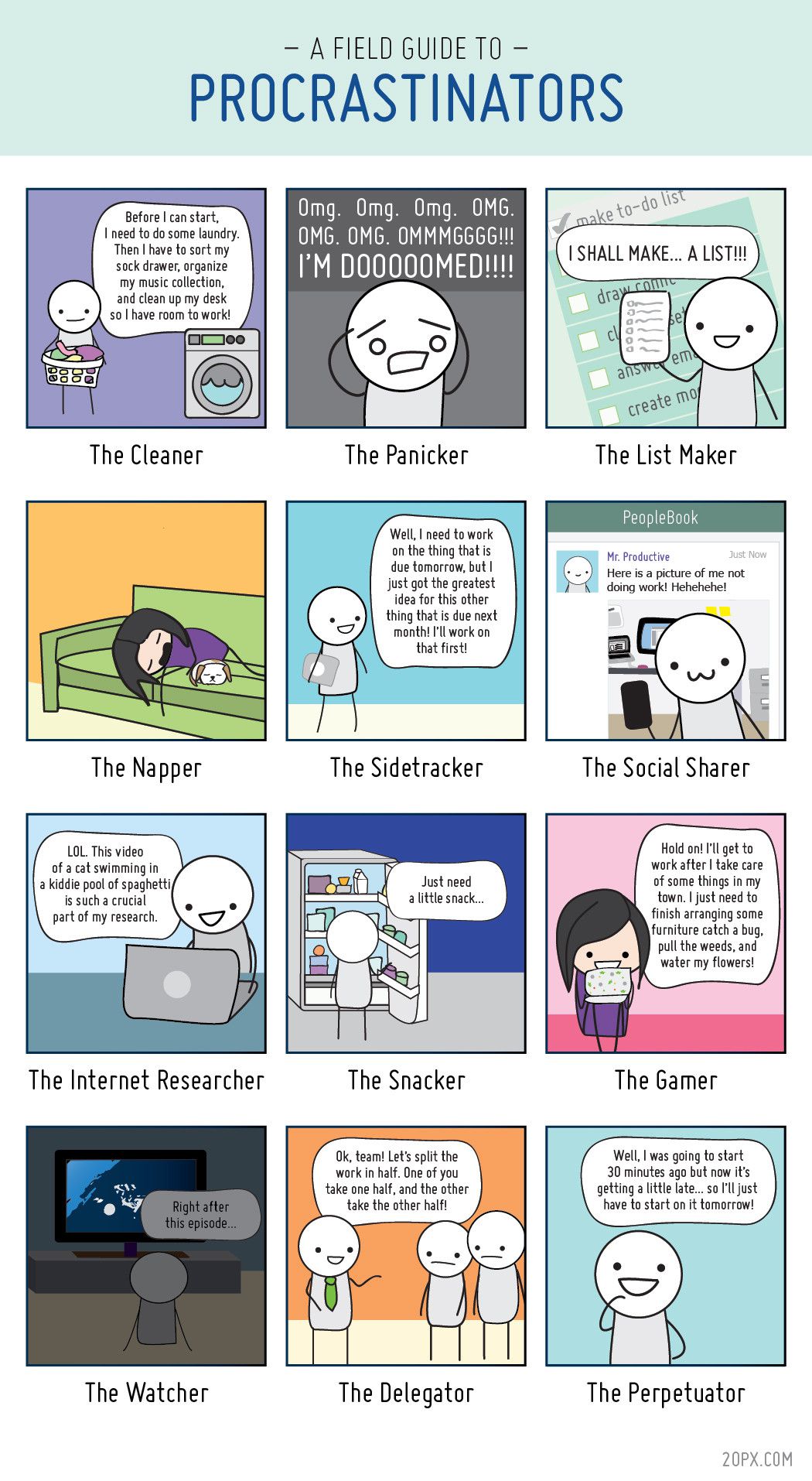
    AFieldGuideToProcrastinators-4366Execute: This is probably the easiest stage. You have some time set aside, now do the things you have tasked to do… and don’t procrastinate about it. While there are a bunch of different methods for doing tasks, such as reading or writing, and I’ll cover some technique to make these easier later in the series, ultimately its down to just doing the tasks. There are some tools that can make this easier, such as good task managers, the Pomodoro technique, and apps to assist with self control and defeat procrastination, and I’ll cover those on Monday as well.

    So how do we be productive? Well its not entirely by following a series of steps and rules. I have outlined a high level method above, which comes from Matt Perman’s book, that I highly recommend you get a copy of and read. But ultimately you need to adapt it to your own life. Perhaps a good piece of homework is to sit down and do the D-A-R-E methodology and see where you end up.

    I would love to hear in the comments your own techniques for the overarching methodology you use.

  • Cognitive Biases: Laptops vs Paper – a useful case study on how to remember things (oh and biases)

    Cognitive Biases: Laptops vs Paper – a useful case study on how to remember things (oh and biases)

    Before we get into the Wednesday series on cognitive biases and fallacies in full swing I thought it would be good to look at a simple case study that not only applies to how we fall into biases unconsciously, but also teaches us a little about how we process information. For a little while now there have been a series of articles floating around the web and popping up from time to time based on the 2014 study by Mueller & Oppenheimer on memory retention with long hand vs laptop note taking. [ref]Mueller, Pam A., and Daniel M. Oppenheimer. “The Pen Is Mightier Than the Keyboard Advantages of Longhand Over Laptop Note Taking.” Psychological Science, April 23, 2014, 0956797614524581. doi:10.1177/0956797614524581.[/ref]

    It’s quite a salient topic to look at with the focus on appropriate methods of pedagogy and learning in our modern society, and the sudden and sharp uptake of computers in the last two decades; thanks to Gordon Moore. Now the majority of these articles focus on the study setup by Mueller and Oppenheimer which looks at memory retention from a variety of TED talks when students were asked to take notes in two different modes: handwriting, and laptop note taking. That study found that students performed better at recognition tasks when handwriting rather than laptop note taking. From this the majority of the articles I have read simply conclude that handwriting is superior to laptop note taking, that in the laptops vs paper debate traditional methods come up trumps.

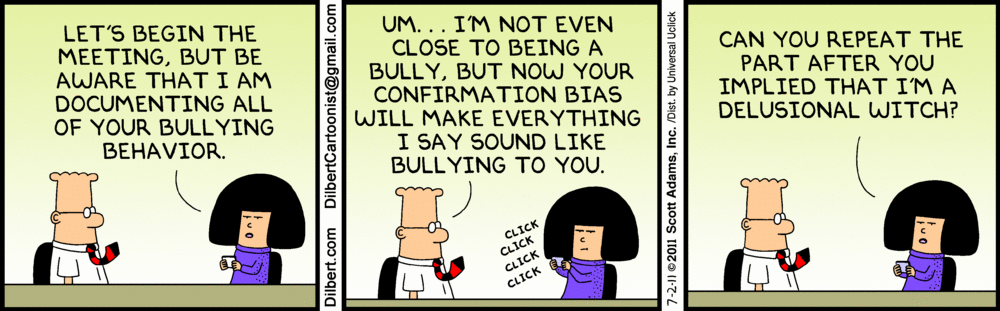
    But is it really? Well before we get into the psychology behind learning and memory, it is worth noting a simple cognitive bias at play here. Confirmation bias. Confirmation bias is a simple bias of taking note of the items or conclusions that fit our existing pattern of beliefs. Simply put the author of most of these articles sub-consciously eliminated the information that disagreed with their presupposition that using laptops in a classroom is detrimental to learning. Notably they ignored the link between laptop use and verbatim transcription, and the corresponding handwriting and synthesis based non-transcription.

    This is just a simple example of the problem with cognitive biases. We simply have a lot of them, and they are excellent at blinding us to alternative data and explanations that challenge our presuppositions. Furthermore there is no malice behind the biases in many cases, which makes it harder to detect in a self-reflective manner. However, being aware of our presuppositions and our predisposition to cognitive biases significantly helps in identifying where our biases are affecting our reasoning and thinking. That is the main reason behind this Wednesday series, if we know more about some of the more common biases it should help us internally defeat them.

    dilbert-confirmation-bias

    Biases aside and back to learning theory, as from the interview in this article: http://www.theatlantic.com/technology/archive/2014/05/to-remember-a-lecture-better-take-notes-by-hand/361478/ where thankfully the reporter has covered the whole of the study, Mueller reflects:

    “We don’t write longhand as fast as we type these days, but people who were typing just tended to transcribe large parts of lecture content verbatim,… the people who were taking notes on the laptops don’t have to be judicious in what they write down.”

    This reflection shows the underlying cognitive working behind the study design of typing vs handwriting. Indeed the claim of better memory retention from handwritten versus typed comes from the level of cognitive engagement, as in thinking and processing, in the memory task. If you are cognitively engaged, such as you are when synthesising material for a paper, then the mode of recording has little consequence (so long as you record something to be able to find it again several months down the track).

    There have been some studies done with low- and high-cognitive load tasks, along with possible low-cognitive load distraction tasks (flipping coins etc) which show its the load of the task that affects retention. Ultimately if you are cognitively disengaged, such as simply transcribing notes for a lecture, then the ‘harder’ cognitive task of handwriting will generally yield better results. [ref]Cf. Piolat et al, 2012; Makany et al, 2008 for cog load; and Schoen, 2012 for contra Mueller & Oppenheimer[/ref]

    wpid-Photo-20141004215054I generally recommend that people take notes in a ‘cognitively difficult’ fashion. What constitutes cognitively difficult varies per person as well, for some it may involve reading around the subject before and after class, while for others it may be formulating interesting questions even if they are not asked in class. While for students who are learning in a non-native language it may actually mean typing verbatim, as the very act of thinking in a non-native language is a hard cognitive task. Indeed some of the students I had last year did this, and subsequently took photos of the whiteboard after class to supplement their notes. As per this amusing anecdote on James McGrath’s blog here. This probably wouldn’t be a useful task for many people with English as a native language, but for them working across a language barrier it helped with both retention and accuracy.

    Realistically for long term memory retention the cognitive load should be high, and the material should be reviewed regularly. I recommend having a high cognitive engagement, even if it is via typing, but review after 24hours and then 3 days and 7 days. Furthermore if the task is able to be used in a synthesis fashion, by perhaps answering questions or writing a personal paper or synopsis on the lecture at hand, then this will reinforce the cognitive loading of the task as well. As from the Mueller & Oppenheimer study abstract the ultimate difference appears to be the act of ‘processing information and reframing it in their own words’ rather than the physical mechanism. So take notes well, and also take note of your cognitive biases.

    Some tools for note taking will be coming up in future Monday posts, and look forward to more cognitive biases on Wednesdays. Tell me what your preferred note taking method is in the comments.

  • Work, Research and Organisational Tools Overview

    Work, Research and Organisational Tools Overview

    When working, or studying, or for that matter going about daily life there are a multitude of skills and disciplines that will help us be better at whatever we are doing. Some of those skills and disciplines I will look at in the Wednesday and Friday sessions. But in addition to these skills and disciplines there are a whole host of software tools that can make the tasks at hand easier, more productive, less painful, and assist us overall. However, there are two caveats with any toolset.

    Firstly, they are only tools, they do not replace the tasks that are at hand, or the skills and discipline needed to complete the task at hand. One common trap I have seen many students and colleagues fall into is assuming that because they are using the right tools that the task will become self-completing, or that they can use less effort for the same results. Using the right tools will make your life easier, but they wont do your work for you. Just because you have a Phillips screwdriver rather than a hammer to undo the screw, doesn’t mean that the screw will automatically undo.

    Secondly, there are a lot of tools out there. In putting together this series I have experimented with some tools outside of my normal toolkit, or tried to find free, cheaper or better alternatives. But commonly this can lead to tool paralysis, where we wonder whether Tool A is right for the job, or whether we would be better served with Tool X, Y, Z and the rest of the alphabet. The truth be told there is no one perfect tool for any job, each has their own quirks and idiosyncrasies, and it is up to the user to decide whether the tool at hand fulfils their requirements accurately. On the flip side there is something to be said for maintaining a relatively stable toolkit, as chopping and changing regularly tends to waste time with the learning curve of the new tool. The toolkit I work with, that I will showcase in this series, has has several tweaks and minor changes, but hasn’t had any major upheavals for several years now. It is stable, and the oddities I have either embraced or learned to work around.

    This Monday series will document my toolkit that I use for my research, synthesis and output in my academic life. In various incarnations this toolkit has served me well through the last ten years of academic research after I finished my undergrads. Some of the software has changed, and certainly the proportion of digital work has increased with new technology, but the overall process has remained relatively stable. While ten years ago I worked mostly in paper, I have transitioned to being predominantly digital in workflow over the last five years. This certainly helps with being able to search and access data easily, and assists in the synthesis and output process.

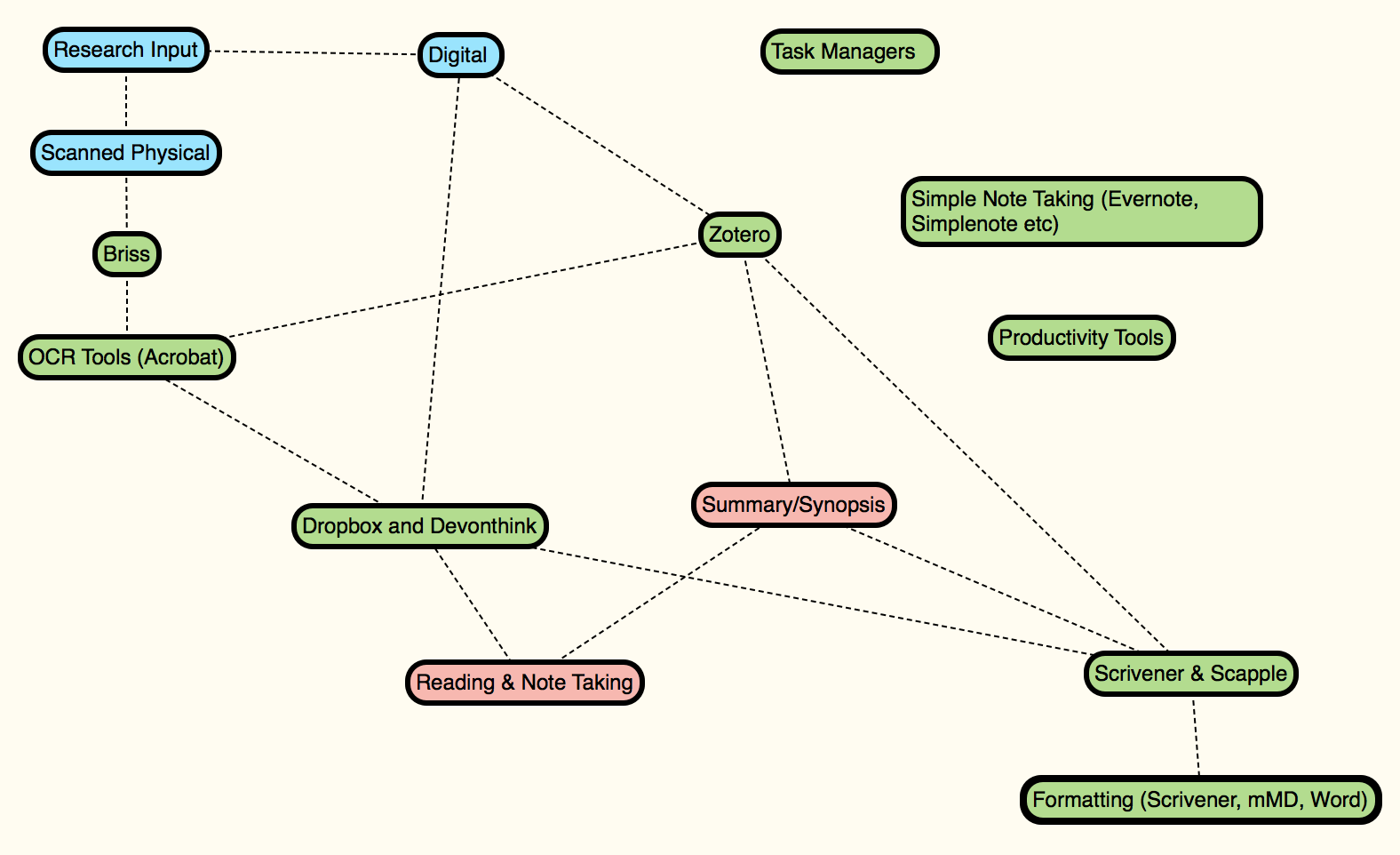
    Overall my workflow looks something like this:
    Organisational Tools
    (Click for a bigger view)

    Roughly speaking I take input either already digital or physical, digitise the physical media, manipulate it so that it is consistent with Briss and OCR (Acrobat) tools, and then add it to my library (Zotero and Devonthink). From there I maintain my library and process the material through reading, note taking and writing synthesised summaries. On the output side I use a mindmapping tool (Scapple) and a word processor (Scrivener) to synthesise my ideas into their final forms.

    Alongside this process sits a bunch of task management tools, note taking apps, and productivity tools that assist me in getting my work done. I will come to each of those in turn.

    The next six blog posts will cover this entire process in more detail, and will roughly follow the workflow. The six posts will be on:

    • Task Managers & Focusing (Tools for Getting Things Done)
    • Briss & Acrobat (Wrangling Digital Files)
    • Zotero (Citation and Library Management)
    • Dropbox and Devonthink (Storing and Accessing Digital Media)
    • Note Taking Tools
    • Synthesis Tools (Scrivener and Scapple)

    I’m looking forward to this series, partly because I’m keen to help others be able to organise their research and writing better, but also because it helps me review my own toolkit and see whether anything needs further tweaking. I would love to hear your thoughts on the process I have outlined, and what tools you use. Comment here or on Facebook.

  • 101 Innovations in Scholarly Communication

    101 Innovations in Scholarly Communication

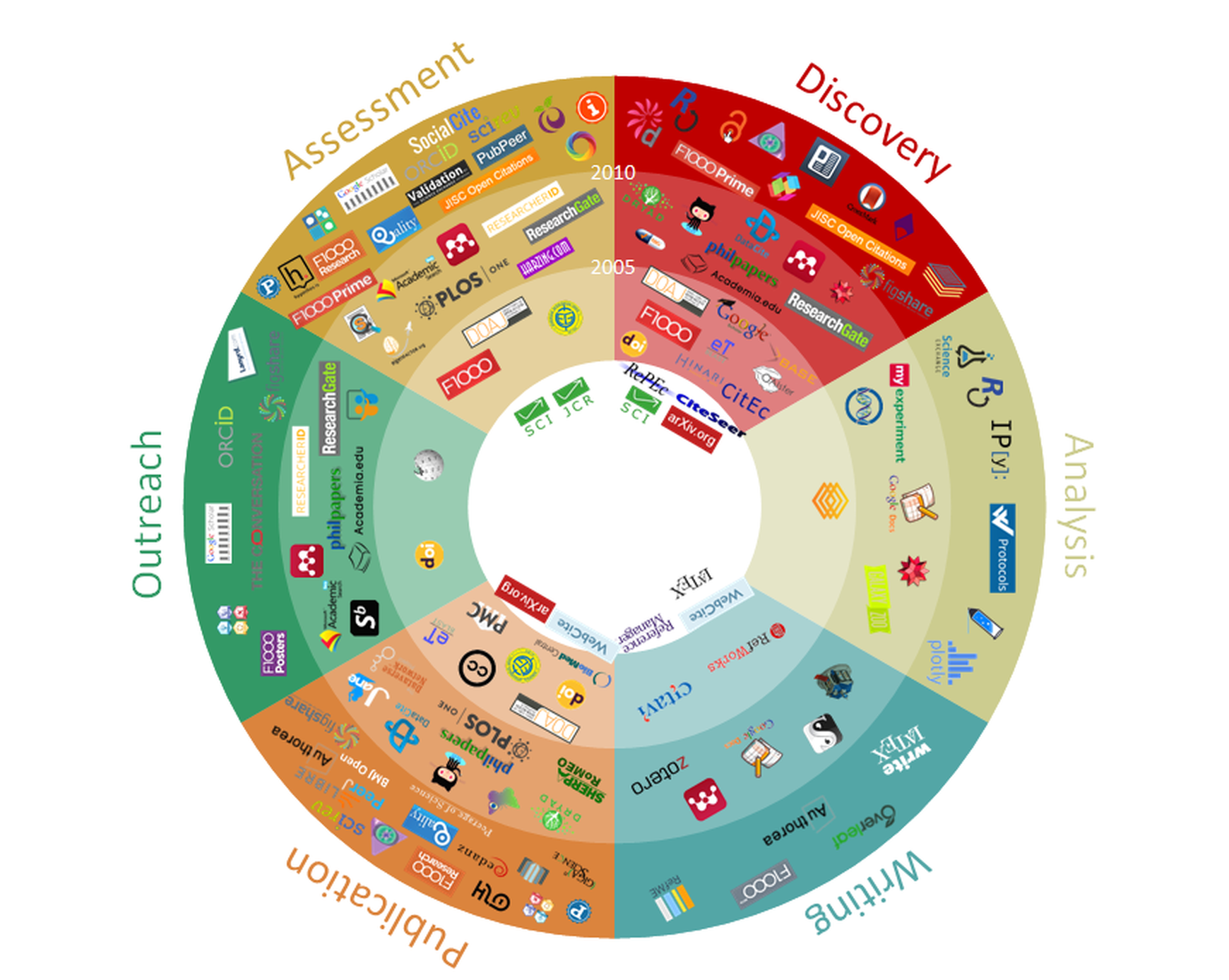
    Just ahead of the Study, Work and Organisation series starting on Monday I have come across this interim report on 101 Innovations in Scholarly Communication. The authors have divided up the research process into six enumerated pieces, and have investigated each separately, looking at the processes that go on within each stage. They have also investigated a bunch of tools for assisting in the research cycle, some of which will be looked at through the upcoming series.

    Its really interesting being able to see the processes that other researchers use, and from a wide variety of fields. I know my processes and structures have varied from Cog. Psych. to Telecoms Engineering and now Theology (my three fields). But it is also interesting to see the overlap between the workflows and disciplines. Just as there is much to learn from interdisciplinary research, there is also much to gain from seeing the workflow and research cycle of other fields.

    I highly recommend having a quick look through their report, and perhaps perusing the long form article over at Inside Higher Ed on the topic: https://www.insidehighered.com/views/2015/01/28/report-101-innovations-scholarly-communication

  • Perfection and Excellence – What do we strive for?

    Perfection and Excellence – What do we strive for?

    ‘Perfect’ it seems has become a dirty word today, and even amongst Christian circles, which I find exceedingly curious. On Sunday I preached at my church (St Matt’s Prahran) on the line in the Lord’s Prayer ‘your will be done, on earth as in heaven’, as part of our series on the Lord’s Prayer. In the sermon I referred to Romans 12:2, where Paul speaks of discerning the will of God, and specifically describes it as: ‘will of God, what is good and acceptable and perfect.’ (Rom 12:2). As part of this I spoke about striving for, and conforming our will to God’s perfect will, and the implication for this as we work out God’s will in our life is that we too need to be striving for perfection and holiness in enacting that perfect and holy will (c.f. Phil 2:12-18). This suggestion was met with significant consternation and challenge, from a variety of angles, and at one level perhaps I shouldn’t have been surprised. Yet in many ways I am, and let me explain why.

    Romans 12:2 describes God’s will as ‘good and acceptable and perfect’ and the Lord’s Prayer calls us to pray that ‘your will be done’, essentially through us as God’s hands and feet in the world. Although we may not perceive or understand the perfection of God’s will from our perspective, scripture still affirms its perfection. However, certainly ‘Perfect’ has some different connotations and excess baggage in our modern world, but it doesn’t mean that it is bereft of meaning. To translate it as anything less than ‘perfect’ in the traditional sense is translationally and theologically doing ourselves a disservice. Rather it is up to us to redefine, or in this case restore the definition of the word, through our understanding and speaking about of the perfection of God and his will.

    But as people we are certainly not perfect, a quick scan of the news headlines shows in stark contrast our imperfection and failings. So how do we, as imperfect people, do the perfect will of God? Firstly I think we must acknowledge that even if we strive for perfection we won’t achieve it. Most, if not all, of our human endeavours, no matter the high quality and strivings for perfection, fall short in many ways. So many ways that we even have coined an -ism for it: ‘perfectionism.’ Now this certainly has its own set of failings and ‘costs associated with consistent failure to meet the high standards demanded.’ It is a trap we can fall into, and a danger we must avoid. However, if we are to be doing the will of God this doesn’t mean we don’t strive for the perfection of God’s will.

    The danger of not aiming for the perfection of God’s will was keenly noted by Francis Schaffer in his book Addicted to Mediocrity: ‘The modern Christian world … is marked, … one outstanding feature, and that is its addiction to mediocrity.’ While he was focused on the realm of arts and culture, his astute observation applies further afield. Often Christians so keenly recognise our human failings that we don’t strive for the perfect will of God, and settle for something far less than that. A mediocrity that only minimally glorifies God in the world.  A useful book I have read on this recently was Excellence: The Character of God and the Pursuit of Scholarly Virtue by Andreas Köstenberger. Although it focuses mainly on academic scholarship, the virtues he writes about are applicable to all walks of life.

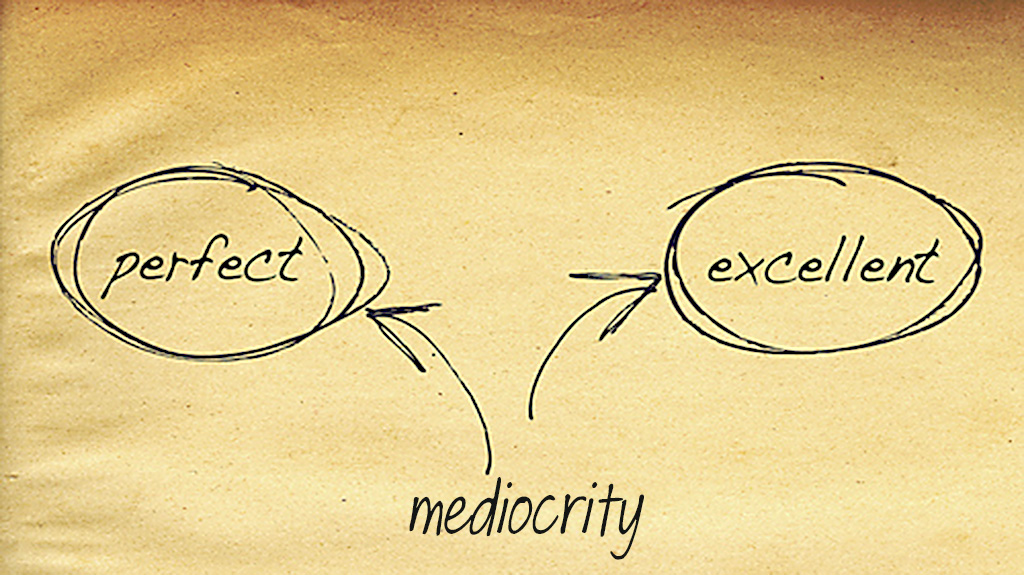
    So how do we strive for the perfect will of God, while balancing that with our own human failings? Firstly I think we strive for God’s perfection, but in the full knowledge that now we will only achieve excellence. We may have to cap our expectations and endeavours so that we don’t fall into human perfectionism, all the while keeping in front of us the vision of that future perfection. It means more than just getting by, or ‘P-s make degrees’, or just scraping over the line. Secondly, it also means that we don’t create a type of ‘works righteousness’ based cultic practice around our personal perfection. Ultimately our perfection is found in Christ, not in our own endeavours, as it is Christ who has saved us, not by our own works. Finally, those good works prepared for us to do, we should do them to the best of our ability, eschewing mediocrity, praying that God’s perfect will be done, and working from that perfect script, even if we know we will only achieve excellence on this earth.

  • ‘Get the F*** off OUR roads’ – Motorists, Cyclists and Intergroup Bias

    ‘Get the F*** off OUR roads’ – Motorists, Cyclists and Intergroup Bias

    In Australia it is that time of year again… summer. Where the weather gets nicer, and in Adelaide the Tour Down Under arrives in town. Now unsurprisingly this annual event sees the  seasonal rise of visible cyclists, and of course accompanying it the usual diatribes and vitriol flashing about in all directions over the topic. There are many directions that these ‘conversations’ inevitably go in, be it down the path of licensing, or psychopathic motorists, or apparent flagrant disregard for the law… from both sides. However, none of these are what I want to address in this post. Rather, I think it is helpful to look at some of the underlying factors within the cyclist/motorist interaction, specifically that of group biases and Social Identity Theory (SIT). It is especially helpful in this case because the interaction is relatively arbitrary and crosses many other more complex social bounds in a relatively equal fashion. This helps as it acts as a type of microcosm or case study that can inform much more complex interactions.

    ingroup-outgroupFirstly, an exceedingly brief overview of SIT and some of the biases at play. SIT was formulated by Henri Tajfel and John Turner in the late 70s and early 80s as a means of exploring intergroup relations. [Ref]Tajfel, Henri, and John C. Turner. “The Social Identity Theory of Intergroup Behaviour.” In Psychology of Intergroup Relations, edited by William G. Austin and Stephen Worchel. Chicago, Ill: Nelson-Hall, 1986.[ref] Primarily SIT seeks to define groups and their relations such that there is a form of predictive capability of the interactions between the groups. At a secondary level it allows for a structured methodology for analysis of intergroup relations and conflict, the primary use for it in this situation. Since SIT’s proposal has been augmented by a series of papers that have investigated how SIT may be used to elucidate further aspects of intergroup interaction. Of particular relevance here is the work by Struch and Schwartz. [ref]Struch, N., and S. H. Schwartz. “Intergroup Aggression: Its Predictors and Distinctness from in-Group Bias.” Journal of Personality and Social Psychology 56, no. 3 (March 1989): 364–73.[/ref] There they note some of the factors that impact upon intergroup aggression; quoting from their abstract:

    Perceived intergroup conflict of interests, the postulated motivator of aggression, predicted it strongly. The effects of conflict on aggression were partially mediated by 2 indexes of dehumanizing the out-group (perceived value dissimilarity and trait inhumanity) and by 1 index of probable empathy with it (perceived in-group–out-group boundary permeability).

    In effect they name ‘intergroup conflict of interest’ as the primary motivator, and impacted by the dehumanisation of the out-group and the permeability of the boundaries. Finally in another study by Mackie et. al. they found significant application of the fundamental attribution error within groups, novelly naming this ‘group attribution error.’ [ref]Mackie, Diane M., Scott T. Allison, and David M. Messick. “Outcome Biases in Social Perception: Implications for Dispositional Inference, Attitude Change, Stereotyping, and Social Behavior.” Advances in Experimental Social Psychology – ADVAN EXP SOC PSYCHOL 28 (1996): 53–93. doi:10.1016/S0065-2601(08)60236-1.[/ref] In lieu of the longer post on FAE to come the simplified understanding is such that in-group members characterise out-group members by individual actions (and usually those that serve the in-group confirmation bias).

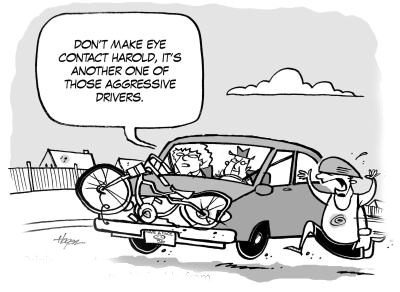
    Aggressive Motorist CartoonSo how does this impact upon our little case study? Well if the motorist/cyclist dynamic is dichotomised between cyclists and motorists, as the debates ensue, then SIT can be utilised in looking at the intergroup interactions. Addressing the first of the sub factors from Struch and Schwartz, even though the permeability between groups is incredibly high, with many bicycle riders owning cars, and obviously vice-versa, the perceived permeability is exceedingly low. I would suggest that this is due to the mutual exclusivity of the means of transport, its impossible to operate both at the same time, and only a marginal percentage of cars are seen with bike racks. Furthermore the proliferation of the ‘ownership’ of the roads, as highlighted by the large number of aggressive claims to ‘our’ roads from both sides serves to further delineate the groups.

    The second of the Struch and Schwartz characteristics is that of dehumanisation of the out-group, and this is extremely easy to see in the language used in the debates. Via that erudite medium of Facebook I have seen a plethora of invectives such as ‘death cage operators’, ‘lycra scum’, etc with many more that aren’t worth repeating. All of these serve to remove the person from the out-group, and replace them with a dehumanised label. For an even more prevalent example of this, see the American propaganda during the Vietnam war dehumanising the Vietnamese as monkeys (c.f. the work of Albert Bandura on the same). The last of Struch and Schwartz’ characteristics is that of conflict of interests, which in this case is the usual and predictable conflict over space on the roads.

    Mackie’s applications of group attribution error can be relatively easily seen as well with the anecdotal evidence base significantly outweighing any statistical or Bayesian measures. The usual argument appears: ‘I saw a cyclist breaking the law, therefore all cyclists break the law’ or ‘I was harassed by a road Cyclist Denigrated Cartoonraging driver once, therefore all motorists are out to kill me.’ As with most, if not all, attribution biases there is an element of truth there, but little to no statistical significance or repeatability. So these anecdotal ‘evidences’ serve only to strengthen the out-group discrimination bias, and reinforce the in-group bias. Furthermore the inverse is true, motorists don’t self-characterise by those ‘hoons’ or criminals who kill people in accidents, and neither do cyclists self characterise by those who run red lights and knock down pedestrians. The confirmation and attribution bias flows in both directions.



    Finally it is worth acknowledging that there are a plethora of other factors at work, from confirmation biases to clustering illusions, empathy gaps and many more. However, the majority of these serve to reinforce existing group boundaries, rather than dissolve them, so while they contribute to the bigger picture it is in terms of detail rather than applicability.

    So what can be done with this situation? It is all well and good to use SIT to describe an intergroup interaction, but as with many aspects of academia it is hollow if left there. One of the advantages of describing the interaction in this way is that participants in the groups get to see how their biases shape the interaction as a whole. This is where education comes into play. While educating cyclists that not all motorists are homicidal psychopaths, and educating motorists that not all cyclists are flagrantly law-flaunting dilettantes will not remove those who are genuinely homicidal psychopaths and flagrant law-flaunters, it does break down the boundaries somewhat.

    This breaking down of the boundaries is important on two levels, firstly as it dismantles some of the conflict, and secondly as it removes places for those who genuinely are psychopathic or law flaunters to hide within their respective in-groups. I note that the Motorcycling Victoria is doing significantly more on the education front than I have seen the cycling and motoring groups do in recent times. See this video here: https://www.youtube.com/watch?v=u3mWQJ9UOm8 There are many more applications of SIT in identifying biases and breaking down the stereotypes, such as serving to re-humanise the participants in each in-group and many more that I don’t have the time to explore here now. Suffice to say that proper analysis of the intergroup bias and interactions helps to inform efforts to resolve issues. But I would also suggest that without a good understanding of the group dynamics at hand there will be little traction in the plethora of discussions to be had.

    Lastly, its worth noting that while the cyclist/motorist example is a salient one for many, myself included as I span both groups (disclaimer: motoring AND cycling enthusiast), it can readily be extrapolated to other intergroup conflict. The other swirling debates over ‘Islam vs the West’, various racial disputes, Republican v Democrat, Liberal vs Labor, liberal vs conservative, religious vs atheist, and many more all find application within the realm of SIT. Furthermore they all can be assisted in better conversation and possible resolutions [ref]Many resolutions are likely impossible, but at least not debating over useless topics[/ref] to various degrees by identifying the intergroup conflicts and seeing the origins and reinforcement of the biases present.

    What do you think? Weigh in on the comments below.

  • New Study Series beginning in February

    New Study Series beginning in February

    With the start of the new academic year it is worth considering some methods, skills and tools for study in the year ahead. This year I have decided to put together a short seven week blog series covering many of the questions I am regularly asked when it comes to studying. I will divide it up into three separate sub categories: Study Tools, Study Skills and an assorted series of Biases and Fallacies that commonly arise. On Mondays the Study Tools part of the series will focus on organisational tools that can make the process of gathering, sorting, absorbing and synthesising information easier.
    On Fridays the Study Skills section will look primarily at holistic skills for getting the most out of the time that is spent studying and writing.
    Finally, on Wednesdays the Biases and Fallacies section will look at a series of common cognitive biases and fallacies that crop up in academia of all levels, and this section will finally culminate in an attempted Grand Theory of (Almost) Everything.

    However, even though I have been studying and working in academia for quite a while now, I certainly have not come across everything that there is to be said in each section. Many of the posts will deal with questions I am asked commonly, and have proven helpful to others at Ridley and elsewhere. So I will mostly be sharing what works for me, and hoping that you, the readers, will be able to use and adapt my methodologies for your purposes.

    I am really interested though in hearing what you would like to see covered. Are there any specific situations or problems that you find yourself regularly encountering? Also I will be welcoming comments and sharing of personal tweaks and methods on each of the sections when I get to the specifics. I am keen to learn from others, and hope that we can make the learning process as a whole better and more enjoyable. So please comment below, or on Facebook with what you would like to see me cover and what would be useful.

  • Charlie Hebdo, terrorism and identity

    Charlie Hebdo, terrorism and identity

    Some will probably know that I have been interested in issues of identity formation, adoption and social identity for quite some time now. While this is not the time or place to engage in a long discussion of the factors of Tajfelian Social Identity Theory, I think that the issues we are facing now interact strongly.

    Many of the statements and  rhetoric surrounding the Charlie Hebdo and subsequent incidents have focused strongly on a type of positive-negative asymmetry, where pejoratively denouncing the other while reinforcing ingroup bias comes as a priority for group identification. The problem is that these reinforcing mechanisms tend to make constructive discourse harder to engage in, as it is driving at the heart of the group identification. The rhetorics of #jesuischarlie, #jesuisahmed and the ‘We don’t condone such actions’   foster such identity dichotomies.

    However, I am somewhat heartened by articles such as this one from the Telegraph: http://www.telegraph.co.uk/news/worldnews/europe/france/11332535/We-think-the-Paris-terrorists-were-offended-by-Charlie-Hebdos-satire.-What-if-were-wrong.html

    Instead, they [extremists] merely pretend to be offended by cartoons, in order to give themselves a pretext to commit murder. Murder so horrifying, on a pretext so unWestern, that non-Muslims – blinded by grief and rage – turn on Muslims. Blame them. Persecute them. Burn their book, attack their mosques, threaten them in the street, demand their expulsion from Western societies. Actions that, in turn, scare Western Muslims, isolate them, alienate them. And thus drive some of them to support – and even become – terrorists.

    While I think that the strong reaction to ignore religious and social differences in many of these articles (this one trends in that direction) is unhelpful. I do think that considering and engaging with some of the underlying social and identity motivating factors, especially in a diachronic fashion, is required. Perhaps this is a good place to start…
  • The New Year – 2015

    The New Year – 2015

    Well after a big 2014 it is 2015 already, and a ton of things are already looming on the horizon. Firstly and briefly the blog has had a bit of a redesign, to indulge in my Art Deco appreciation phase (revived in no small part from visiting the Hoover Dam during my trip to SBL) .

    We also have Caleb’s first birthday coming up, as well as Gill changing practices for her next GP terms, and I’m hopefully starting further study. All of that though is in the future, so in the first few weeks of the year we will be taking stock and going a bit slower.

    Ill certainly have to be going a bit slower, as the other item of note during the New Years break were 10407523_10152877889130944_7042218840394785802_nliterally some breaks. I spent Boxing Day evening in a fetching neck brace, and have a few arm fractures from a cycling accident. Healing up well though, and it could have been worse, Ill spare the gory photos.

    Expect more blogging this year, I have planned out a couple of series on study and organisation techniques,  plus some on fallacies and biases, along with some work I have been engaged with over the last little while. All of that is to come though. For now, its time to rest.

  • What is the Point?

    What is the Point?

    Recently I was at the ETS and then SBL/AAR conferences in the US, with about 15,000 people descending on San Diego for the SBL/AAR conference alone. While one of the Ridley lecturers, Andrew Malone, and I were heading out for dinner we encountered a lady who challenged us on what is the point in studying the bible if for so many it doesn’t change our actions. He has eloquently blogged about it over on the Ridley site here:
    http://www.ridley.edu.au/college-life/so-what/

    Let me briefly quote from his blog:

    All too many Christians known to us and to Amy are simply lazy or selfish when it comes to putting theory into practice … It’s our job to ensure that the members of God’s church for whom we’re responsible (and we ourselves) are adept and conscientious at asking ‘so what?’ and putting the theory into practice. Yes, we need to know how to distinguish Greek genitives and to rightly interpret Genesis and Hebrews. And we also need to know why and how to share Jesus’ compassion with a sin-laden society that’s made in God’s image, a compassion that quells physical hunger as readily as it strives to furnish spiritual nourishment. And we need to get on with it.