Category: Psychology

  • Stereotyping: A Preacher, The Gospel, and That Wedding.

    Stereotyping: A Preacher, The Gospel, and That Wedding.

    Disclaimer: I didn’t actually watch the wedding, and this post isn’t on the wedding per-se. But I have seen the plethora of responses to the sermon from the wedding, and this post is in relation to those. It is also psych heavy—although much is Cog.Psych 101—so if you were here for commentary on the sermon, or on wedding dresses, you have come to the wrong place.

    In the last few days I think everyone has been bombarded on social media by content about ‘that wedding’ [the Royal wedding if you have been living under a PhD driven rock like me]. However, also interesting has been the responses to the sermon from various segments of my social media feed (if you haven’t been seeing the same responses, well that is unsurprising given the opaque Facebook algorithms). In this post I want to briefly explore two of the main responses to the sermon that I have seen, and from the perspective of Social Identity Theory as I think it highlights something interesting about our interactions.

    Before we dive in though, for the sake of the conversation, I am standing on the shoulders of Penny Oakes (along with Alex Haslam and John Turner) on Stereotyping Theory[ref]Oakes, Penelope J., S. Alexander Haslam, and John C. Turner. Stereotyping and Social Reality. Malden: Blackwell Publishing, 1994.[/ref], as she has built on the work of Tajfel and Turner in the formulation of Social Identity Theory[ref]Tajfel, Henri, and JC Turner. “An Integrative Theory of Intergroup Conflict.” Pages 33–47 in Psychology of Intergroup Relations. Edited by WG Austin and S Worchel. Brooks/Cole, 1979.[/ref]. From that basis when I talk about ‘stereotyping’ I am meaning that cognitive process that we all utilise to ascribe ‘characteristics to people on the basis of their group memberships.’ [ref]Oakes et al., 1994, 1[/ref] Now I need to emphasise that this is not intrinsically a negative process, as our modern language uses it. Rather it is just a means of reducing cognitive load by perceiving people as members of social categories in the initial phase. Similarly, I will use the term prototype, which is merely the (often fictive) composite idea of the embodiment of the main characteristics of a social group. These basic definitions will be how i will use stereotype and prototype throughout this post.

    Onward therefore to the responses.

    The General Response

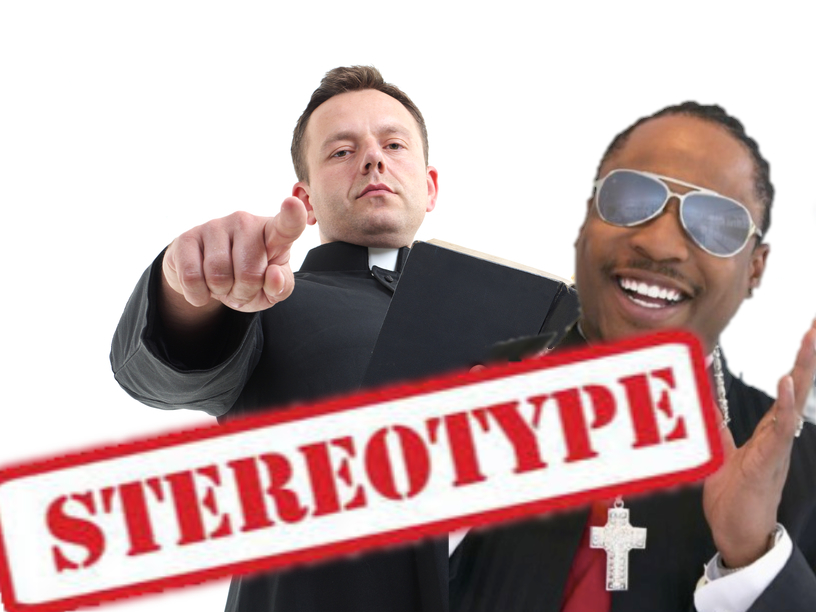
    The first response, to the sermon, I have seen from various friends is one of amazement and shock that such a good sermon could be preached and especially broadcast all over the world. After a bit of digging through various comment sections, I think much of this is to do with a mismatch between Bishop Curry and his sermon, and the cognitive stereotype of Bishops and wedding sermons.

    Firstly, a bit on stereotyping and dissonance. We use stereotypes as a means of cognitive minimisation, an effort to know more about an individual or group by ascribing the stereotypical characteristics of that group to the individual. This is done all the time, and we aren’t even conscious of it. In fact, just the other day an elderly lady approached me and started talking to me in an Asian language. This is a stereotypical ascription as she has ascribed the category ‘Asian’ to me on the basis of my racial presentation, and for her that category included language. Unfortunately for her my language repertoire outside of English is solely European, or dead languages, and the blank look on my face must have highlighted that. The response for her was one of sheer dissonance, effectively ‘how do you not know Asian language X, you don’t fit my category of Asian.’ It is this dissonance that draws our attention to things. Such as when Australians are shocked that a footballer graduates with a law degree, as most Australian footballers (of any code) have no tertiary education [real conversation].

    In the case of the wedding sermon it is a dissonance between the stereotype of Bishops and sermons, and what Bishop Curry actually delivered.

    Simply put, what people were expecting was:

    via GIPHY

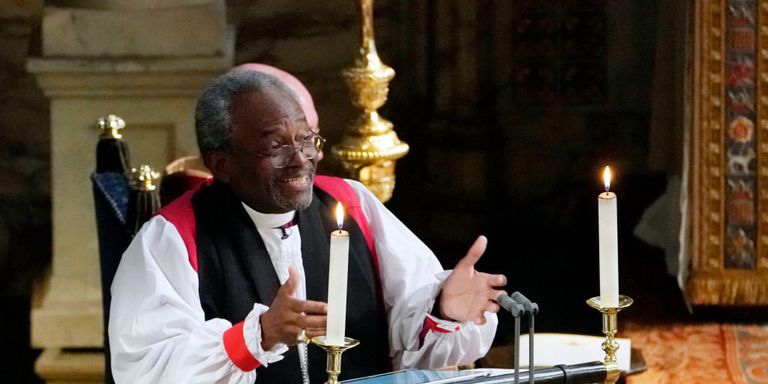
    But what they got was this:

    Needless to say this causes significant dissonance, much of which was writ large on the faces of several members of the royal family during the wedding. But it is also the same dissonance which has caused such significant engagement with the sermon and Curry. Because this dissonance forces a refactoring of the stereotypes at hand and reassessing where Curry fits. Much of this refactoring comes in the form of comparison with other social-category prototypes that might suit as a representative of a new stereotype for the individual. With this in mind it is completely unsurprising that there have been comparisons drawn with Martin Luther King, who stands as a comparative prototype for the social category that roughly exists as ‘African American preacher.’

    Now this is highly simplistic and significantly under-nuanced. But it serves as a basis of the other type of response I want to look at.


    The Conservative Evangelical Response

    The other type of response I have been seeing is that of conservative evangelicals who have lambasted the sermon as being ‘Gospel-lite,’ and ‘not a real sermon.’ Much of this initial response is in a similar cognitive vein to that of the general response. However, instead of the pre-existing social category being accessed as ‘a bumbling fumbling mumbling old fuddy duddy in a smock’ [a direct quote], there is instead a plethora of prototypes for the social-category ‘good Anglican preacher.’ Notably, one of the prototypical characteristics for the social-category involves ‘preaching the gospel.’ Now this is where the stereotype comparison resonates strongly, as many features of Bishop Curry and his sermon cohere with the social-category stereotype for ‘good Anglican preacher.’ But due to the meta-contrast ratio between ‘good Anglican preacher’ and Bishop Curry, the dissonances stand out strongly against the background consonance.

    Here the primary dissonance revolves around that prototypical characteristic ‘preaching the gospel’ and hence the plethora of articles on how/why/when/where Curry did/did not/should have articulated the gospel. Similarly this exposes a new set of dissonances regarding the content of the gospel, and a similar process ensues…


    Take Home Lessons

    So what are the take home lessons from this flurry of social media activity? Well the primary thing is that dissonance between stereotypes and reality cause interest, and the greater the dissonance between the types, the greater the interest. Furthermore, this is also the case when the dissonance occurs within a stereotype, not just outside of the stereotype. For social-identity people, both internal and external stereotype comparisons are examples of the meta-contrast ratio at work.

    In the end we should not be surprised when these sort of things attract strong interest and debate, it is breaking the stereotypical norms that we have set up, and things that break stereotypical norms are of great interest to us as social individuals, as we attempt to make sense of the world.

  • That Cooper’s ‘Keeping it Light’ Ad… what it got wrong and what is so very right.

    That Cooper’s ‘Keeping it Light’ Ad… what it got wrong and what is so very right.

    I’ve been meaning to write about this since March, when the original Coopers ‘Keeping it Light’ ad aired, but haven’t got around to it until now. However, I think that the take home points from that ad are just as relevant now—and perhaps even more relevant with the postal survey about to close.

    For those who may have missed the furore—or more realistically are reading this from overseas, as it was pretty hard to miss here in Australia—it goes something like this. Coopers partners with the Bible Society Australia to produce a line of commemoratively tagged cans under the “Keeping it Light” slogan, and subsequently filmed an ad featuring two Liberal party MPs discussing Same Sex Marriage. Perhaps unsurprisingly this didn’t go down well with the general public, and after just a few days the entire campaign was pulled (campaign archive here). So, then, what are the take home points from this furore? Well, here are some things that the ad got very wrong, and one thing it actually got right.

    Getting it Wrong

    Perhaps the biggest thing that the ad got wrong was the overall tone of the discourse. By placing it within the context of a ‘light discussion’ the creative team behind the ad severely undercut the discourse that happened within the ‘debate’—the tone and content of which frankly was pretty mild. Primarily, this is because the topic of same sex marriage in Australia is considered—as in many other countries—a heavy topic, and one that evidently is serious enough to spend $122M on (don’t get me started on that). But to pitch it as a ‘light discussion’ was sorely misguided.

    Secondly though was the choice of conversation partners, in Liberal MPs Tim Wilson and Andrew Hastie. While the MPs do helpfully hold different positions, and Tim Wilson self-declares as same-sex attracted, they are notably both from the same party. That same party that has been notoriously resistant to allowing any discourse on the issue entirely. By pitching the debate as ‘light’ and between two members entrenched in a party that has traditionally disallowed this discussion both of the conversation partners are immediately categorised as part of a group that is negatively associated with same-sex marriage—despite Wilson’s own stated views.

    These two factors probably explain much of why the ad received so much negative attention and subsequent backlash. Leaving off the whole concept of light beer in the first place, which is a serious mispitch anyway.

    What it got Right

    However, not all is lost. Despite the massive failings of the ad, it did get one thing right: face-to-face discussions. Much of modern social discourse is conducted over relatively impersonal mediums such as social media. This goes for the SSM postal survey as much as it does for political debate (see Trump), and debates over race and gender. While these mediums give some semblance of interpersonal interaction, they lack much of the emotional engagement that interpersonal contact generates, as we have discussed here.

    What the Coopers ad gets right is that face-to-face one-on-one interaction defuses much of the group identity that is present on social media, and promotes interpersonal interaction instead. It, as social-identity theorists put it, reduces the salience of inter-group interaction, and increases the salience of inter-personal interaction. [ref]Haslam, S. Alexander. Psychology in Organizations. SAGE, 2004.,23[/ref] Why is this important? Well much of the literature on change of attitude in conflicting social groups emphasises that most of the change happens at an individual level, rather than at a social group level. Indeed, interaction at a group level ‘increases the perceived homogeneity of outgroups and consensus among the ingroup.’ Effectively entrenching views within those social groups.

    Perhaps then the take home from the Coopers ad is that if you really want to change someones mind on a contentious social-group issue, sit down with them face-to-face as individuals. Easy? No. But worthwhile. Just don’t use light beer. The next post in this series will focus on a practical example of this.

  • Does Social Media help our Debate? – The Medium is the Message

    Does Social Media help our Debate? – The Medium is the Message

    This is the second of four (possibly more) posts in which I consider how our shift to social media as the forum of the polis affects our arguments.

    As we get deeper and deeper into this social media age, the question I often return to is whether or not social media helps or hinders our debate in this new digital ‘public square.’

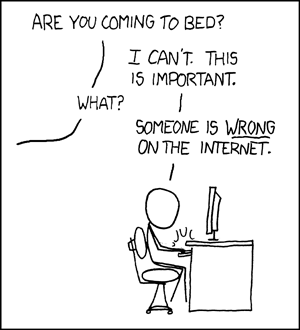
    A while ago a colleague was doing some research using eye tracking while participants looked at websites, and as an aside noted that many participants actively looked at other links on the screen, rather than the primary content of the website.[ref]Research was published as Benjamin Stone, ‘Using LSA Semantic Fields to Predict Eye Movement on Web Pages’, International Journal of Human-computer Studies 69/11 (2011): 720–740.[/ref] This seemed to indicate that people were more interested in finding another page and source of information than processing the information in front of them.

    https://xkcd.com/386/

    This serves as a helpful reminder of Marshall McLuhan’s thesis that it isn’t merely the message that determines attention and retention, but the medium of the message holds salience even within CMC.  In this case the very nature of reading articles and even books on a digital device reduces attention span within the overall populace. We should not be surprised when users interact with only a mere snippet of material, while ignoring the rest of the argument.

    In combination with the sheer volume of information available, this has significant detrimental effects. In sorting and filtering through the ever expanding sea of information, our heuristics to detect the ever dwindling signal to noise ratio have to become far coarser. In doing so our modern culture has condensed the information gathering process into a series of bite sized snippets. News articles have been condensed from the long-form essay, to short columns, and then pithy snippets, shared on Facebook, condensed into 140 character tweets, and subsequently regurgitated as 2-3 second sound bites. This reduction in information length has seen a corresponding reduction in the average attention span for all media; and the reduction doesn’t appear to be merely an expression of ‘the Elvis Hypothesis.'[ref]The Elvis bias is essentially an inverted appeal to novelty fallacy, or a modified appeal to tradition. Karina J. Linnell et al., ‘Urbanization decreases attentional engagement.’, Journal of Experimental Psychology: Human Perception and Performance 39/5 (2013): 1232–1247.[/ref]

    Ultimately, I think that engaging in public debate on social media may be a low return proposition, as a minimal amount of argument is engaged with, and much is skipped over rapidly, and this isn’t even considering the ‘echo chamber’ like filtering that many social media companies engage in.[ref]https://www.wired.com/2016/11/filter-bubble-destroying-democracy/[/ref]

    So, is there any point in public debate on social media? Is my writing and publishing of this piece (on social media) a futile exercise? Not quite, as we will see in future posts. But the situation is likely to get worse before it gets better.

  • Why I am becoming convinced that bifurcated argument on Social Media is detrimental

    Why I am becoming convinced that bifurcated argument on Social Media is detrimental

    During this current ‘not-plebicite’ season I have been asked several times on various social media platforms as to what my position on various aspects of the debate are. But, apart from one more sleep deprived enquiry about jurisprudence, I have decided that I won’t be posting on the topic. More than this, I am becoming convinced for a few reasons that the place for extended debate is not on social media.

    Much of this has come from revisiting some research I was involved in back when Tom was the ‘first friend’ you had, and Facebook was in its infancy (ok, it was 2006). Most of this research involved evaluating hugely expensive telepresence solutions such as the HP Halo system as means of improving computer mediated communication (CMC).

    Two aspects of this research I will briefly consider–and most of this post is drawn from a paper I wrote back in 2015, so some bits are dated, and it is written for academic presentation. On the upside there are footnotes 😉

    Emotional Confusion

    The first aspect is emotional confusion, which is often present within textual communication is often parodied in mainstream media. From the innocently worded text message being read in an unintended tone, to the innocuous social media message eliciting murderous responses. See that classic Key and Peele sketch on text message confusion here (language warning). The situations are so often parodied because they are highly relatable, many, if not all, of us have had similar experiences before. Why? Why does text on a screen elicit such powerful emotive responses, when the same message in other forms barely registers a tick on the Abraham-Hicks. Studies have shown that it is the sociality, or social presence of the medium that provides the best insight into the emotional regulation that can be so diversely represented in CMC.[ref]Antony S. R. Manstead, Martin Lea, and Jeannine Goh, ‘Facing the future: emotion communication and the presence of others in the age of video-mediated communication’, in Face-To-Face Communication over the Internet (Studies in Emotion and Social Interaction; Cambridge University Press, 2011), http://dx.doi.org/10.1017/CBO9780511977589.009.[/ref] Specifically in our case it is the factors of physical visibility, or more precisely, the lack thereof that impact on emotional regulation. When engaging in social interaction an enormous amount of social cues are communicated non-verbally, through facial features and mannerisms. Of course with CMC the majority of these are removed, and those that remain are relegated to the domain of various emoticons and emoji. Notably this devaluation of the majority of non-verbal social cues serves to reduce the salience of social presence, and therefore the corresponding salience of the interaction partner. It is this effect that has led several companies, including my previous employer, to invest millions into virtual telepresence systems in an attempt to mitigate the loss of visual cues and the salience of interpersonal interaction.

    What does that mean? Well in essence the vast majority of social cues for interpersonal interaction are removed on social media, and it is this context that assists in evaluating the emotional content of the message. From a social identity perspective Spears et al. found that within CMC based interactions both in-group and out-group salience and bounds were profoundly strengthened, and inter-group conflict was heightened.[ref]Russell Spears et al., ‘Computer-Mediated Communication as a Channel for Social Resistance The Strategic Side of SIDE’, Small Group Research 33/5 (2002): 555–574.[/ref] Furthermore, the degree of expression of these conflicts was also heightened along with the corresponding in-group solidarity expressions. Essentially, the majority of CMC interactions serve to strengthen positions, rather than act as bridges for meaningful communication. For more on that see my post a while ago on the Backfire Effect.

    Emotional Regulation

    The other side of this comes in terms of emotional regulation. On this Castella et al. studied the interactions found between CMC, video conferencing and face-to-face mediums and interestingly found that not only is there a heightened level of emotive behaviour for a non-visual CMC interaction.[ref]V. Orengo Castellá et al., ‘The influence of familiarity among group members, group atmosphere and assertiveness on uninhibited behavior through three different communication media’, Computers in Human Behavior 16/2 (2000): 141–159.[/ref] But also found that the emotive behaviour was significantly negatively biased. So it is not merely a heightening of all emotions, but as Derks et al also observed it ‘suggest[s] that positive emotions are expressed to the same extent as in F2F interactions, and that more intense negative emotions are even expressed more overtly in CMC.'[ref]Daantje Derks, Agneta H. Fischer, and Arjan E. R. Bos, ‘The role of emotion in computer-mediated communication: A review’, Computers in Human Behavior 24/3 (2008): 766–785.[/ref]

    Ultimately when people are emotionally confused, in low physical presence environments, they tend to react emotionally–and predominantly negatively. Hence, the majority of emotional expressions that will be found in CMC will be negative reactions from the extremes of any dialectical spectrum.

    What is the outcome of all of this then? Well simply put the very mechanism of computer mediated social media interacts with our own natural cognitive biases and produces an outcome that is predisposed towards burning bridges rather than building them. And this even before any considerations of social media echo chambers have been made (thats another post for another time).

    Where to?

    Sure, there will be always a plethora of anecdotal counters, but given human predisposition I think there is a better way. For me that better way is in person, in a setting where we can explore any conversation at length. So, if you want my views on the majority of controversial topics out there, come and talk to me over a coffee or beer.

  • Learning from Comics: Compilation of Oral Tradition and Making sense of Time and Narrative

    Learning from Comics: Compilation of Oral Tradition and Making sense of Time and Narrative

    I have been doing some musing recently on how compilations of oral traditions communicate time in linking a story together. For example if a series of stories about a person are communicated, does it necessarily matter the order that they are communicated in, and does the significance of that order change between different cultures?

    Say we have a collection of stories about Winnie the Pooh, labeled Scene A, B, C and D. Temporally they occurred in a certain order A > B > C > D, but what would happen if A.A. Milne decided to compile these as C, A, D, B? While in our Western concept of time and space this would appear unnatural and confusing, I’m not sure that this is universally applicable.

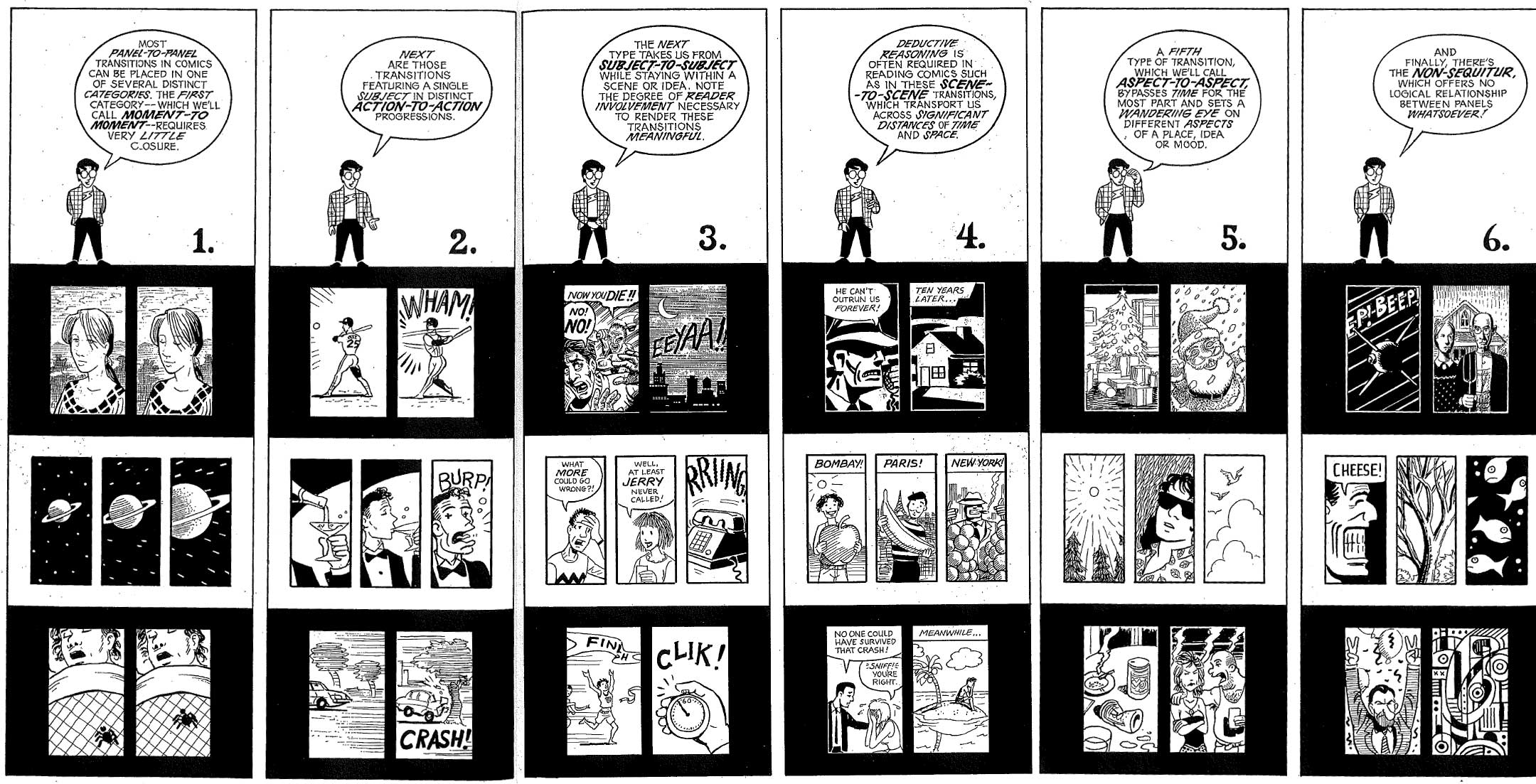
    In musing about this I went back to an old book I have around on how sequential artists communicate in their specific medium: comics. Scott McCloud provides a helpful series of categories that comic artists use in communicating transitions between their panels.

    Scott McCloud on Comic Transitions
    Scott McCloud on Comic Transitions (click for bigger)

    In the book (and elsewhere) he notes that the majority of Western comics reflect a western concept of time, and therefore use action-to-action or scene-to-scene transitions, that are specifically temporally linked. Interestingly Eastern (Japanese/Chinese) cultures tend to also use more subject-to-subject and aspect-to-aspect transitions in communication–as shown here in reflections on Ghost in the Shell: https://www.youtube.com/watch?v=gXTnl1FVFBw

    However, I think that the style of communication with subject-to-subject and aspect-to-aspect transitions is lost on a lot of Western audiences, as they impose a temporally sequential hermeneutic on the panels.

    What I have been wondering about is how this would apply to collections of oral traditions or memories. In many cases when Western trained scholars look at collections of oral tradition, such as the Gospel of John, or the book of Judges, it is presumed that the material must be temporally sequential in some form. But I have a sneaking suspicion that this is a particularly Greco-Roman concept, and that quite possibly the Hebrew/Jewish concept of time is more along the subject-to-subject and aspect-to-aspect line.

    This, I think, would significantly change how we interpret and centre the compilations of collections of oral traditions. The next question though is how does it change?

  • Book Review: Understanding Gender Dysphoria – Mark Yarhouse

    Book Review: Understanding Gender Dysphoria – Mark Yarhouse

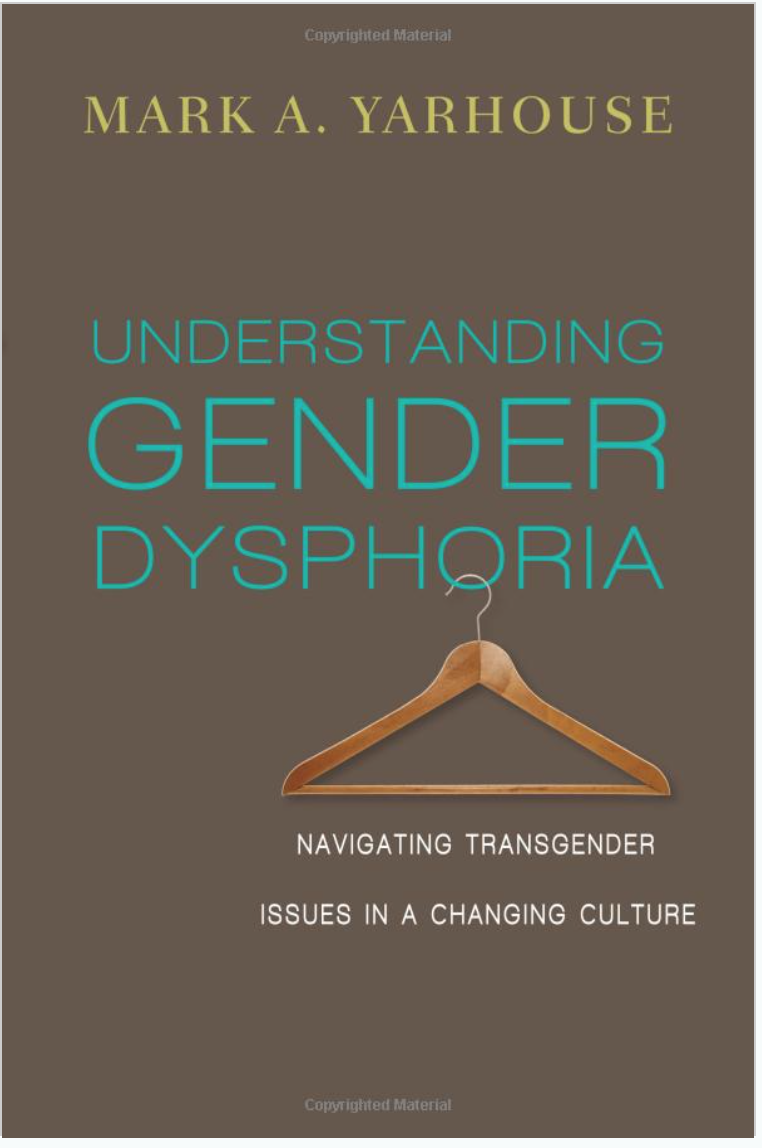
    Understanding Gender Dysphoria
    Mark Yarhouse; 2015. | IVP Academic | 191 pages
    978-0-8308-2859-3

    Gender dysphoria (GD) and transgender issues are currently a hot topic in the media and everyday discourse, thanks in no small part to the topic being thrust into the limelight by celebrity events. However, the current media focus on the topic doesn’t do justice to the complexity of the issue. Especially given the superficial gloss awarded to the psychological and medical aspects. From a psychological perspective, Gender Dysphoria [302.85]—or Gender Identity Disorder (GID) as it was known—has been described in the Diagnostics and Statistics Manual (DSM)—the psychological disagnostic handbook—since version III (1980) under different categories. My own interest in the topic originated with two friends announcing their identification as ‘trans’ and ‘gender identity dissonant’ (yeah, he was a Psych friend) around fourteen years ago. In particular, there has been a lack of helpful, well thought through analysis from a Christian perspective.

    A few books have been released recently, intent on speaking to this modern interest in gender dysphoria, and the first for review is the aptly titled Understanding Gender Dysphoria by Mark Yarhouse. This is a relatively slim book from Yarhouse, given his previous work on Modern Psychopathologies and books on therapy. As with his previous work he writes from a distinctly Christian perspective, although firmly embedded within the psychological discipline as a well-rounded practitioner. As such this book walks the fine line between disciplinary specificity and appealing to a broader audience. The introduction describes this tension well:

    ‘This book invites Christians to reflect on several issues related to these findings [sexual identity research], a broader research literature…and other anecdotal accounts. …I note that as we wade into this particular pool, we are going to quickly be in the deep end, as the topic is complex.’ (p11)

    However it is this tension that makes this book both appealing and somewhat unsatisfying. From my own background I will be reviewing it from both a psychological and a theological perspective, with all the conflict and overlap that this presents.

    Given Yarhouse’s aim of engaging with a broad Christian audience, he starts from a point that is relatively accessible to his audience. However, this accessible starting point is not without its costs, as the first few pages present a steep learning curve. By the second page of the first content chapter Yarhouse is deep within identity theory, chromosomal difference, and introducing a spectrum of gender identification. Although this book may be written for a lay audience it expects a strong degree of education, reflection and analysis. Drawing from his psychological background Yarhouse helpfully differentiates between biological/chromosomal sex, gender identity, and gender role/acts. It is this degree of nuance that is useful in defining aspects of the discussion up front.

    From the first chapter that seeks to appreciate the complexity surrounding gender dysphoria, the second chapter attempts to assemble a useful Christian perspective on the topic. The opening anecdote sets the tone for the chapter by highlighting a limited and closed-minded approach. Throughout this model building Yarhouse draws upon a biblical theology of humanity. From this he proposes three preliminary models for engaging with gender dysphoria: the integrity framework, the disability framework and the diversity framework. While these three frameworks represent usable approaches it is worth noting that of them none will please everyone. Conservative Christians will likely follow after the integrity framework, while abhorring the diversity framework. Similarly staunch supporters of Gender Dysphoria (in the DSM-5 sense) will likely support the diversity model while decrying the integrity framework. Nevertheless these three frameworks are a useful heuristic for approaching the issue. Yarhouse attempts to blend these three frameworks in presenting an integrated model that acknowledges ‘integrity of sex differences,’ drives for ‘compassionate management of gender dysphoria,’ and validates ‘meaning making, identity and community.’ From a theological perspective the anthropology feels quite shallow and I wish it wrestled further with the imago dei and Christian identity. Still this section is a good introduction to the topic, and will be useful even to those with no faith convictions whatsoever, due to the paucity of helpful literature on the topic. [ref]The majority of literature at a lay-level provides brief glosses at best, while more in-depth literature tends towards ‘clinicalisation’ and diagnostic issues.[/ref]

    From this chapter, the book moves onto an investigation of the Phenomenology and Prevalence (Ch4) and Prevention and Treatment (Ch5) of Gender Dysphoria. These chapters are presented from the perspective of the DSM-5 with some minor comparisons with the previous DSM-IV. Here Yarhouse’s clinical practice is set centre stage, with regular anecdotal excurses supporting and highlighting facets of the clinical definitions. Personally from my background in Socio-cognitive psychology, I would wish for more in these chapters on the DSM-5 update to the DSM-IV given the change from Gender Identity Disorder to Gender Dysphoria. This change in the DSM-5 acknowledges the increasing ‘medicalisation’ of the diagnostic criteria, but seemingly sidelines many of the identity issues in favour of focusing on the ‘distress’ involved in the diagnosis. (Koh, 2012) This aspect of identity and gender is the primary area that my inner socio-cognitive psych wants to see addressed and engaged with further from a Christian perspective, especially concerning issues of cognitive dissonance in this sphere.

    The final section of the book envisages a Christian response from both individuals and the broader community (or institution). These chapters seek to cement the theory and specialist praxis within the sphere of Christian community. Ultimately these chapters are likely to be the most useful to the intended audience and have the most impact; my psychological and theological wishes aside. These chapters paint a picture of a church that seeks to love and engage with those who have gender identity concerns. Furthermore, the picture that Yarhouse paints is certainly not the whitewashing of the issue that is commonly presented, nor is it the seemingly random spatters of paint that resemble a church that has not wrestled with these issues. The practical application here will greatly benefit churches and individuals alike.

    Ultimately this book provides an invaluable foray into the issues surrounding Gender Dysphoria/Gender Identity Disorder. It seeks to present a strong case for understanding gender dysphoria from a biblical, theological, pastoral and psychological standpoint. The argument presented will certainly not please everyone, with many conservatives seeing it as capitulating and many progressives seeing it as not radical enough. Personally there are times I wish that certain issues were investigated further, or extricated from the holistic model to be examined individually. However, despite these issues the book makes an important contribution to a sorely neglected issue within the church, and our society, today. All readers, even those who have no faith affiliation, are likely to find this book useful in addressing the basis of their exploration in understanding gender dysphoria.

    I hope that Gill can also review this book from a medical perspective in the near future.

    This book review was originally published on Euangelion and archived here. 

  • Personal Stories and Narrative Identity

    Personal Stories and Narrative Identity

    Identity is a hot topic in our society, with regular articles on ‘How to find your identity’ and what identity means in a shifting culture. Advocates on all sides of the culture, gender and sexuality wars also appeal to identity as a core ideal worth defending. However, from the broad usage of ‘identity’ across these different scopes I get the feeling that many of these ‘dialogues’ are really talking cross-purposes and using different definitions of identity. So how do we think about identity?

    Well one of the helpful ways of thinking about various forms of identity is from the perspective of story telling. Simply put if you were to tell the story of your life how would you go about recounting it? What would you emphasise, and what would you leave out? Which events have shaped your life, and which have fallen by the wayside unnoticed? How do you integrate all the different facets and experiences that you have?

    I stumbled across an article over on the Atlantic that elaborates on some aspects of Narrative Identity from the perspective of telling our own personal story. It is a very useful way of figuring out identity issues, and as we struggle in a world that values identity highly, but doesn’t have a strong grasp on it, it will become invaluable. For Christians the value of Christian identity is similarly core, although just as tenuously grasped.

    This short snippet gives the gist of the article:

    In the realm of narrative psychology, a person’s life story is not a Wikipedia biography of the facts and events of a life, but rather the way a person integrates those facts and events internally—picks them apart and weaves them back together to make meaning. This narrative becomes a form of identity, in which the things someone chooses to include in the story, and the way she tells it, can both reflect and shape who she is.  A life story doesn’t just say what happened, it says why it was important, what it means for who the person is, for who they’ll become, and for what happens next.

    I highly recommend you go and read the rest: http://www.theatlantic.com/health/archive/2015/08/life-stories-narrative-psychology-redemption-mental-health/400796/

    In addition I will continue to be posting things on identity, gender and social identity in the next little while. Many of which will build on some of the concepts that I’m raising now.

    Let me know in the comments what you think of Narrative Identity.

  • Racism, Identity and Identities: a Question of Salience

    Racism, Identity and Identities: a Question of Salience

    Yesterday I had the time to read an excellent long form report from Gary Younge—a British reporter for the Guardian—on his upcoming departure from the United States, where he has been reporting for the past twelve years (http://www.theguardian.com/us-news/2015/jul/01/gary-younge-farewell-to-america). Throughout his report he notes that the overwhelming reason for his imminent departure is the continual subtext of racism that he identifies as present in his environment. Now while there are a swathe of interesting observations and great points in his article, I want to focus on just one aspect: identity and racism.

    In amongst his reflections of the swirling maelstrom of race relations he recounts an exchange he had with his son while walking to school:

    Explaining the complex historical and social forces that make such a dance necessary is not easy at the best of times. Making them comprehensible to a child is nigh impossible without gross simplifications and cutting corners. Once, during our 10-minute walk to daycare, my son asked if we could take another route. “Why?” I asked.

    “Because that way they stop all the black boys,” he said.

    He was right. Roughly twice a week we would pass young black men being frisked or arrested, usually on the way home. He was also four, and until that point I was not aware that he had even noticed. I tried to make him feel safe.

    “Well don’t worry. You’re with me and they’re not going to stop us,” I told him.

    “Why not?” he asked.

    “Because we haven’t done anything,” I said.

    “What have they done?” he asked.

    He had me. From then on we took another route.

    In amongst all of the social issues going on and the complexity of issues on the street, his son has rapidly assessed the situation at hand and identified a core issue: blackness. However this isn’t merely an issue with the melanin content of skin, but of something deeper—an identity of blackness. But some would argue that Gary Younge doesn’t fit the typical stereotype for the target of racial interactions, he is educated, employed and is British, not American.

    Yet here is where I think the crux lies for our modern society. We don’t deal well with identity.

    Within Psychology the stream of questioning that addresses this area is logically called Identity Theory. As Stryker and Burke write:

    Identity theory began with questions about the origins of differential salience of identities in persons’ self-structures and why identity salience may change over time (e.g., Stryker 1968; Wells and Stryker 1988). These questions led to the development of theory concerning ways in which people are tied into social structure and the consequences of these ties for their identities. [ref]Stryker, Sheldon, and Peter J. Burke. “The Past, Present, and Future of an Identity Theory.” Social Psychology Quarterly, no. 4 (2000): 284-297, 287.[/ref]

    Sounds logical enough. Certainly for Younge, the black American population, and every one of us we are each tied into our social structures by our identities. Not just black or white, but father, student, worker, mother, wife, single, married, and many more.

    But in this case what matters is the salience of those identities. When Gary Younge receives an extra frisking at a checkpoint, or Trayvon Martin was shot dead, or any one of the myriad of instances of racial abuse, the identity factor that matters is mainly reduced to one aspect: race. The other identities just don’t matter. All the other identities: gender, education, family relations, are all ignored in favour of the identity that is perceived to be most salient: race.

    In this aspect we can see one of the issues: we are terrible at engaging with multiple identity factors, and seek to reduce them to a single factor. Be it race, sexuality, religion, or many more. In each encounter one identity factor will likely be more salient than the others, and correspondingly others will perceive one factor as more salient than the others in our lives.

    Perhaps then the real solution to racism isn’t how to reduce the identity based discrimination, but how to broaden the salience of the perception of identity factors. This is a topic that I intend to explore further on this blog, keep an eye out.

    For now though, have a read of Gary Younge’s reflections, it is well written, sobering and eye opening: http://www.theguardian.com/us-news/2015/jul/01/gary-younge-farewell-to-america

  • The OODA loop and Cognitive Biases

    The OODA loop and Cognitive Biases

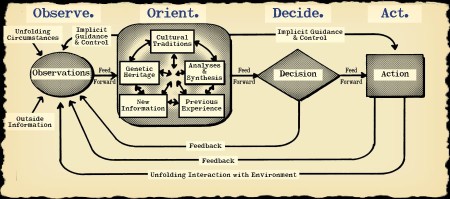
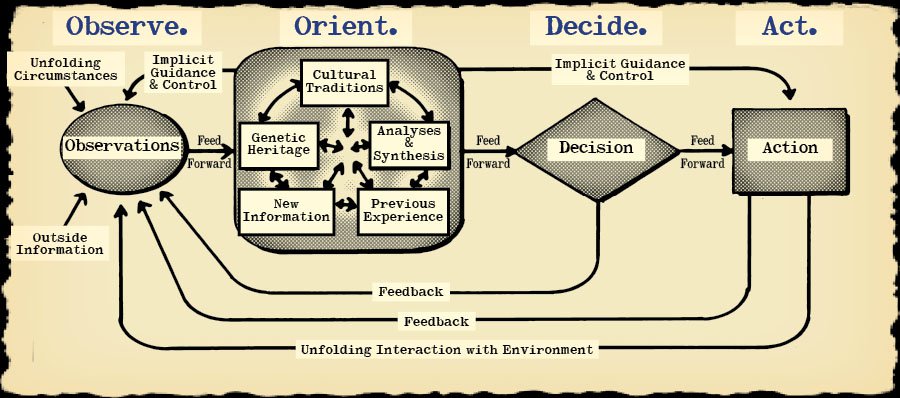
    This morning I gave a brief talk on several of the cognitive biases that have featured on here over the last few months, and their often stormy relationship with our rapid decision making/heuristic processes. During that talk I mentioned the OODA (Observe-Orient-Decide-Act) loop briefly, and a couple of people asked questions over morning tea on the loop. If you aren’t up to speed on the OODA loop then read this good article on it on the Art of Manliness blog here: http://www.artofmanliness.com/2014/09/15/ooda-loop/.  On the drive home I was considering at which levels our intrinsic cognitive biases affect the OODA loop. Using this diagram the Art of Manliness blog,t he majority of our cognitive biases unsurprisingly impact the Orient stage of the process.

    OODA-Loop-2-1

    However, even within this larger model (many other models just have the four stages  in linear or cyclic fashion) there isn’t any neat place for the biases. I would suggest that they act within the Orient stage as a sixth box, affecting the others, and also within the ‘Implicit Guidance & Control’ and Feed Forward stages of the O-O section of the loop. 

    Perhaps we need to do further thinking on where our biases affect our rapid decision making processes. Anyone have a version of the OODA model that incorporates biases tightly?

  • Cognitive Biases: Laptops vs Paper – a useful case study on how to remember things (oh and biases)

    Cognitive Biases: Laptops vs Paper – a useful case study on how to remember things (oh and biases)

    Before we get into the Wednesday series on cognitive biases and fallacies in full swing I thought it would be good to look at a simple case study that not only applies to how we fall into biases unconsciously, but also teaches us a little about how we process information. For a little while now there have been a series of articles floating around the web and popping up from time to time based on the 2014 study by Mueller & Oppenheimer on memory retention with long hand vs laptop note taking. [ref]Mueller, Pam A., and Daniel M. Oppenheimer. “The Pen Is Mightier Than the Keyboard Advantages of Longhand Over Laptop Note Taking.” Psychological Science, April 23, 2014, 0956797614524581. doi:10.1177/0956797614524581.[/ref]

    It’s quite a salient topic to look at with the focus on appropriate methods of pedagogy and learning in our modern society, and the sudden and sharp uptake of computers in the last two decades; thanks to Gordon Moore. Now the majority of these articles focus on the study setup by Mueller and Oppenheimer which looks at memory retention from a variety of TED talks when students were asked to take notes in two different modes: handwriting, and laptop note taking. That study found that students performed better at recognition tasks when handwriting rather than laptop note taking. From this the majority of the articles I have read simply conclude that handwriting is superior to laptop note taking, that in the laptops vs paper debate traditional methods come up trumps.

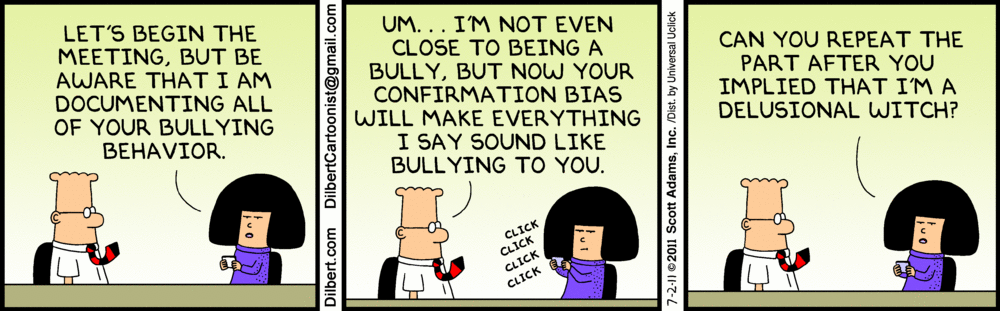
    But is it really? Well before we get into the psychology behind learning and memory, it is worth noting a simple cognitive bias at play here. Confirmation bias. Confirmation bias is a simple bias of taking note of the items or conclusions that fit our existing pattern of beliefs. Simply put the author of most of these articles sub-consciously eliminated the information that disagreed with their presupposition that using laptops in a classroom is detrimental to learning. Notably they ignored the link between laptop use and verbatim transcription, and the corresponding handwriting and synthesis based non-transcription.

    This is just a simple example of the problem with cognitive biases. We simply have a lot of them, and they are excellent at blinding us to alternative data and explanations that challenge our presuppositions. Furthermore there is no malice behind the biases in many cases, which makes it harder to detect in a self-reflective manner. However, being aware of our presuppositions and our predisposition to cognitive biases significantly helps in identifying where our biases are affecting our reasoning and thinking. That is the main reason behind this Wednesday series, if we know more about some of the more common biases it should help us internally defeat them.

    dilbert-confirmation-bias

    Biases aside and back to learning theory, as from the interview in this article: http://www.theatlantic.com/technology/archive/2014/05/to-remember-a-lecture-better-take-notes-by-hand/361478/ where thankfully the reporter has covered the whole of the study, Mueller reflects:

    “We don’t write longhand as fast as we type these days, but people who were typing just tended to transcribe large parts of lecture content verbatim,… the people who were taking notes on the laptops don’t have to be judicious in what they write down.”

    This reflection shows the underlying cognitive working behind the study design of typing vs handwriting. Indeed the claim of better memory retention from handwritten versus typed comes from the level of cognitive engagement, as in thinking and processing, in the memory task. If you are cognitively engaged, such as you are when synthesising material for a paper, then the mode of recording has little consequence (so long as you record something to be able to find it again several months down the track).

    There have been some studies done with low- and high-cognitive load tasks, along with possible low-cognitive load distraction tasks (flipping coins etc) which show its the load of the task that affects retention. Ultimately if you are cognitively disengaged, such as simply transcribing notes for a lecture, then the ‘harder’ cognitive task of handwriting will generally yield better results. [ref]Cf. Piolat et al, 2012; Makany et al, 2008 for cog load; and Schoen, 2012 for contra Mueller & Oppenheimer[/ref]

    wpid-Photo-20141004215054I generally recommend that people take notes in a ‘cognitively difficult’ fashion. What constitutes cognitively difficult varies per person as well, for some it may involve reading around the subject before and after class, while for others it may be formulating interesting questions even if they are not asked in class. While for students who are learning in a non-native language it may actually mean typing verbatim, as the very act of thinking in a non-native language is a hard cognitive task. Indeed some of the students I had last year did this, and subsequently took photos of the whiteboard after class to supplement their notes. As per this amusing anecdote on James McGrath’s blog here. This probably wouldn’t be a useful task for many people with English as a native language, but for them working across a language barrier it helped with both retention and accuracy.
    Realistically for long term memory retention the cognitive load should be high, and the material should be reviewed regularly. I recommend having a high cognitive engagement, even if it is via typing, but review after 24hours and then 3 days and 7 days. Furthermore if the task is able to be used in a synthesis fashion, by perhaps answering questions or writing a personal paper or synopsis on the lecture at hand, then this will reinforce the cognitive loading of the task as well. As from the Mueller & Oppenheimer study abstract the ultimate difference appears to be the act of ‘processing information and reframing it in their own words’ rather than the physical mechanism. So take notes well, and also take note of your cognitive biases.

    Some tools for note taking will be coming up in future Monday posts, and look forward to more cognitive biases on Wednesdays. Tell me what your preferred note taking method is in the comments.