In amongst the many joys of having a baby is the strange re-learning of a whole bunch of nursery rhymes and kids songs that have been floating around somewhere at the back of your consciousness since your own childhood, and then are able to be re-deployed to pacify or entertain a new generation. However, and perhaps this is odd, I frequently find myself applying Barthes essay on the Death of the Author and amuse myself by imbuing these songs with new meaning, usually ones far removed from the simplistic intentions of the rhyme itself. While dual meanings are present in many nursery rhymes, Ring a Ring a Rosey as a commentary on the Plague comes to mind, I generally find it far more amusing to imbue them with meanings that are clearly not the intention of the song.
As such this may be the start of a new series of Philosophical Whimsy, where I will post a range of philosophically odd interpretations of children’s rhymes and stories. Today we will start with one of Caleb’s favourites: Row, Row, Row Your Boat. The base form of this song goes roughly as follows:
Row, row, row your boat,
Gently down the stream.
Merrily, merrily, merrily, merrily,
Life is but a dream.
Row, row, row your boat
Gently down the stream
If you see a crocodile
Don’t forget to scream!
Rock, rock, rock your boat
Gently from side to side
If you see a crocodile
Throw him off the side!
While this simple little ditty has been previously used to ask questions about the existential nature of reality, and the perception of the universe, a la Lewis Carroll at the end of Through the Looking Glass, Star Trek V: The Final Frontier, or Eternal Sunshine of the Spotless Mind; I think that another fitting philosophical framework is provided for us by Karl Marx.
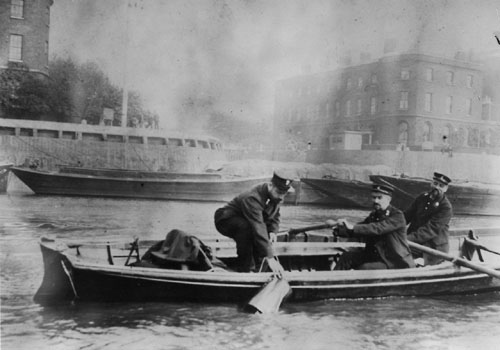
You see this simple children’s ditty is actually propagating a form of cultural hegemony, where the rower in the boat is a member of the bourgeoisie ‘rowing’ upon the stream of the proletariat flowing beneath him. It teaches that life is a dream when supported from below by those who are there to do the work, and that the picture of peacefully bobbing and floating down a river on a summer’s day is a metaphor for ruling over the masses, and bending them to your will. Furthermore, when the hapless proletariat rise up, as represented by the terror of the crocodile rising out of the status quo of the waters, the reality of the oppressive rule and attempts at the proletariat revolt, as evidenced by the screaming of the bourgeoisie at the revolting crocodile. However, this terror is short lived as the revolt is quickly repressed in the third verse. The bourgeoisie rapidly reestablish the dominant class organisation by repressing the proletariat that are seeking to rise up out of the class based status quo, and throw them back into the milieu of ‘the river.’
Thus by the end the short song has gone through the three stages of narrative structure: setup, conflict and resolution. Firstly it sets up the societal expectations of bourgeoisie and proletariat, secondly it introduces the conflict of a proletariat revolt, and finally draws together the repressive resolution of the revolt being quickly quashed.
Thus I present the first in the series: Row, Row, Row Your Boat from a Neo-Marxist Framework.
What do you think? Which song/story/poem should I investigate next?