Category: Opinon

  • Why I am becoming convinced that bifurcated argument on Social Media is detrimental

    Why I am becoming convinced that bifurcated argument on Social Media is detrimental

    During this current ‘not-plebicite’ season I have been asked several times on various social media platforms as to what my position on various aspects of the debate are. But, apart from one more sleep deprived enquiry about jurisprudence, I have decided that I won’t be posting on the topic. More than this, I am becoming convinced for a few reasons that the place for extended debate is not on social media.

    Much of this has come from revisiting some research I was involved in back when Tom was the ‘first friend’ you had, and Facebook was in its infancy (ok, it was 2006). Most of this research involved evaluating hugely expensive telepresence solutions such as the HP Halo system as means of improving computer mediated communication (CMC).

    Two aspects of this research I will briefly consider–and most of this post is drawn from a paper I wrote back in 2015, so some bits are dated, and it is written for academic presentation. On the upside there are footnotes 😉

    Emotional Confusion

    The first aspect is emotional confusion, which is often present within textual communication is often parodied in mainstream media. From the innocently worded text message being read in an unintended tone, to the innocuous social media message eliciting murderous responses. See that classic Key and Peele sketch on text message confusion here (language warning). The situations are so often parodied because they are highly relatable, many, if not all, of us have had similar experiences before. Why? Why does text on a screen elicit such powerful emotive responses, when the same message in other forms barely registers a tick on the Abraham-Hicks. Studies have shown that it is the sociality, or social presence of the medium that provides the best insight into the emotional regulation that can be so diversely represented in CMC.[ref]Antony S. R. Manstead, Martin Lea, and Jeannine Goh, ‘Facing the future: emotion communication and the presence of others in the age of video-mediated communication’, in Face-To-Face Communication over the Internet (Studies in Emotion and Social Interaction; Cambridge University Press, 2011), http://dx.doi.org/10.1017/CBO9780511977589.009.[/ref] Specifically in our case it is the factors of physical visibility, or more precisely, the lack thereof that impact on emotional regulation. When engaging in social interaction an enormous amount of social cues are communicated non-verbally, through facial features and mannerisms. Of course with CMC the majority of these are removed, and those that remain are relegated to the domain of various emoticons and emoji. Notably this devaluation of the majority of non-verbal social cues serves to reduce the salience of social presence, and therefore the corresponding salience of the interaction partner. It is this effect that has led several companies, including my previous employer, to invest millions into virtual telepresence systems in an attempt to mitigate the loss of visual cues and the salience of interpersonal interaction.

    What does that mean? Well in essence the vast majority of social cues for interpersonal interaction are removed on social media, and it is this context that assists in evaluating the emotional content of the message. From a social identity perspective Spears et al. found that within CMC based interactions both in-group and out-group salience and bounds were profoundly strengthened, and inter-group conflict was heightened.[ref]Russell Spears et al., ‘Computer-Mediated Communication as a Channel for Social Resistance The Strategic Side of SIDE’, Small Group Research 33/5 (2002): 555–574.[/ref] Furthermore, the degree of expression of these conflicts was also heightened along with the corresponding in-group solidarity expressions. Essentially, the majority of CMC interactions serve to strengthen positions, rather than act as bridges for meaningful communication. For more on that see my post a while ago on the Backfire Effect.

    Emotional Regulation

    The other side of this comes in terms of emotional regulation. On this Castella et al. studied the interactions found between CMC, video conferencing and face-to-face mediums and interestingly found that not only is there a heightened level of emotive behaviour for a non-visual CMC interaction.[ref]V. Orengo Castellá et al., ‘The influence of familiarity among group members, group atmosphere and assertiveness on uninhibited behavior through three different communication media’, Computers in Human Behavior 16/2 (2000): 141–159.[/ref] But also found that the emotive behaviour was significantly negatively biased. So it is not merely a heightening of all emotions, but as Derks et al also observed it ‘suggest[s] that positive emotions are expressed to the same extent as in F2F interactions, and that more intense negative emotions are even expressed more overtly in CMC.'[ref]Daantje Derks, Agneta H. Fischer, and Arjan E. R. Bos, ‘The role of emotion in computer-mediated communication: A review’, Computers in Human Behavior 24/3 (2008): 766–785.[/ref]

    Ultimately when people are emotionally confused, in low physical presence environments, they tend to react emotionally–and predominantly negatively. Hence, the majority of emotional expressions that will be found in CMC will be negative reactions from the extremes of any dialectical spectrum.

    What is the outcome of all of this then? Well simply put the very mechanism of computer mediated social media interacts with our own natural cognitive biases and produces an outcome that is predisposed towards burning bridges rather than building them. And this even before any considerations of social media echo chambers have been made (thats another post for another time).

    Where to?

    Sure, there will be always a plethora of anecdotal counters, but given human predisposition I think there is a better way. For me that better way is in person, in a setting where we can explore any conversation at length. So, if you want my views on the majority of controversial topics out there, come and talk to me over a coffee or beer.


  • Racism, Identity and Identities: a Question of Salience

    Racism, Identity and Identities: a Question of Salience

    Yesterday I had the time to read an excellent long form report from Gary Younge—a British reporter for the Guardian—on his upcoming departure from the United States, where he has been reporting for the past twelve years (http://www.theguardian.com/us-news/2015/jul/01/gary-younge-farewell-to-america). Throughout his report he notes that the overwhelming reason for his imminent departure is the continual subtext of racism that he identifies as present in his environment. Now while there are a swathe of interesting observations and great points in his article, I want to focus on just one aspect: identity and racism.

    In amongst his reflections of the swirling maelstrom of race relations he recounts an exchange he had with his son while walking to school:

    Explaining the complex historical and social forces that make such a dance necessary is not easy at the best of times. Making them comprehensible to a child is nigh impossible without gross simplifications and cutting corners. Once, during our 10-minute walk to daycare, my son asked if we could take another route. “Why?” I asked.

    “Because that way they stop all the black boys,” he said.

    He was right. Roughly twice a week we would pass young black men being frisked or arrested, usually on the way home. He was also four, and until that point I was not aware that he had even noticed. I tried to make him feel safe.

    “Well don’t worry. You’re with me and they’re not going to stop us,” I told him.

    “Why not?” he asked.

    “Because we haven’t done anything,” I said.

    “What have they done?” he asked.

    He had me. From then on we took another route.

    In amongst all of the social issues going on and the complexity of issues on the street, his son has rapidly assessed the situation at hand and identified a core issue: blackness. However this isn’t merely an issue with the melanin content of skin, but of something deeper—an identity of blackness. But some would argue that Gary Younge doesn’t fit the typical stereotype for the target of racial interactions, he is educated, employed and is British, not American.

    Yet here is where I think the crux lies for our modern society. We don’t deal well with identity.

    Within Psychology the stream of questioning that addresses this area is logically called Identity Theory. As Stryker and Burke write:

    Identity theory began with questions about the origins of differential salience of identities in persons’ self-structures and why identity salience may change over time (e.g., Stryker 1968; Wells and Stryker 1988). These questions led to the development of theory concerning ways in which people are tied into social structure and the consequences of these ties for their identities. [ref]Stryker, Sheldon, and Peter J. Burke. “The Past, Present, and Future of an Identity Theory.” Social Psychology Quarterly, no. 4 (2000): 284-297, 287.[/ref]

    Sounds logical enough. Certainly for Younge, the black American population, and every one of us we are each tied into our social structures by our identities. Not just black or white, but father, student, worker, mother, wife, single, married, and many more.

    But in this case what matters is the salience of those identities. When Gary Younge receives an extra frisking at a checkpoint, or Trayvon Martin was shot dead, or any one of the myriad of instances of racial abuse, the identity factor that matters is mainly reduced to one aspect: race. The other identities just don’t matter. All the other identities: gender, education, family relations, are all ignored in favour of the identity that is perceived to be most salient: race.

    In this aspect we can see one of the issues: we are terrible at engaging with multiple identity factors, and seek to reduce them to a single factor. Be it race, sexuality, religion, or many more. In each encounter one identity factor will likely be more salient than the others, and correspondingly others will perceive one factor as more salient than the others in our lives.

    Perhaps then the real solution to racism isn’t how to reduce the identity based discrimination, but how to broaden the salience of the perception of identity factors. This is a topic that I intend to explore further on this blog, keep an eye out.

    For now though, have a read of Gary Younge’s reflections, it is well written, sobering and eye opening: http://www.theguardian.com/us-news/2015/jul/01/gary-younge-farewell-to-america

  • Exhaustion is Not a Status Symbol

    Exhaustion is Not a Status Symbol

    Came across this helpful article today that reflects on some of the topics covered in the skills series. http://www.washingtonpost.com/national/exhaustion-is-not-a-status-symbol/2012/10/02/19d27aa8-0cba-11e2-bb5e-492c0d30bff6_story.html

    In this interview with researcher Brené Brown, she looks at some of the outcome from her research on leadership and busyness, and has some great insight into some of the processes behind our obsession with work.

    Let me quote briefly from the article, Brown writes:

    ‘Crazy-busy’ is a great armor, it’s a great way for numbing. What a lot of us do is that we stay so busy, and so out in front of our life, that the truth of how we’re feeling and what we really need can’t catch up with us.

    and pertinent to the last blog post in our series:

    One of the things that I found was the importance of rest and play, and the willingness to let go of exhaustion as a status symbol and productivity as self-worth. A lot of people told me that when they put their work away and when they try to be still and be with family, sometimes they feel like they’re coming out of their skins. They’re thinking of everything they’re not doing, and they’re not used to that pace.

    Do go read the article, here is the link again: http://www.washingtonpost.com/national/exhaustion-is-not-a-status-symbol/2012/10/02/19d27aa8-0cba-11e2-bb5e-492c0d30bff6_story.html

    It is a really helpful reflection.

    H/T Shane Rogerson.

  • The rise of Edutainment, and its implications.

    The rise of Edutainment, and its implications.

    I came across this little article recently from the NY Times, on the prevalence of the broader general public turning to education based entertainment for their downtime. Rather than merely switching off and not engaging their faculties. http://www.nytimes.com/2015/03/20/education/turning-to-education-for-fun.html

    Let me quote from the article:

    What does it mean when people who can afford to spend their time however they please hunker down in front of their flat screens to watch theoretical physicists or experts on other subjects lecture for hours?

    Entertainment values have come to dominate many aspects of life, but another trend has been playing out, too. Call it the academization of leisure. It can be found in the live-streaming TED Talks lectures, the Great Courses, learning vacations, podcasts, science centers, brain-training games and retirement communities like Lasell Village in Newton, Mass., whose residents must complete “a minimum of 450 hours of learning and fitness activity each calendar year,”…

    I find this really fascinating, certainly the increase in ‘edutainment’ or more positively framed, the rise of a broadly educated populace, is appealing. In many ways having a broader education and knowledge base helps people think from their own frameworks, and analyse perspectives better. It should also help the general public engage in better and justifiable public discourse, rather than unsubstantiated positions.

    However, on the flip-side it also leads to a rise in the outward exemplification of the Dunning-Kruger effect, where a little knowledge actually hinders engagement with longer term learning and education at a broader level.

    Nevertheless, I am still optimistic about this trend, and will be interested to see how it plays out. Thoughts? How do you see it working in your context?

  • Perfection and Excellence – What do we strive for?

    Perfection and Excellence – What do we strive for?

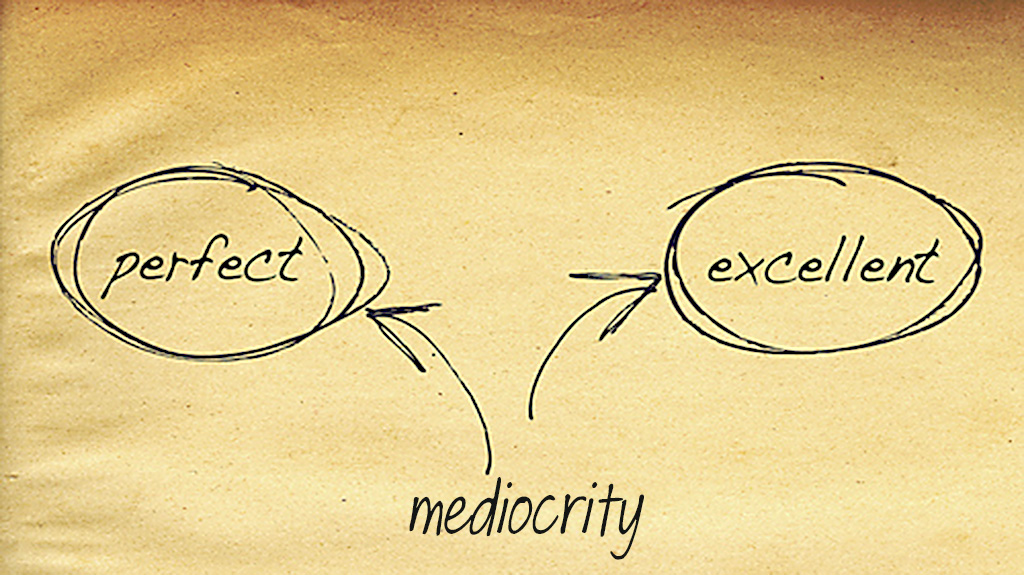
    ‘Perfect’ it seems has become a dirty word today, and even amongst Christian circles, which I find exceedingly curious. On Sunday I preached at my church (St Matt’s Prahran) on the line in the Lord’s Prayer ‘your will be done, on earth as in heaven’, as part of our series on the Lord’s Prayer. In the sermon I referred to Romans 12:2, where Paul speaks of discerning the will of God, and specifically describes it as: ‘will of God, what is good and acceptable and perfect.’ (Rom 12:2). As part of this I spoke about striving for, and conforming our will to God’s perfect will, and the implication for this as we work out God’s will in our life is that we too need to be striving for perfection and holiness in enacting that perfect and holy will (c.f. Phil 2:12-18). This suggestion was met with significant consternation and challenge, from a variety of angles, and at one level perhaps I shouldn’t have been surprised. Yet in many ways I am, and let me explain why.

    Romans 12:2 describes God’s will as ‘good and acceptable and perfect’ and the Lord’s Prayer calls us to pray that ‘your will be done’, essentially through us as God’s hands and feet in the world. Although we may not perceive or understand the perfection of God’s will from our perspective, scripture still affirms its perfection. However, certainly ‘Perfect’ has some different connotations and excess baggage in our modern world, but it doesn’t mean that it is bereft of meaning. To translate it as anything less than ‘perfect’ in the traditional sense is translationally and theologically doing ourselves a disservice. Rather it is up to us to redefine, or in this case restore the definition of the word, through our understanding and speaking about of the perfection of God and his will.

    But as people we are certainly not perfect, a quick scan of the news headlines shows in stark contrast our imperfection and failings. So how do we, as imperfect people, do the perfect will of God? Firstly I think we must acknowledge that even if we strive for perfection we won’t achieve it. Most, if not all, of our human endeavours, no matter the high quality and strivings for perfection, fall short in many ways. So many ways that we even have coined an -ism for it: ‘perfectionism.’ Now this certainly has its own set of failings and ‘costs associated with consistent failure to meet the high standards demanded.’ It is a trap we can fall into, and a danger we must avoid. However, if we are to be doing the will of God this doesn’t mean we don’t strive for the perfection of God’s will.

    The danger of not aiming for the perfection of God’s will was keenly noted by Francis Schaffer in his book Addicted to Mediocrity: ‘The modern Christian world … is marked, … one outstanding feature, and that is its addiction to mediocrity.’ While he was focused on the realm of arts and culture, his astute observation applies further afield. Often Christians so keenly recognise our human failings that we don’t strive for the perfect will of God, and settle for something far less than that. A mediocrity that only minimally glorifies God in the world.  A useful book I have read on this recently was Excellence: The Character of God and the Pursuit of Scholarly Virtue by Andreas Köstenberger. Although it focuses mainly on academic scholarship, the virtues he writes about are applicable to all walks of life.

    So how do we strive for the perfect will of God, while balancing that with our own human failings? Firstly I think we strive for God’s perfection, but in the full knowledge that now we will only achieve excellence. We may have to cap our expectations and endeavours so that we don’t fall into human perfectionism, all the while keeping in front of us the vision of that future perfection. It means more than just getting by, or ‘P-s make degrees’, or just scraping over the line. Secondly, it also means that we don’t create a type of ‘works righteousness’ based cultic practice around our personal perfection. Ultimately our perfection is found in Christ, not in our own endeavours, as it is Christ who has saved us, not by our own works. Finally, those good works prepared for us to do, we should do them to the best of our ability, eschewing mediocrity, praying that God’s perfect will be done, and working from that perfect script, even if we know we will only achieve excellence on this earth.

  • ‘Get the F*** off OUR roads’ – Motorists, Cyclists and Intergroup Bias

    ‘Get the F*** off OUR roads’ – Motorists, Cyclists and Intergroup Bias

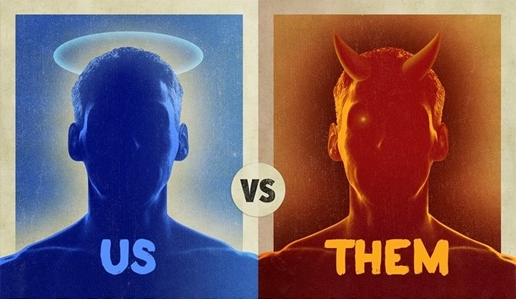
    In Australia it is that time of year again… summer. Where the weather gets nicer, and in Adelaide the Tour Down Under arrives in town. Now unsurprisingly this annual event sees the  seasonal rise of visible cyclists, and of course accompanying it the usual diatribes and vitriol flashing about in all directions over the topic. There are many directions that these ‘conversations’ inevitably go in, be it down the path of licensing, or psychopathic motorists, or apparent flagrant disregard for the law… from both sides. However, none of these are what I want to address in this post. Rather, I think it is helpful to look at some of the underlying factors within the cyclist/motorist interaction, specifically that of group biases and Social Identity Theory (SIT). It is especially helpful in this case because the interaction is relatively arbitrary and crosses many other more complex social bounds in a relatively equal fashion. This helps as it acts as a type of microcosm or case study that can inform much more complex interactions.

    ingroup-outgroupFirstly, an exceedingly brief overview of SIT and some of the biases at play. SIT was formulated by Henri Tajfel and John Turner in the late 70s and early 80s as a means of exploring intergroup relations. [Ref]Tajfel, Henri, and John C. Turner. “The Social Identity Theory of Intergroup Behaviour.” In Psychology of Intergroup Relations, edited by William G. Austin and Stephen Worchel. Chicago, Ill: Nelson-Hall, 1986.[ref] Primarily SIT seeks to define groups and their relations such that there is a form of predictive capability of the interactions between the groups. At a secondary level it allows for a structured methodology for analysis of intergroup relations and conflict, the primary use for it in this situation. Since SIT’s proposal has been augmented by a series of papers that have investigated how SIT may be used to elucidate further aspects of intergroup interaction. Of particular relevance here is the work by Struch and Schwartz. [ref]Struch, N., and S. H. Schwartz. “Intergroup Aggression: Its Predictors and Distinctness from in-Group Bias.” Journal of Personality and Social Psychology 56, no. 3 (March 1989): 364–73.[/ref] There they note some of the factors that impact upon intergroup aggression; quoting from their abstract:

    Perceived intergroup conflict of interests, the postulated motivator of aggression, predicted it strongly. The effects of conflict on aggression were partially mediated by 2 indexes of dehumanizing the out-group (perceived value dissimilarity and trait inhumanity) and by 1 index of probable empathy with it (perceived in-group–out-group boundary permeability).

    In effect they name ‘intergroup conflict of interest’ as the primary motivator, and impacted by the dehumanisation of the out-group and the permeability of the boundaries. Finally in another study by Mackie et. al. they found significant application of the fundamental attribution error within groups, novelly naming this ‘group attribution error.’ [ref]Mackie, Diane M., Scott T. Allison, and David M. Messick. “Outcome Biases in Social Perception: Implications for Dispositional Inference, Attitude Change, Stereotyping, and Social Behavior.” Advances in Experimental Social Psychology – ADVAN EXP SOC PSYCHOL 28 (1996): 53–93. doi:10.1016/S0065-2601(08)60236-1.[/ref] In lieu of the longer post on FAE to come the simplified understanding is such that in-group members characterise out-group members by individual actions (and usually those that serve the in-group confirmation bias).

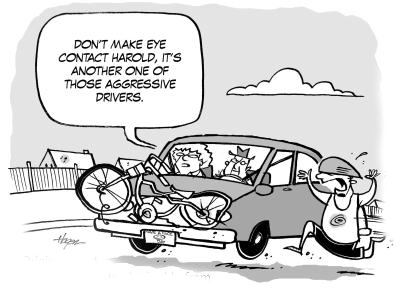
    Aggressive Motorist CartoonSo how does this impact upon our little case study? Well if the motorist/cyclist dynamic is dichotomised between cyclists and motorists, as the debates ensue, then SIT can be utilised in looking at the intergroup interactions. Addressing the first of the sub factors from Struch and Schwartz, even though the permeability between groups is incredibly high, with many bicycle riders owning cars, and obviously vice-versa, the perceived permeability is exceedingly low. I would suggest that this is due to the mutual exclusivity of the means of transport, its impossible to operate both at the same time, and only a marginal percentage of cars are seen with bike racks. Furthermore the proliferation of the ‘ownership’ of the roads, as highlighted by the large number of aggressive claims to ‘our’ roads from both sides serves to further delineate the groups.

    The second of the Struch and Schwartz characteristics is that of dehumanisation of the out-group, and this is extremely easy to see in the language used in the debates. Via that erudite medium of Facebook I have seen a plethora of invectives such as ‘death cage operators’, ‘lycra scum’, etc with many more that aren’t worth repeating. All of these serve to remove the person from the out-group, and replace them with a dehumanised label. For an even more prevalent example of this, see the American propaganda during the Vietnam war dehumanising the Vietnamese as monkeys (c.f. the work of Albert Bandura on the same). The last of Struch and Schwartz’ characteristics is that of conflict of interests, which in this case is the usual and predictable conflict over space on the roads.

    Mackie’s applications of group attribution error can be relatively easily seen as well with the anecdotal evidence base significantly outweighing any statistical or Bayesian measures. The usual argument appears: ‘I saw a cyclist breaking the law, therefore all cyclists break the law’ or ‘I was harassed by a road Cyclist Denigrated Cartoonraging driver once, therefore all motorists are out to kill me.’ As with most, if not all, attribution biases there is an element of truth there, but little to no statistical significance or repeatability. So these anecdotal ‘evidences’ serve only to strengthen the out-group discrimination bias, and reinforce the in-group bias. Furthermore the inverse is true, motorists don’t self-characterise by those ‘hoons’ or criminals who kill people in accidents, and neither do cyclists self characterise by those who run red lights and knock down pedestrians. The confirmation and attribution bias flows in both directions.


    Finally it is worth acknowledging that there are a plethora of other factors at work, from confirmation biases to clustering illusions, empathy gaps and many more. However, the majority of these serve to reinforce existing group boundaries, rather than dissolve them, so while they contribute to the bigger picture it is in terms of detail rather than applicability.

    So what can be done with this situation? It is all well and good to use SIT to describe an intergroup interaction, but as with many aspects of academia it is hollow if left there. One of the advantages of describing the interaction in this way is that participants in the groups get to see how their biases shape the interaction as a whole. This is where education comes into play. While educating cyclists that not all motorists are homicidal psychopaths, and educating motorists that not all cyclists are flagrantly law-flaunting dilettantes will not remove those who are genuinely homicidal psychopaths and flagrant law-flaunters, it does break down the boundaries somewhat.

    This breaking down of the boundaries is important on two levels, firstly as it dismantles some of the conflict, and secondly as it removes places for those who genuinely are psychopathic or law flaunters to hide within their respective in-groups. I note that the Motorcycling Victoria is doing significantly more on the education front than I have seen the cycling and motoring groups do in recent times. See this video here: https://www.youtube.com/watch?v=u3mWQJ9UOm8 There are many more applications of SIT in identifying biases and breaking down the stereotypes, such as serving to re-humanise the participants in each in-group and many more that I don’t have the time to explore here now. Suffice to say that proper analysis of the intergroup bias and interactions helps to inform efforts to resolve issues. But I would also suggest that without a good understanding of the group dynamics at hand there will be little traction in the plethora of discussions to be had.

    Lastly, its worth noting that while the cyclist/motorist example is a salient one for many, myself included as I span both groups (disclaimer: motoring AND cycling enthusiast), it can readily be extrapolated to other intergroup conflict. The other swirling debates over ‘Islam vs the West’, various racial disputes, Republican v Democrat, Liberal vs Labor, liberal vs conservative, religious vs atheist, and many more all find application within the realm of SIT. Furthermore they all can be assisted in better conversation and possible resolutions [ref]Many resolutions are likely impossible, but at least not debating over useless topics[/ref] to various degrees by identifying the intergroup conflicts and seeing the origins and reinforcement of the biases present.

    What do you think? Weigh in on the comments below.

  • Charlie Hebdo, terrorism and identity

    Charlie Hebdo, terrorism and identity

    Some will probably know that I have been interested in issues of identity formation, adoption and social identity for quite some time now. While this is not the time or place to engage in a long discussion of the factors of Tajfelian Social Identity Theory, I think that the issues we are facing now interact strongly.

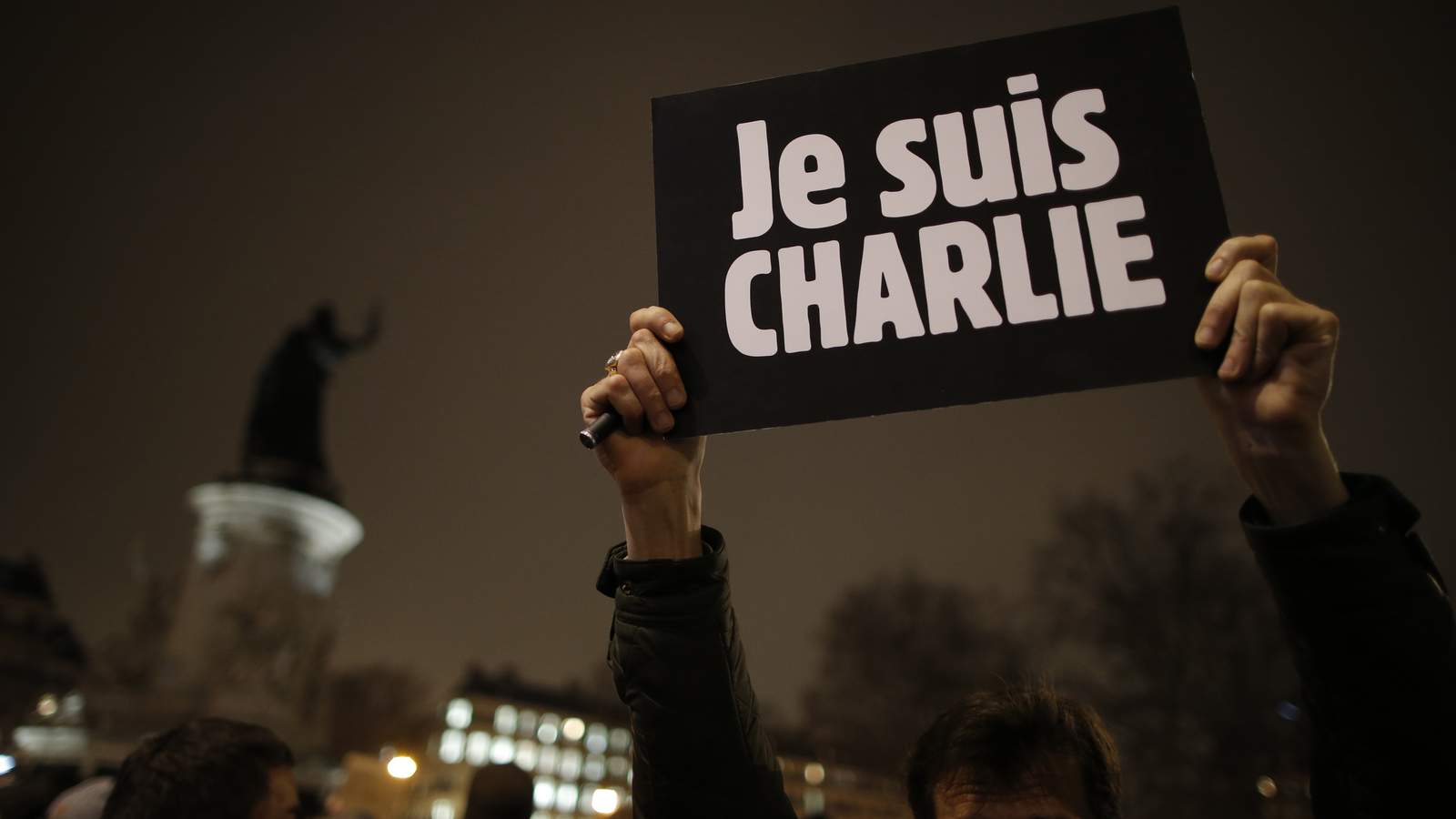
    Many of the statements and  rhetoric surrounding the Charlie Hebdo and subsequent incidents have focused strongly on a type of positive-negative asymmetry, where pejoratively denouncing the other while reinforcing ingroup bias comes as a priority for group identification. The problem is that these reinforcing mechanisms tend to make constructive discourse harder to engage in, as it is driving at the heart of the group identification. The rhetorics of #jesuischarlie, #jesuisahmed and the ‘We don’t condone such actions’   foster such identity dichotomies.

    However, I am somewhat heartened by articles such as this one from the Telegraph: http://www.telegraph.co.uk/news/worldnews/europe/france/11332535/We-think-the-Paris-terrorists-were-offended-by-Charlie-Hebdos-satire.-What-if-were-wrong.html

    Instead, they [extremists] merely pretend to be offended by cartoons, in order to give themselves a pretext to commit murder. Murder so horrifying, on a pretext so unWestern, that non-Muslims – blinded by grief and rage – turn on Muslims. Blame them. Persecute them. Burn their book, attack their mosques, threaten them in the street, demand their expulsion from Western societies. Actions that, in turn, scare Western Muslims, isolate them, alienate them. And thus drive some of them to support – and even become – terrorists.

    While I think that the strong reaction to ignore religious and social differences in many of these articles (this one trends in that direction) is unhelpful. I do think that considering and engaging with some of the underlying social and identity motivating factors, especially in a diachronic fashion, is required. Perhaps this is a good place to start…
  • A Cult of Personality – whose persona to follow?

    A Cult of Personality – whose persona to follow?

    Originally I wasn’t going to write on this topic, but this morning I was reading an old friend’s blog and started thinking about the situation, and these thoughts became notes, and became a small comment, and now this brief post. So the logical starting point for this post is here: http://www.dylanmalloch.com/2014/10/mark-driscoll-theology-vs-behaviour.html and with Mark Driscoll’s sudden resignation from Mars Hill (Christianity Today).

    Many of the words written on Driscoll’s sudden resignation have focused on specific aspects of his life, ministry, theology or church, but while these are all good perspectives to explore, I’m not convinced that these explorations will go much further than skin deep. Mark DriscollWhile there are a plethora of facets, historical and present, theological and personal, and many more that serve to build a bigger and stronger picture of the situation at hand, but one aspect I think has been overlooked a bit. I think that it is not the theological credentials or creeds that is at stake here, rather it is more about the cult of personality that was built up around Driscoll, and that is certainly not unique.

    Rather we see the same sort of implosions and resignations across a wider range of the church including many non-conservative Reformed Evangelicals. Issues with various pastors and leaders are rife in the wider church, and while snippets are heard briefly, they certainly don’t make national news headlines. I think that the case with Mars Hill got significant air time because traditionally conservative evangelical Christianity has followed the example set forth in 1 Corinthians and has rejected cults of leadership in the same fashion that is found in Paul’s admonition.

    However, our society as a whole certainly has not shied away from following after leaders and personalities, and perhaps the best example of this is MTV and the plethora of people following after the strong personalities in the public space. The cult of personality  appears intrinsic in human nature, and I think it probably reflects the middle category of Maslow’s hierarchy of needs: Love and Belonging. These needs are further intensified by interacting with strong social identity markers in an ever splintering social world, and seeking an in-group to feel at home with.

    But I think just as the Church is in the world, it imbibes this ever nervousness over social identity and so we too can be just as obsessed with status and and personality as early Corinthian church was. Just as the Corinthian’s were divided over Apollos vs Paul vs Cephas (1 Corinthians 1:12) so too the modern church follows after Driscoll, Calvin, Dollar, Houston etc etc. Across the church as a whole there are strong tendencies towards cults of personality, and driven by a complex web of social identity construction and formation. While certainly a cult of personality needs a personality to follow after, I think there is also a strong onus on those sitting in the pews, the general congregation, and the Church catholic.

    Perhaps a few illustrations are warranted. The cult of personality is easiest to see in the case of Driscoll and the wider range of mega-church preachers, and even easier again to see with itinerant preachers such as Creflow Dollar. But I was a bit stunned this week to find that the cult of personality doesn’t actually need a living breathing person to follow after.

    This week I discovered a 10626606_726511277385898_8876200350693483732_nnasty little practiced called ‘grave sucking’, basically involving the veneration of grave sites of various Christian leaders. Simply put these people head out to a grave, and believe that they can ‘suck’ special blessings from the corpse of the dead. See the thumbnail for an example. A cult of personality without even a person to physically follow.


    Of course there is the theologically sanitised version of this, where people follow theological tradition in such a slavish way that they may as well be physically following the individual in question. Hyper-Calvinists, hyper-Lutherans etc. Arguably the differentiating factor here is disagreement. While I follow the reformed Anglican tradition, and i think highly of Calvin’s theology, I occasionally disagree with his interpretation or application of scripture. This can be extrapolated out slightly, where it is not only a personage to follow, but an ideological slavishness. One recent example of this has been the engagement and accusations of ‘going Catholic’ towards a swathe of Reformed Protestant scholars  that sits somewhere between confusing and bizarre. I wont write more on this, but simply refer to Mike Bird’s blog article on the topic: http://www.patheos.com/blogs/euangelion/2014/10/setting-the-australian-church-record-straight-about-justification/

    One interesting indicator I found recently on the health of wider Anglicanism on this topic has been the responses to the admission from Justin Welby the Archbishop of Canterbury over the interaction between faith and doubt. http://www.theguardian.com/uk-news/2014/sep/18/archbishop-canterbury-doubt-god-existence-welby Interestingly there has been significant backlash from some in the church who believe that leaders should be infallible, and certainly not doubting anything whatsoever. When a leader admits that they are not on the pedestal that they have been set upon, then they are set on by the swathes of Facebook and Twitter commentators. Perhaps the less said about that the better.

    The final point I will adduce is the astute and active denial of the cult of personality that some leaders, such as Tim Keller, have engaged with. Keller commonly refuses to pose for selfies, chooses to speak less on stage than others if possible, and his appearance here in Australia this year was likely a one off event. His choice to actively undercut any cult of personality as much as he can certainly says something about the human tendencies at play here.

    So if these psychological and social issues are at play then what can be done to move forward here. In our sinful state I think that it is likely folly to be attempting to change our intrinsic psycho-social disposition. However, I think that there is one aspect to our social identity formation, and desire to follow after a personality that can be recognised. Namely that we do have a personality to follow, one who was a living breathing fleshly person, and indeed is so now. In the end the only persona that we should be following of is the second person of the tres persona una substantia. As Christians our cult of personality should be, must be, and is centred around Christ. It should be psychologically cathartic, socially comforting, and strongly identity building.

    christcentered

  • Writing, Jazz, Plagiarism and Improv – Jazz as a metaphor for academic writing.

    Writing, Jazz, Plagiarism and Improv – Jazz as a metaphor for academic writing.

    Copyright: Unattributed Creative CommonsAcademic writing, Jazz, Plagiarism and Improv. You might be wondering at what these concepts have in common, and why they should be written about in a single article. Well last week I had the opportunity to attend a network meeting-come-book launch-come-philosophy lecture by Bruce Ellis Benson talking about his new-ish book Liturgy as a Way of Life. “Ugh, are you serious” – I can hear the groans already. What does Liturgy have to do with anything? Well i wont be directly addressing the liturgy part of the lecture tonight, except to say that it’s not quite as you may think.

    Instead one of the parts that piqued my interest was Benson’s extensive use of musica as a philosophical framework for the explanation of life, amongst many other things. From this framework he posits a veritable bevy of comparisons between Jazz and life, of which I will only look at one in this post: Improv. Benson argues that while God is the originator and creator of the world, we are instead re-creators, taking what has been already created and reimagining it and recreating it into something new. While Marx and Hegel may have argued that everything has been done already, in the same vein as Ecclesiastes 1:9; Benson instead argues that we take the original strains of musica and reinterpret them as a form of Jazz-like improvisation i.e. Improv. In such a way we stand on the shoulders of giants and play the tune that has come before but in a slightly different way.

    Now for this metaphor to work it is worth noting a few things about Jazz music. Firstly, despite the seemingly cacaphonic nature of an improv within the piece it inevitably picks up on the theme laid out earlier in the piece, and ‘riffs’ off it. In this way the improv soloist (or band) are taking what has already happened and turning it into something a little bit new. Secondly, it is not the wholesale replacement of the original piece. Despite how different the improv may seem there is acknowledgement of what has come before, and cues for what is to come afterward. In this way an improv cannot simply stand on its own as a whole piece, it is shallow and thin; and the piece is somewhat hollow without that corresponding improv.

    But what does this have to do with academic writing? – I hear you ask; well I offer this corollary. One of the aspects of academic essay writing that the students who come and see me for first year tutoring commonly wrestle with is how to present ‘novel’ thoughts within their essays. They rebel at the concept that an essay could be simply the regurgitation of someone else’s ideas, organised into a pithy 2000 words; and I would say rightly so. Nevertheless the balance between acknowledging the supports for your argument and simply depositing it onto the page with a citation is a fine balance at times. [ref]I know that the comparison between classical music and regurgitation can be made here. However, even in classical music I think there is some scope for individual interpretations.[/ref] Here is where I think the metaphor of Jazz plays into the equation: writing an academic essay is somewhat like performing a Jazz improv. When you are writing an academic piece you are constantly acknowledging the shoulders on which you stand, those who have run the race beforehand and set benchmarks, the explorers who have charted their little bit of new territory and laid out some of the markers. Rare is it that a paper stands on its own, and in the vein of Star Trek: boldly goes ‘where no man has gone before.’

    However, a good academic essay should not be simply regurgitating the previous information, but should be teasing out the implications, the differences in individual perspective  that make previous arguments sing more brightly, or lend weight to a specific train of thought over another. This is the improv part, the offering of a different interpretation, nuances here and there, extending the bounds of the sphere of research wider. It is not simply slavish wholesale copying which is realistically plagiarism, even if it is cited. But rather seeing the intricacies of the arguments that have come before hand, watching the notes bounce off each other, and recognising the gaps that can be filled, or the silences that can be left, and working with those. Sure at an introductory level the author is bound to find that someone else has thought of their lightbulb before, or shares the same interpretation of a text as them. But even there the nuance is different. In the indomitable words of Monty Python ‘you are all individuals’, and as such the individual differences of our perspectives can be brought to bear in an essay, of any level.

    Perhaps the best way to sum it up is by using Bruce Ellis Benson’s own words:

    Just like in Jazz improv, one may borrow an idea but one must return it with interest.


  • How to engage in productive public discourse?

    How to engage in productive public discourse?

    Most of this post has been sparked from the Q and A program on Monday night on the ABC; so while this post should make sense even if you haven’t seen the program, it will probably make more sense after watching it or reading the transcript. You can find that here: http://ab.co/1lQzstT

    After the program John Dickson on his Facebook wall asked the question on his wall (https://www.facebook.com/john.dickson.9406417/posts/10153072863099447) about whether there are constructive methods of discussing conflicting truth-claims (my paraphrase). The part of the show that sparked this off was the perception that John Stackouse,  speaking relatively objectively on the history and ideology of Islam was being ‘judgemental’ as he was expressing views, and arguably accurate ones, that contradicted another panellist’s own conception of the same issue. Unfortunately the comments on John’s post have diverged off on a tangent, and haven’t really addressed the question of public discourse.

    When discussing theories or data, it is relatively easy to find stable and consistent bases for discourse on the matter. Maths for example has a fairly long and standard ‘language’ and agreed set of norms. Such that when one theory is set against another, the playing field is set and comparisons are able to be made. However, in more subjective environments the discourse is far from clear, for example individual preferences: Why is Coffee A better than Coffee B in a blind tasting? The level of public discourse swings wildly between those two extremes, although I think often attempts are being made to discuss concepts and ideas that are naturally towards the ‘objective truth-claim’ end of the spectrum, but using ideology from the ‘subjective perception claim’ end of the spectrum.

    As such this issue of productive public discourse has been bugging me for a while, as I think it appears to be stemming from the recent headlong collision in the public sphere between variants of post-modern philosophy and the burgeoning use of scientific method in all spheres of life. I wonder if a lot of the interface of a rational modernistic ‘burden of proof’ approach with narrative philosophy, and probably internal psyche narratives, has given us a hyperbolic expression of Lyotard’s early post-modern narrative philosophy. [ref]http://plato.stanford.edu/entries/postmodernism/#2[/ref]  However, I don’t think that either Lyotard or Derrida envisaged modernistic scientifically based narratives as being shoe-horned into place for supporting truth claims.

    I think from this our society has embraced a form of post-modernism in an antithetical type of Orwellian-doublethink. No longer saying ‘your truth offends me’, but rather a case of ‘a different truth-claim to mine offends,’ and ‘your different truth-claim to theirs offends me’. The proof of accuracy and justification is no longer considered external but rather internal. This has impacts on all spheres of life, not only religious discourse, but legal, political, ethical and even starting to have inroads into scientific discourse. (cf Sweet, 1998 Discourse and the possibility of religious truth; Habermas 1996 Between facts and norms; Patterson, 1996 Law and Truth). Take for example the current debate surrounding the 18C vilification laws. While it was arguably never overly socially acceptable to be a bigot, it is no longer socially acceptable in many spheres to even entertain the idea that there are unsilenced bigoted people out there. Furthermore, the push towards legislation of ‘bigotry’ is arguably a case for making what has been considered internally subjective in cultural meta-narratives, externally objective in the rule of law.

    It seems that no longer is it a case of ‘I am right, and you aren’t’ but more along the lines of ‘I am internally justified, and your own internal justification is worth less than mine’

    So how do we end up doing public discourse over major issues in this environment? Is it even possible to conduct productive discourse in an environment where the mere expression of another subjective opinion causes ‘disgust’? Has anyone conducted studies in discourse analysis in this sphere? How about studies in other fields I’m less familiar with? Would love to hear about it in the comments.