Category: Church

  • Stereotyping: A Preacher, The Gospel, and That Wedding.

    Stereotyping: A Preacher, The Gospel, and That Wedding.

    Disclaimer: I didn’t actually watch the wedding, and this post isn’t on the wedding per-se. But I have seen the plethora of responses to the sermon from the wedding, and this post is in relation to those. It is also psych heavy—although much is Cog.Psych 101—so if you were here for commentary on the sermon, or on wedding dresses, you have come to the wrong place.

    In the last few days I think everyone has been bombarded on social media by content about ‘that wedding’ [the Royal wedding if you have been living under a PhD driven rock like me]. However, also interesting has been the responses to the sermon from various segments of my social media feed (if you haven’t been seeing the same responses, well that is unsurprising given the opaque Facebook algorithms). In this post I want to briefly explore two of the main responses to the sermon that I have seen, and from the perspective of Social Identity Theory as I think it highlights something interesting about our interactions.

    Before we dive in though, for the sake of the conversation, I am standing on the shoulders of Penny Oakes (along with Alex Haslam and John Turner) on Stereotyping Theory[ref]Oakes, Penelope J., S. Alexander Haslam, and John C. Turner. Stereotyping and Social Reality. Malden: Blackwell Publishing, 1994.[/ref], as she has built on the work of Tajfel and Turner in the formulation of Social Identity Theory[ref]Tajfel, Henri, and JC Turner. “An Integrative Theory of Intergroup Conflict.” Pages 33–47 in Psychology of Intergroup Relations. Edited by WG Austin and S Worchel. Brooks/Cole, 1979.[/ref]. From that basis when I talk about ‘stereotyping’ I am meaning that cognitive process that we all utilise to ascribe ‘characteristics to people on the basis of their group memberships.’ [ref]Oakes et al., 1994, 1[/ref] Now I need to emphasise that this is not intrinsically a negative process, as our modern language uses it. Rather it is just a means of reducing cognitive load by perceiving people as members of social categories in the initial phase. Similarly, I will use the term prototype, which is merely the (often fictive) composite idea of the embodiment of the main characteristics of a social group. These basic definitions will be how i will use stereotype and prototype throughout this post.

    Onward therefore to the responses.

    The General Response

    The first response, to the sermon, I have seen from various friends is one of amazement and shock that such a good sermon could be preached and especially broadcast all over the world. After a bit of digging through various comment sections, I think much of this is to do with a mismatch between Bishop Curry and his sermon, and the cognitive stereotype of Bishops and wedding sermons.

    Firstly, a bit on stereotyping and dissonance. We use stereotypes as a means of cognitive minimisation, an effort to know more about an individual or group by ascribing the stereotypical characteristics of that group to the individual. This is done all the time, and we aren’t even conscious of it. In fact, just the other day an elderly lady approached me and started talking to me in an Asian language. This is a stereotypical ascription as she has ascribed the category ‘Asian’ to me on the basis of my racial presentation, and for her that category included language. Unfortunately for her my language repertoire outside of English is solely European, or dead languages, and the blank look on my face must have highlighted that. The response for her was one of sheer dissonance, effectively ‘how do you not know Asian language X, you don’t fit my category of Asian.’ It is this dissonance that draws our attention to things. Such as when Australians are shocked that a footballer graduates with a law degree, as most Australian footballers (of any code) have no tertiary education [real conversation].

    In the case of the wedding sermon it is a dissonance between the stereotype of Bishops and sermons, and what Bishop Curry actually delivered.

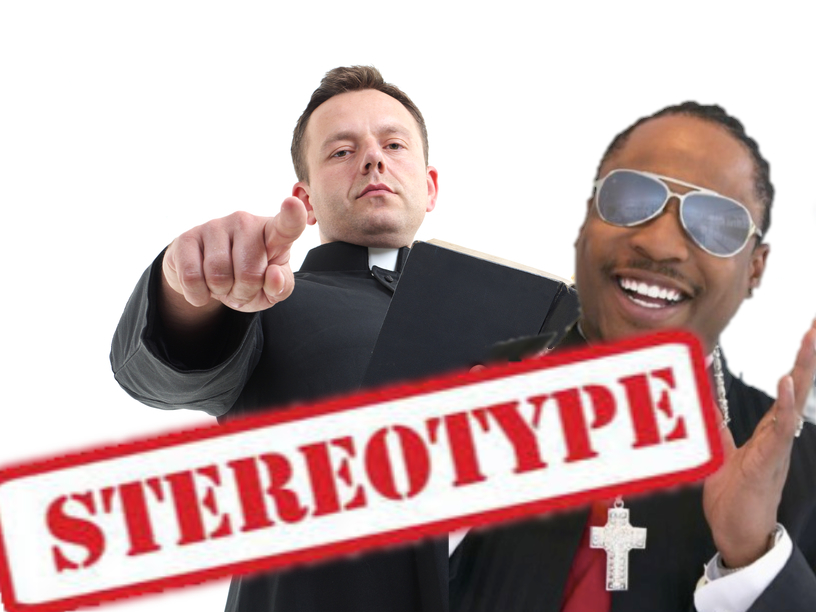
    Simply put, what people were expecting was:

    via GIPHY

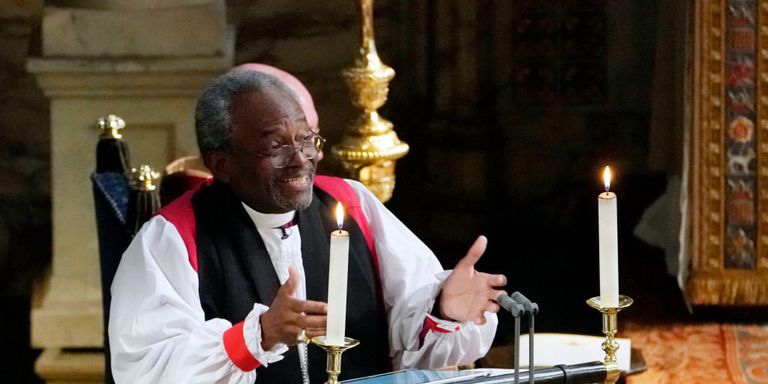
    But what they got was this:

    Needless to say this causes significant dissonance, much of which was writ large on the faces of several members of the royal family during the wedding. But it is also the same dissonance which has caused such significant engagement with the sermon and Curry. Because this dissonance forces a refactoring of the stereotypes at hand and reassessing where Curry fits. Much of this refactoring comes in the form of comparison with other social-category prototypes that might suit as a representative of a new stereotype for the individual. With this in mind it is completely unsurprising that there have been comparisons drawn with Martin Luther King, who stands as a comparative prototype for the social category that roughly exists as ‘African American preacher.’

    Now this is highly simplistic and significantly under-nuanced. But it serves as a basis of the other type of response I want to look at.


    The Conservative Evangelical Response

    The other type of response I have been seeing is that of conservative evangelicals who have lambasted the sermon as being ‘Gospel-lite,’ and ‘not a real sermon.’ Much of this initial response is in a similar cognitive vein to that of the general response. However, instead of the pre-existing social category being accessed as ‘a bumbling fumbling mumbling old fuddy duddy in a smock’ [a direct quote], there is instead a plethora of prototypes for the social-category ‘good Anglican preacher.’ Notably, one of the prototypical characteristics for the social-category involves ‘preaching the gospel.’ Now this is where the stereotype comparison resonates strongly, as many features of Bishop Curry and his sermon cohere with the social-category stereotype for ‘good Anglican preacher.’ But due to the meta-contrast ratio between ‘good Anglican preacher’ and Bishop Curry, the dissonances stand out strongly against the background consonance.

    Here the primary dissonance revolves around that prototypical characteristic ‘preaching the gospel’ and hence the plethora of articles on how/why/when/where Curry did/did not/should have articulated the gospel. Similarly this exposes a new set of dissonances regarding the content of the gospel, and a similar process ensues…


    Take Home Lessons

    So what are the take home lessons from this flurry of social media activity? Well the primary thing is that dissonance between stereotypes and reality cause interest, and the greater the dissonance between the types, the greater the interest. Furthermore, this is also the case when the dissonance occurs within a stereotype, not just outside of the stereotype. For social-identity people, both internal and external stereotype comparisons are examples of the meta-contrast ratio at work.

    In the end we should not be surprised when these sort of things attract strong interest and debate, it is breaking the stereotypical norms that we have set up, and things that break stereotypical norms are of great interest to us as social individuals, as we attempt to make sense of the world.


  • Reading Project: Intentional Community, New Monasticism, Spiritual Friendship and Rhythms and Rules of Life

    Reading Project: Intentional Community, New Monasticism, Spiritual Friendship and Rhythms and Rules of Life

    One of the practices I keep is to always have a long term reading project on the go, that is less directly related to my active research. I find this keeps me reading broadly and more agile in the way that I process and link concepts together. Over the winter break (in Australia) I completed my last reading project of N.T. Wright’s Christian Origins series, and have been debating what to start next. Some discussions in the last week have pushed me towards revisiting some thinking I have been doing for several years now on intentional community, the Benedict option, and various rules of life. Plus it seems that from the responses on Facebook others are interested in this as well, so this is where I will be doing my extra-curricular reading for the next few months.

    In discussions with people on Facebook and in the communities I’m a part of, I thought it may be useful to start compiling a list of resources and reviewing them, along with attempting to foster discussion on them. Some of these discussions will happen in person, as I am investigating setting up a reading group or two to discuss ideas. But I also want these to be more broadly reaching.

    This then is the start of the online side of the discussion, a reading list. Here is a bibliography of suggested works from a plethora of different sources, that I am hoping to read. Im also hoping to review, or have someone else review, most of the works too and make those reviews available publicly. If you have more suggested works, then please contribute them in the comments or send them to me via another method.

    Do let me know if you want to be part of this reading project, either online or in person. Reading is always more fun in community… and reading on community should be even more so again!

    For now though here is the bibliography:

    Bibliography

    Arpin-Ricci, Jamie, and Jonathan Wilson-Hartgrove. The Cost of Community: Jesus, St. Francis and Life in the Kingdom. Downers Grove, Ill: IVP Books, 2011.
    Barker, Ashley. Surrender All: A Call to Sub-Merge with Christ. Melbourne: CreateSpace Independent Publishing Platform, 2005.
    Barton, Ruth Haley. Life Together in Christ: Experiencing Transformation in Community. Downers Grove: IVP Books, 2014.
    Bonhoeffer, Dietrich. Discipleship. Unknown edition. Minneapolis: FORTRESS PRESS, 2003.
    ———. Life Together: The Classic Exploration of Christian in Community. 1St Edition edition edition. New York: HarperOne, 2009.
    Chester, Tim, and Steve Timmis. Everyday Church: Gospel Communities on Mission. 1 edition. Wheaton, Ill: Crossway, 2012.
    ———. Total Church: A Radical Reshaping around Gospel and Community. Wheaton, Ill: Crossway, 2008.
    Claiborne, Shane, and Jim Wallis. The Irresistible Revolution: Living as an Ordinary Radical. 1st edition. Grand Rapids, Mich: Zondervan, 2006.
    Claiborne, Shane, and Jonathan Wilson-Hartgrove. Common Prayer Pocket Edition: A Liturgy for Ordinary Radicals. Poc Rep edition. Grand Rapids, Mich: Zondervan, 2012.
    Duckworth, Jenny, and Justin Duckworth. Against the Tide, Towards the Kingdom: Eugene, Or: Wipf & Stock Pub, 2011.
    Edgar, Brian. God Is Friendship: A Theology of Spirituality, Community, and Society. Seedbed Publishing, 2013.
    Ford, Leighton. The Attentive Life: Discerning God’s Presence in All Things. Place of publication not identified: IVP Books, 2014.
    Hauerwas, Stanley, and William H. Willimon. Resident Aliens: Life in the Christian Colony. Anniversary ed. edition. Nashville: Abingdon Press, 2014.

    Heath, Elaine A. Missional. Monastic. Mainline.: A Guide to Starting Missional Micro-Communities in Historically Mainline Traditions. Eugene, Oregon: Cascade Books, 2014.

    ———. The Mystic Way of Evangelism: A Contemplative Vision for Christian Outreach. Grand Rapids, MI: Baker Academic, 2008.
    Heath, Elaine A., and Scott T. Kisker. Longing for Spring: A New Vision for Wesleyan Community. Eugene, Or: Wipf & Stock Pub, 2010.
    Hill, Wesley. Spiritual Friendship: Finding Love in the Church as a Celibate Gay Christian. Grand Rapids, Michigan: Brazos Press, 2015.
    Holmes, Jonathan, and Ed Welch. The Company We Keep: In Search of Biblical Friendship. Place of publication not identified: Cruciform Press, 2014.
    Janzen, David, Shane Claiborne, and Jonathan Wilson-Hartgrove. The Intentional Christian Community Handbook: For Idealists, Hypocrites, and Wannabe Disciples of Jesus. Brewster, Mass: Paraclete Press, 2012.
    Macchia, Stephen A., and Mark Buchanan. Crafting a Rule of Life: An Invitation to the Well-Ordered Way. Downers Grove, Ill: IVP Books, 2012.
    McKnight, Scot. A Fellowship of Differents: Showing the World God’s Design for Life Together. Grand Rapids, Michigan: Zondervan, 2015.
    Nouwen, Henri J. M. Reaching Out: The Three Movements of the Spiritual Life. Reissue edition. Garden City, N.Y: Image, 1986.
    Palmer, Parker J. To Know as We Are Known: Education as a Spiritual Journey. Reprint edition. San Francisco: HarperOne, 1993.
    Smith, William P. Loving Well. Greensboro, NC: New Growth Press, 2012.
    Sparks, Paul, Tim Soerens, and Dwight J. Friesen. The New Parish: How Neighborhood Churches Are Transforming Mission, Discipleship and Community. Downers Grove, Illinois: IVP Books, 2014.
    Vanderstelt, Jeff. Saturate: Being Disciples of Jesus in the Everyday Stuff of Life. Wheaton: Crossway, 2015.
    Vanier, Jean. Community and Growth. 2nd Revised edition. New York: Paulist Press, 1989.
  • Academic Catchphrase – Help Sourcing a Calvin Quote on ‘Muzzling Dogs.’

    Academic Catchphrase – Help Sourcing a Calvin Quote on ‘Muzzling Dogs.’

    UPDATE: See end of blog post.

    At times finding quotes and references in student essays, and even in academic works, can be a bit like the old gameshow Catchphrase. Although on the whole quotations should be clearly referenced, and therefore relatively easily found, there are occasionally those which send you deep down the rabbit hole and turn up only loose ends. One of these quotes that keeps raising its head is this quote attributed to Calvin:

    ‘But we muzzle dogs, and shall we leave men free to open their mouths as they please.’

    Over the last couple of decades it has been popularised in a wide variety of sources, and generally attributed to Calvin’s works on Deuteronomy. It is understandable why it has become popular: it is polemical, expresses a censorious sentiment that is abhorrent to modern ears, and does it with a degree of vitriolic rhetoric that grabs the attention. On that basis it gets trotted out regularly to support issues of religious censorship such as this piece from the ABC on the Zaky Mallah/QandA affair: http://www.theage.com.au/comment/the-abc-wasnt-wrong-to-have-zaky-mallah-on-qa-20150623-ghvaow.[ref]Thanks to a friend for pointing this one out[/ref] However, the majority of these secondary works, if they cite anything at all, refer not to any work by Calvin, but to other secondary literature.

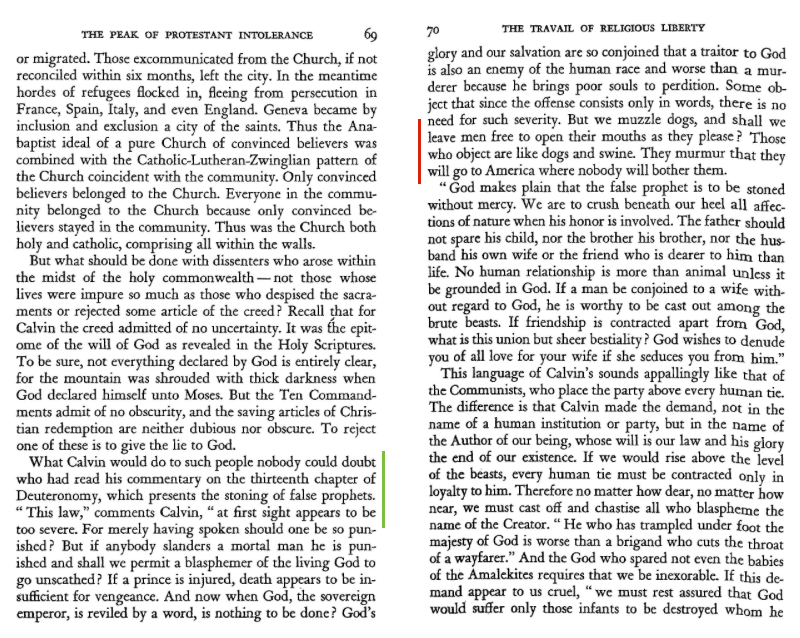
    When these references are chased through the rabbit warren eventually lead back to The Travail of Religious Liberty by Roland Bainton (1951).[ref]The full text of this is out of copyright and archived on Archive.org here: https://archive.org/details/travailofreligio012230mbp[/ref] The quote itself is found on page 70 of the book, but has no citation for the quote itself (update: citations were in an end-note that was missing from my copy). For context, here is the two page spread extracted from the archive.org edition with the pertinent pieces highlighted:

    Screen Shot 2015-09-03 at 10.25.50 am

    The full quote reads:

    ‘But we muzzle dogs, and shall we leave men free to open their mouths as they please? Those who object are like dogs and swine. They murmur that they will go to America where nobody will bother them.’ [ref]Bainton, Roland H. The Travail of Religious Liberty – Nine Biographical Studies. Philadelphia, PA: Westminster Press, 1951.,70.[/ref]

    In the text this quote has no ending quotemark, although the next paragraph starts with a further quotemark, and so one may presume that these words are intended to be cited as a quote from Calvin, especially as the opening quotemark on page 69 reads ‘“This law,” comments Calvin “at first sight…’ It is relatively safe to take the understanding that Bainton is intending to quote Calvin at this point.

    Indeed in the opening sentence of this paragraph he writes:

    ‘What Calvin would do to such people nobody could doubt who had read his commentary on the thirteenth chapter of Deuteronomy’[ref]Roland H. Bainton, The Travail of Religious Liberty – Nine Biographical Studies (Philadelphia, PA: Westminster Press, 1951)., 69[/ref]

    From this the natural reference for Bainton is that of Calvin’s words on Deuteronomy 13. However, here lies the multi-faceted problem.

    Firstly, in the reference editions of Calvin’s commentaries, there is no distinct commentary on Deuteronomy. Rather there is a commentary on the Harmony of the Law, which contains many of his words on Deuteronomy. It would be a reasonable expectation to find this quote in the Harmony of the Law when Calvin deals with Deuteronomy 13, and it was my first port of call, but there is nothing there. I can find no references to dogs, canis, and muzzling can be found in any of the versions of the work I have looked at (the work from the Calvin Translation Society is the primary reference here).

    The second location to search was that of the Institutes, as Calvin occasionally draws upon various passages and provides a mini-commentary to support his points. Again no references to muzzling dogs may be found in any of the four editions of the Institutes that I referred to.

    The third place to search was Calvin’s sermons on Deuteronomy that he preached in October of 1555. At first this source seems to yield some parallels, with Calvin preaching regarding ‘dogs’:

    ‘At a word, men would have either dogs or swine in the pulpit. This is the thing that they seek for; and this is mens desires in most places; who instead of good and faithful servants to God, do choose dogs and swine’[ref]Calvin, John. Sermons on Deuteronomy. Translated by Arthur Golding. Facsimile edition edition. Edinburgh; Carlisle, Pa.: Banner of Truth, 1987., 538[/ref]

    In this sermon, and the sermon preached in the following week, Calvin does talk about dogs and swine (dogges and ſwine) in a few places. However, all but one are paired as ‘dogs and swine,’ while the final reference is to the Papists and Cardinals as being dogs. Throughout his sermons on Deuteronomy I can find no reference to muzzling at all.

    These three locations form the core of the material that Calvin wrote or preached on Deuteronomy. But in case I was missing something I also ran searches for ‘muzzling’ and ‘dogs’ throughout all of the resources I could find electronically (the Calvini Opera, Archive.org, CCEL, StudyLight etc provided ample resourcing). Logos, DevonThink, were used for basic searches and a custom LSA[ref]Latent Semantic Analysis is a natural language computational linguistics tool[/ref] corpus was used to see if any inferences and alternately translated words could be detected. None of these searches returned any significant results, with the majority of hits being those found in Calvin’s sermons on Deuteronomy 13. All in all I cannot find any reference to the core of the original quote regarding muzzling dogs anywhere in Calvin’s works.

    However, I have another reservation about the full quote from Bainton’s book. The quote continues on to indicate that ‘they murmur that they will go to America where nobody will bother them.’ Given that Bainton is talking about Protestant religious persecution in this chapter, this indication seems somewhat anachronistic. Presuming the quote is genuine, at latest it would have been written in c.1559 when the last of the material on Deuteronomy (Commentary on the Harmony of the Law) was written, as from this quote in Vie de Calvin

    Towards the end of that year [1559] they began in the Friday meetings the exposition of the four last books of Moses in the form of a Harmony, just as Calvin assembled the material in his commentary which he had published afterwards. [ref]CO 21:90. See DeBoer Origin And Originality Of John Calvin’s ‘Harmony Of The Law’, The Expository Project On Exodus-Deuteronomy (Acta Theologica Supplementum 10, 2008) for more details[/ref]

    At this time the prime settlements in America were Catholic in nature. The only reference to a Protestant site that I can find is that of Charlesfort-Santa Elena in South Carolina, the site of a Hugenot settlement. However, apart from this failed settlement where may this American settlement refer to. Indeed if, as Bainton is arguing, this quote is referring to Protestants fleeing Europe over persecution (Bainton later links the Michael Servetus incident here), then it would make no sense to flee to a location that was experiencing significant religious persecution if they want to go somewhere where ‘nobody will bother them.’ This sentiment fits far better in the early-17th century, rather than the mid-16th century.

    This historical tangent aside, what do we make of this quote? Certainly if one wants to convey the sentiment of religious persecution and debate, a case may be mounted from Calvin’s works. But I would argue that this quote is not a reliable source for it. I still cannot find any reference to the quote, nor any significant material on fleeing to America, in any of Calvin’s works. I have enquired with some Calvin scholars to no avail—or with some no reply.

    Therefore I am turning to the broader internet, if anyone can supply the location of the quote I would be very interested.

    UPDATE:

    It appears that in my prejudice for trusting the validity of physical books over archive.org scans I had missed that Travails has its sourcing in end notes after the final chapter. Unfortunately the copy that I had sourced from a local library was rebound and missing the sources and index at the end of the book. Thanks to Richard Walker for highlighting this to me, see his Disqus comment for more details (unless Disqus isn’t loading again).

    However, I’m still not convinced by the translation that Bainton has supplied and will blog on that later.

  • Book Review: ‘Jonathan Edwards and the Church’ by Rhys Bezzant

    Book Review: ‘Jonathan Edwards and the Church’ by Rhys Bezzant

    Jonathan Edwards and the Church
    Rhys S. Bezzant; 2014. | OUP USA | 328 pages
    978-0-19-989030-9


    Although Jonathan Edwards wrote and preached on an exceedingly wide variety of theological subjects, many scholars declare that he did not have any independent ecclesiology. Rather that his ecclesiological impulses were driven by social and broader theological focuses. In Jonathan Edwards and the Church Rhys Bezzant demonstrates that Edwards actually held a robust ecclesiology that took into account both social and theological drivers. Bezzant sets out to expound Edwardsean on his oft-repeated model of the church as a ‘focused domain where God’s promises, presence and purpose are to be discovered.’ (ix) In doing so he opines that Edwards’s ecclesiology was ultimately ‘a revivalist ecclesiology within a traditional ecclesiology of nurture and institutional order.’ (xi)

    In order to investigate Edwards’s ecclesiology Bezzant follows a diachronic model, describing the various aspects of Edwards’s ministry, writings and church engagement throughout his life. In chapter one Bezzant paints a rich picture of the church world of the New England colonies before Edwards’s ministry, highlighting a vast array of ecclesiological and social pressures upon the Puritan endeavour. Chapters two, three, and four trace Edwards’s ecclesiological development through the three primary stages of his life—delineated by two works A Faithful Narrative in 1735 and A Humble Attempt in 1747. Bezzant traces Edwards’s reflections from his less-conventional conversion narrative through his early life, developing theology and burgeoning ministry—the period heavily influenced by the Great Awakening—and then into his mature ecclesial ministry and global focus. These chapters mine the depths of Edwards’s own writings—recently published as a letterpress edition by Yale University Press—as well as the copious secondary literature on the variety of topics. Within the investigation of Edwards’s writings these chapters are shaped by the contours of the New England history and are firmly set within their broader context.

    Throughout Bezzant helpfully shows how wider theological and social concerns impacted upon the fledgling colonies and does not seek to divorce Edwards from his historical milieu. This dual focus assists in understanding Edwards’s ecclesiology as well as how it has shaped evangelical patterns in the following generations. Although there is little room for sustained modern theological reflection and application—likely a product of this forming a doctoral dissertation for the Australian College of Theology—the passion for the church of Bezzant and Edwards shines through and any astute reader will be able to draw concrete links and applications with ease. Observations such as Edwards’s description of the church functioning as a tree are ripe for reflection and harvest by the reader. (101) However, when the space permits, brief observations gleam from the text such as when Bezzant observes ‘the church is an expression not just of pastoral or apocalyptic functions but of prophetic aspirations too.’ (198)

    In the final chapters Bezzant draws the themes of the book—and Edwards’s ecclesiology—together and highlights the weekly ecclesiological routine of Northampton and the broader New England church. This summary in chapter five focuses upon worship, discipline and polity and assists the reader in seeing how Edwards’s ecclesiological vision played out at a broader scale—even if imperfectly. Finally Bezzant reflects upon the ecclesiological tensions and pressures present within Edwards’s ministry and concludes that his ecclesiology ‘highlights the orderly processes but not the ordinary origins of the church’s life.’ (260) This organising theme of ‘orderly but not ordinary’ plays out throughout the book and helps to strike a balance between the extremes of each theme.

    While Jonathan Edwards and the Church is aimed at an academic audience, the book will appeal to academics, clergy and intent readers of all stripes. It reads easily and engagingly covering a wide variety of theological and social topics with ease. From start to finish Bezzant is comfortable with Edwards as his primary interlocutor and with the host of secondary voices in the galleries. If there is one minor quibble it is that the diachronic path can make tracing certain theological themes hard at times, but not insurmountable. Although he provides little modern theological application, this is likely of benefit as the observations in Jonathan Edwards and the Church are at their best when properly digested and contextualised. Ultimately it is fitting to end with the words that Bezzant chose to end his book with:

    ‘His [Edwards’] insights, scattered amongst his works, can be for us today a modest lamp for our path, even when we struggle to fulfill our own calling to be a city on a hill.’ (260)


    This review originally commissioned for Sparklit and EFAC Vic-Tas.

  • Book Review: Esther and Her Elusive God

    Book Review: Esther and Her Elusive God

    One of the many joys of having children is getting to experience different aspects of your childhood all over again, albeit in a different form. I have alluded to some of these via the various reinterpretations of children’s stories and nursery rhymes on this blog. However, given my current training in biblical studies one of these aspects that interests me is how various bible stories are presented for kids. These stories come in a variety of forms, from the simple board picture books through to cartoons.

    hqdefaultBut out of the whole host of stories there are a few that irk me with their retelling: Daniel, David, Jonah etc. Notable amongst these is the book of Esther, which usually gets transformed into a Disney/Cinderella type redemption narrative. Therefore it was with interest that I saw that a friend of mine published his thoughts on the book of Esther last year in Esther and Her Elusive God.

    This book from John Anthony Dunne squarely addresses the elephant in Esther’s room: the lack of God in the story. Dunne begins by proposing that the point of Esther isn’t that God is merely the subtext behind the action that is going on. But rather that the book functions to highlight ‘that the elusive God of Esther was steadfast and faithful, preserving his people though they did not deserve it.’ (5) In order to address this point he considers the secular nature of the story through three aspects: the Compromise of the Israelites in the narrative, the relationship of the narrative to the Covenant, and the reception history of the book of Esther and its subsequent modifications in the Septuagint (LXX) and Alpha Text (AT). Throughout the book Dunne provides convenient comparisons with modern retellings of the story, and their emphases on the changed narrative in order to reintroduce and highlight God in the story.

    The analysis portion of the book is carefully, slowly and cumulatively argued and builds a strong picture of the secular nature of the book. In this section the primary weakness and likely stumbling block for many readers lies in the treatment of Esther 4:13-14 which many scholars point to as the recognition of the implied deus ex machina at work. However, even here the argument makes cumulative sense if taken as a whole and this should not cause a careful reader too many issues. The final chapter of this the first part of the book addresses the redaction and additions present within the LXX and AT. This chapter presents some of the changes to the Masoretic throughout the lifespan of the book, although it would have been useful for the associated appendix to be integrated into the chapter as a whole.

    If the first part of the book advocated for a negative reading of the lack of God in the book of Esther, the second part asks the question of why the book is in the bible at all. In these last thirty odd pages Dunne drives home his argument that the secularity of Esther and its presence and context within the canon actually highlights the providence of God in the story. Here he argues that like Job, the book of Esther is another exception that proves the rule, that ‘Esther [is] a tale of how good things happen to undeserving people.’ (125) These two chapters as the crux of the book are arguably the highlight of the careful argument that has gone before, and I wish that he had the time and space to expand on this application further.

    Overall I believe Dunne provides a convincing argument, and one that resolves many of the aspects of the book that have irked me in the past without simply being a hagiographic retelling. However, in getting his argument across occasionally the book comes across as somewhat vindictive and vilifying in its highlighting the moral, cultic and covenantal failings of the characters. This slight polemical tone jars with Dunne’s otherwise laid-back style and will hamper the absorption by some audiences. This aside I found it an enjoyable and convincing read, and look forward to thinking about how it will impact on my preaching and retelling of the story for children.

    In addition I quite like the dedication:

    10570005_953244694698823_1468668219_n


    John Anthony Dunne, Esther and Her Elusive God:How a Secular Story Functions as Scripture, Eugene: Wipf & Stock, 2014.

    Available: Amazon

  • Perfection and Excellence – What do we strive for?

    Perfection and Excellence – What do we strive for?

    ‘Perfect’ it seems has become a dirty word today, and even amongst Christian circles, which I find exceedingly curious. On Sunday I preached at my church (St Matt’s Prahran) on the line in the Lord’s Prayer ‘your will be done, on earth as in heaven’, as part of our series on the Lord’s Prayer. In the sermon I referred to Romans 12:2, where Paul speaks of discerning the will of God, and specifically describes it as: ‘will of God, what is good and acceptable and perfect.’ (Rom 12:2). As part of this I spoke about striving for, and conforming our will to God’s perfect will, and the implication for this as we work out God’s will in our life is that we too need to be striving for perfection and holiness in enacting that perfect and holy will (c.f. Phil 2:12-18). This suggestion was met with significant consternation and challenge, from a variety of angles, and at one level perhaps I shouldn’t have been surprised. Yet in many ways I am, and let me explain why.

    Romans 12:2 describes God’s will as ‘good and acceptable and perfect’ and the Lord’s Prayer calls us to pray that ‘your will be done’, essentially through us as God’s hands and feet in the world. Although we may not perceive or understand the perfection of God’s will from our perspective, scripture still affirms its perfection. However, certainly ‘Perfect’ has some different connotations and excess baggage in our modern world, but it doesn’t mean that it is bereft of meaning. To translate it as anything less than ‘perfect’ in the traditional sense is translationally and theologically doing ourselves a disservice. Rather it is up to us to redefine, or in this case restore the definition of the word, through our understanding and speaking about of the perfection of God and his will.

    But as people we are certainly not perfect, a quick scan of the news headlines shows in stark contrast our imperfection and failings. So how do we, as imperfect people, do the perfect will of God? Firstly I think we must acknowledge that even if we strive for perfection we won’t achieve it. Most, if not all, of our human endeavours, no matter the high quality and strivings for perfection, fall short in many ways. So many ways that we even have coined an -ism for it: ‘perfectionism.’ Now this certainly has its own set of failings and ‘costs associated with consistent failure to meet the high standards demanded.’ It is a trap we can fall into, and a danger we must avoid. However, if we are to be doing the will of God this doesn’t mean we don’t strive for the perfection of God’s will.

    The danger of not aiming for the perfection of God’s will was keenly noted by Francis Schaffer in his book Addicted to Mediocrity: ‘The modern Christian world … is marked, … one outstanding feature, and that is its addiction to mediocrity.’ While he was focused on the realm of arts and culture, his astute observation applies further afield. Often Christians so keenly recognise our human failings that we don’t strive for the perfect will of God, and settle for something far less than that. A mediocrity that only minimally glorifies God in the world.  A useful book I have read on this recently was Excellence: The Character of God and the Pursuit of Scholarly Virtue by Andreas Köstenberger. Although it focuses mainly on academic scholarship, the virtues he writes about are applicable to all walks of life.

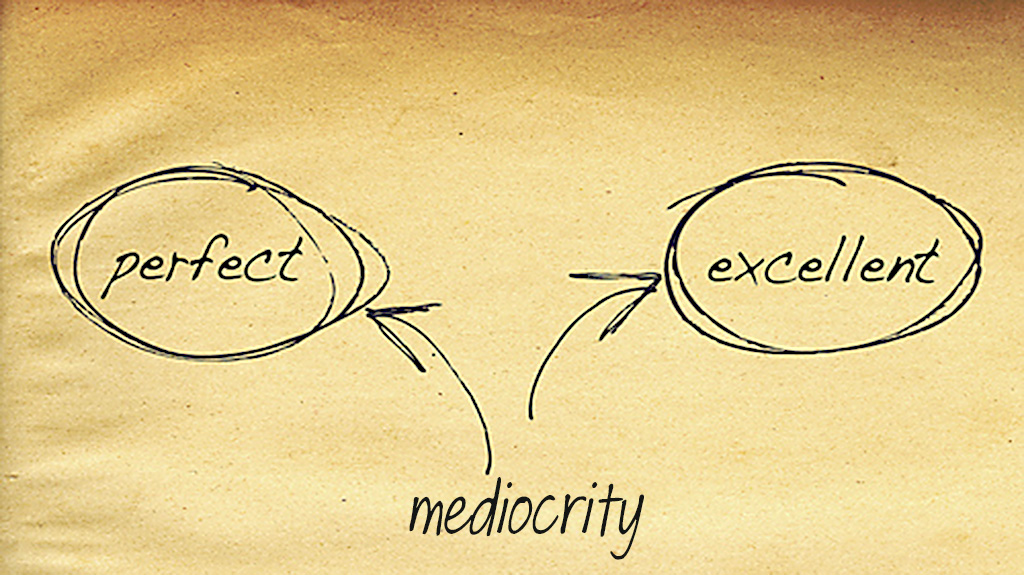
    So how do we strive for the perfect will of God, while balancing that with our own human failings? Firstly I think we strive for God’s perfection, but in the full knowledge that now we will only achieve excellence. We may have to cap our expectations and endeavours so that we don’t fall into human perfectionism, all the while keeping in front of us the vision of that future perfection. It means more than just getting by, or ‘P-s make degrees’, or just scraping over the line. Secondly, it also means that we don’t create a type of ‘works righteousness’ based cultic practice around our personal perfection. Ultimately our perfection is found in Christ, not in our own endeavours, as it is Christ who has saved us, not by our own works. Finally, those good works prepared for us to do, we should do them to the best of our ability, eschewing mediocrity, praying that God’s perfect will be done, and working from that perfect script, even if we know we will only achieve excellence on this earth.

  • Enclave Theology and Social Identity

    Enclave Theology and Social Identity

    Mike Bird has a brief piece over here on the prevalence of Enclave Theology: http://www.patheos.com/blogs/euangelion/2014/10/enclave-theology/ which relates back to the previous post on how labels are used in scholarship. He quotes from George Hunsinger

    By ‘enclave’ theology, I mean a theology based narrowly in a single tradition that seeks not to learn from other traditions and to enrich them, but instead to topple and defeat them, or at least to withstand them.

    Broadly speaking this can be seen as a polemical form of legitimation of social identity in the wider social sphere. Similarly to how labels are used as well.

    However, ultimately the monsters outside the door become the monsters inside. As Pierre Bourdieu wrote

    social identity lies in difference, and difference is asserted against what is closest, which represents the greatest threat

  • Larry Hurtado on Labels in Scholarship

    Larry Hurtado on Labels in Scholarship

    This morning I noticed that Larry Hurtado has blogged on the prevalence of reductionistic and entrenched camp labels and their usage in scholarship. I must say I couldn’t agree more with the sentiment and how poisonous reductionistic and pejorative labels can be. Both when they are used to shore up weak and insufficient argument, and when they are used to compromise and tear down the arguments of others.

    I especially liked his take on scholarly works:

    But to my mind, for scholarship to mean anything, the only thing that counts is what a given scholar says/writes, and how well based it is:  How well it takes account of all relevant evidence, how soundly it is reasoned, how well it engages the positions of others, etc.

    As scholars and students, and even more as Christians, we should strive after excellence in our scholarly works, rather than bandying around labels to support or tear down.

    I do encourage you to read it on his blog over here: http://larryhurtado.wordpress.com/2014/10/20/more-on-labels-and-scholarship/

  • TGC on the Mars Hill Postmortem

    TGC on the Mars Hill Postmortem

    Following on from the last post I see that TGC has their 4 points of Mars Hill Postmortem, over here: http://www.thegospelcoalition.org/blogs/trevinwax/2014/10/16/the-mars-hill-postmortem/

    Their fourth point is roughly the point I was making in a cliff note form. I do encourage you to read their first three points though. But perhaps most poignant in there are these quotes from Tim Keller and John Stott:

    Tim Keller describes a “gospel-based ministry” not merely in terms of doctrinal correctness but as being “marked by loving honesty, not spin, image, and flattery.”

    Likewise, John Stott writes: The Christian minister should be preoccupied with the people’s spiritual progress and care nothing for his own prestige. 

    I highly encourage reading the whole thing.

  • Pope Francis a Universalist? Perhaps….

    4577728-3x2-700x467In the midst of other worldwide theological furores, and local stuff with heretical bishops and the like, it seems that even Pope Francis is taking his share of the limelight. According to the Huff this week Pope Francis strongly implied a universalist position with his statement:
    “The Lord has redeemed all of us, all of us, with the Blood of Christ: all of us, not just Catholics. Everyone! ‘Father, the atheists?’ Even the atheists. Everyone!”
    The Huff has reported on it here: http://www.huffingtonpost.com/2013/05/23/atheists-like-what-they-see-in-pope-francis-new-openness_n_3329548.html and the Irish here: http://www.irishcentral.com/news/Atheists-big-fans-of–Pope-Francis-openness-and-good-works-among-those-in-need-209048751.html

    Now that does sound very universalist, with all people being redeemed by the cross, not just the Catholics, and it appears that Francis’ handlers think so too. A couple of days later they issued a correction to Francis’ homily, clearly stating that all who are apostate from the Catholic church are condemned:
    “Although they are otherwise good, moral people they are still doomed to burn in a lake of fire for having the temerity to have been born outside of Catholicism or having chosen to remain so.”
    http://www.irishcentral.com/story/ent/manhattan_diary/vatican-corrects-infallible-pope-atheists-will-still-burn-in-hell-208987111.html

    This has raised some eyebrows around the world, with the “moral atheists” obviously being rather unhappy about it, as too are many Protestants who thought that there might have been some form of reconciliation on the table. However, to me it sounds like a whole bunch of semantics over three words: ‘redeemed’, ‘salvation’ and ‘infallible’.

    Firstly, when Francis talks about ‘redeemed’ does he merely mean that Christ’s sacrifice on the cross was sufficient for all humanity, but will only be effective for those who believe (whether you take an election or free will argument)? I would suggest that this is probably the easiest orthodox reading of Francis’ statement, but it does end up slightly semantically skewed. All of humanity redeemed, but not all of humanity justified… its hard to see how those two can be separated. Indeed, this seems to be the place that his handlers have ended up when they issue the correction.

    Secondly, along with the redemption question, and tightly linked, is the issue of what does Francis think it means to have ‘salvation.’ Is it for him simply a position of being able to do good works? Or is it to stand justified before the throne in Christ? Without further homilies or statements to rely on its a bit hard to tell at the moment, but from this homily it does seem to trend towards the ability to do good works. Now I don’t want to be heard saying that doing good works is outside of the realm of anyone who is not in Christ, and I want to affirm that it does come back to the view of the image of God in humanity. But to equate good works with justification and salvation is stretching it….. a lot.

    Finally, infallibility. The doctrine has been swirling around for quite a few years now, with various Popes taking differing stances on it. Pope John XXIII is recorded as saying: “I am only infallible if I speak infallibly but I shall never do that, so I am not infallible.” But it seems that the principal place for the Pope to be infallible is when they are ex cathedra. Is a homily ex cathedra? Perhaps, but Francis’ handlers certainly don’t think so.

    It will be interesting to see how this one plays out, and I wonder whether Francis has been reading Rob Bell?